Dickson Kelly, Bangpan Mukdarut
Department of Social Science, University College London Institute of Education, London WC1H 0AL, UK.
Glob Ment Health (Camb). 2018 Jun 1;5:e21. doi: 10.1017/gmh.2018.12. eCollection 2018.
Humanitarian emergencies can impact people's psychosocial well-being and mental health. Providing mental health and psychosocial support (MHPSS) is an essential component of humanitarian aid responses. However, factors influencing the delivery MHPSS programmes have yet to be synthesised. We undertook a systematic review on the barriers to, and facilitators of, implementing and receiving MHPSS programmes delivered to populations affected by humanitarian emergencies in low- and middle-income countries.
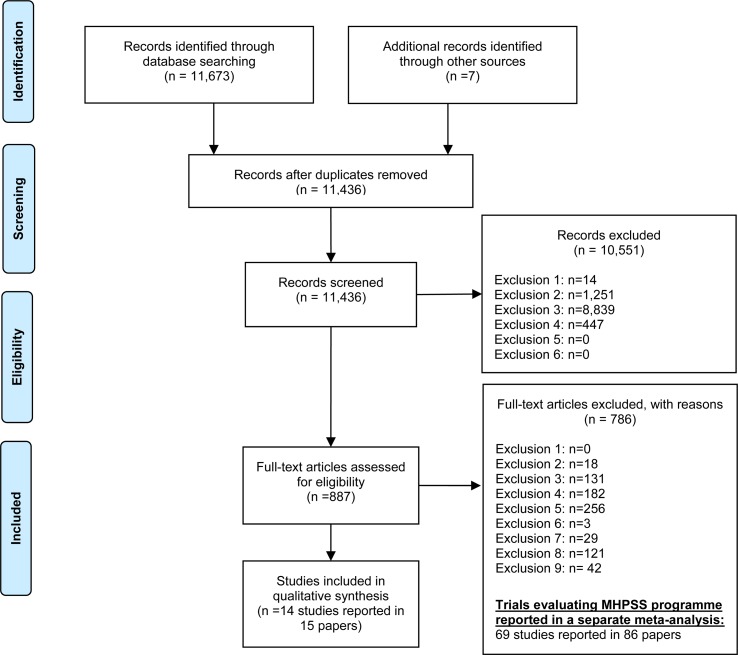
A comprehensive search of 12 bibliographic databases, 25 websites and citation checking was undertaken. Studies published in English from 1980 onwards were included if they contained evidence on the perspectives of adults or children who had engaged in or programmes providers involved in delivering, MHPSS programmes in humanitarian settings. Thirteen studies were critically appraised and analysed thematically.
Community engagement was a key mechanism to support the successful implementation and uptake of MHPSS programmes. Establishing good relationships with parents may also be important when there is a need to communicate the value of children and young people's participation in programmes. Sufficient numbers of trained providers were essential in ensuring a range of MHPSS programmes were delivered as planned but could be challenging in resource-limited settings. Programmes need to be socially and culturally meaningful to ensure they remain appealing. Recipients also valued engagement with peers in group-based programmes and trusting and supportive relationships with providers.
The synthesis identified important factors that could improve MHPSS programme reach and appeal. Taking these factors into consideration could support future MHPSS programmes achieve their intended aims.
人道主义紧急情况会影响人们的心理社会福祉和心理健康。提供心理健康和心理社会支持(MHPSS)是人道主义援助应对措施的重要组成部分。然而,影响MHPSS项目实施的因素尚未得到综合分析。我们对低收入和中等收入国家中向受人道主义紧急情况影响的人群提供MHPSS项目的实施障碍和促进因素进行了系统综述。
对12个文献数据库、25个网站进行了全面检索并检查了引用情况。纳入了1980年以来以英文发表的研究,这些研究包含了参与MHPSS项目的成年人或儿童的观点证据,或涉及在人道主义环境中提供MHPSS项目的项目提供者的证据。对13项研究进行了严格评估并进行了主题分析。
社区参与是支持MHPSS项目成功实施和推广的关键机制。在需要传达儿童和年轻人参与项目的价值时,与家长建立良好关系也可能很重要。足够数量的训练有素的提供者对于确保按计划提供一系列MHPSS项目至关重要,但在资源有限的环境中可能具有挑战性。项目需要具有社会和文化意义,以确保它们仍然具有吸引力。接受者也重视在基于小组的项目中与同龄人互动,以及与提供者建立信任和支持性的关系。
综合分析确定了可以提高MHPSS项目覆盖面和吸引力的重要因素。考虑这些因素可以支持未来的MHPSS项目实现其预期目标。