Institute of Medical Biology, Chinese Academy of Medical Sciences and Peking Union Medical College, Kunming, China.
Yunnan Key Laboratory of Vaccine Research and Development on Severe Infectious Diseases, Kunming, China.
Front Cell Infect Microbiol. 2018 Jun 27;8:219. doi: 10.3389/fcimb.2018.00219. eCollection 2018.
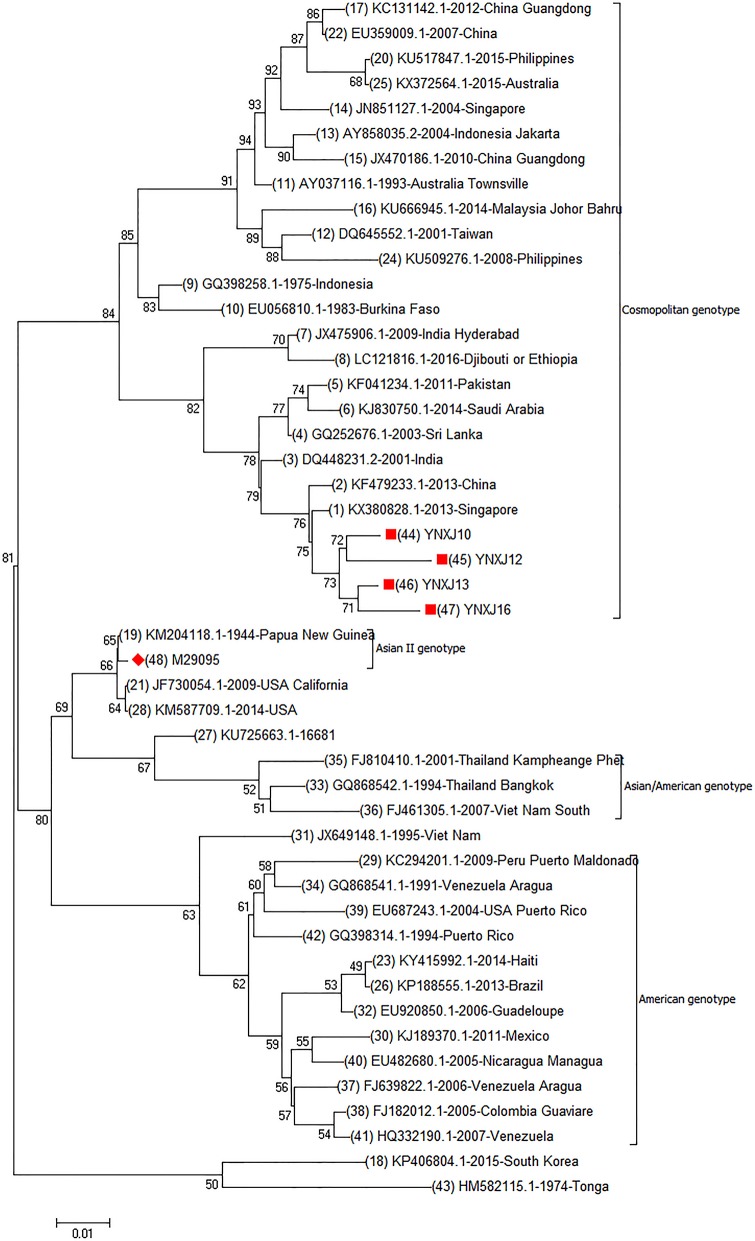
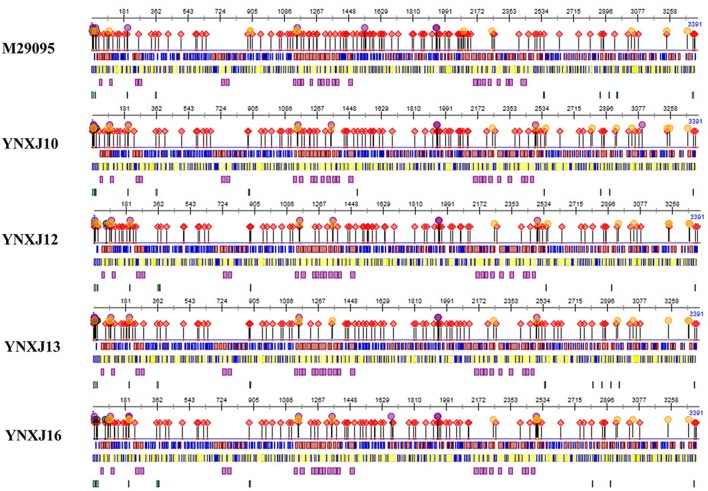
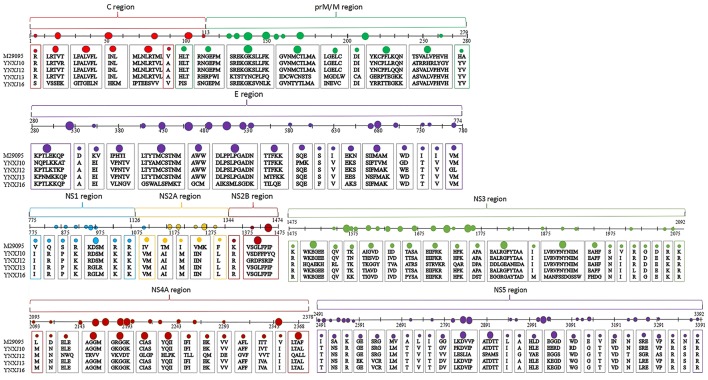
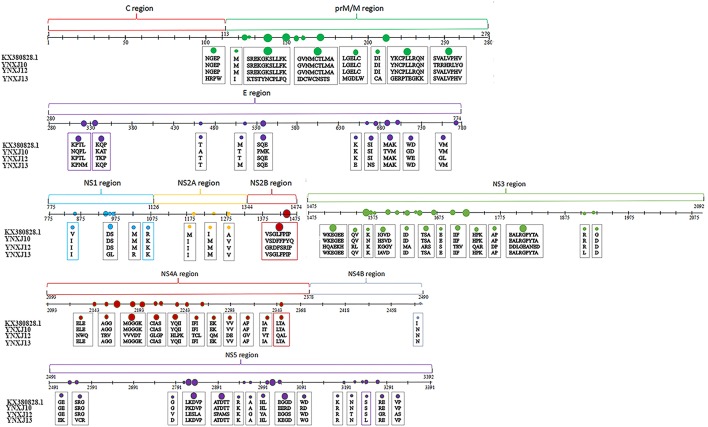
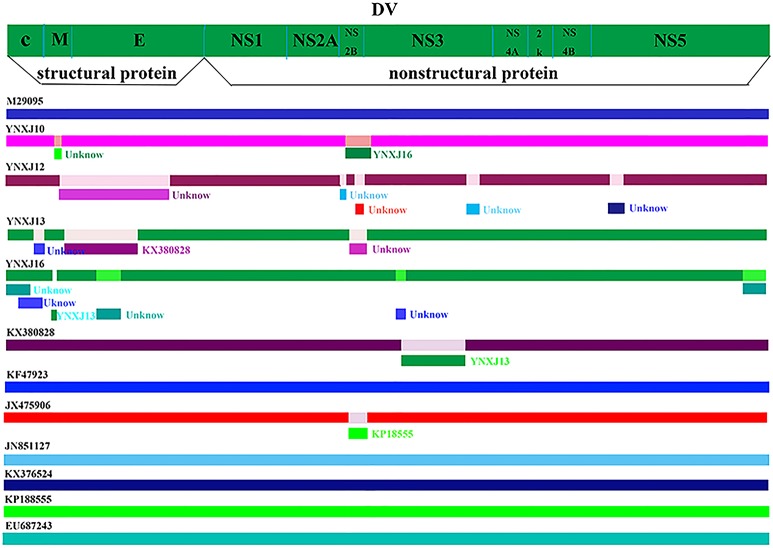
In 2015, a dengue outbreak with 1,067 reported cases occurred in Xishuangbanna, a city in China that borders Burma and Laos. To characterize the virus, the complete genome sequence was obtained and phylogenetic, mutation, substitution and recombinant analyses were performed. DENV-NS1 positive serum samples were collected from dengue fever patients, and complete genome sequences were obtained through RT-qPCR from these serum samples. Phylogenetic trees were then constructed by maximum likelihood phylogeny test (MEGA7.0), followed by analysis of nucleotide mutation and amino acid substitution. The recombination events among DENVs were also analyzed by RDP4 package. The diversity analysis of secondary structure for translated viral proteins was also performed. The complete genome sequences of four amplified viruses (YNXJ10, YNXJ12, YNXJ13, and YNXJ16) were 10,742, 10,742, 10,741, and 10,734 nucleotides in length, and phylogenetic analysis classified the viruses as cosmopolitan genotype of DENV-2. All viruses were close to DENV Singapore 2013 (KX380828.1) and the DENV China 2013 (KF479233.1). In comparison to DENV-2SS (M29095), the total numbers of base substitutions were 712 nt (YNXJ10), 809 nt (YNXJ12), 772 nt (YNXJ13), and 841 nt (YNXJ16), resulting in 109, 171, 130, and 180 amino acid substitutions in translated regions, respectively. In addition, compared with KX380828.1, there were 44, 105, 64, and 116 amino acid substitutions in translated regions, respectively. The highest mutation rate occurred in the prM region, and the lowest mutation rate occurred in the NS4B region. Most of the recombination events occurred in the prM, E and NS2B/3 regions, which corresponded with the mutation frequency of the related portion. Secondary structure prediction within the 3,391 amino acids of DENV structural proteins showed there were 7 new possible nucleotide-binding sites and 6 lost sites compared to DENV-2SS. In addition, 41 distinct amino acid changes were found in the helix regions, although the distribution of the exposed and buried regions changed only slightly. Our findings may help to understand the intrinsic geographical relatedness of DENV-2 and contributes to the understanding of viral evolution and its impact on the epidemic potential and pathogenicity of DENV.
2015 年,中国西双版纳发生了一起登革热疫情,报告病例 1067 例,该城市与缅甸和老挝接壤。为了描述该病毒的特征,我们获得了完整的基因组序列,并进行了系统进化、突变、替换和重组分析。从登革热患者采集的 DEN-NS1 阳性血清样本中,通过 RT-qPCR 获得了完整的基因组序列。然后通过最大似然系统发育检验(MEGA7.0)构建系统发育树,随后分析核苷酸突变和氨基酸替换。通过 RDP4 包分析 DENVs 之间的重组事件。还对翻译病毒蛋白的二级结构进行了多样性分析。四个扩增病毒(YNXJ10、YNXJ12、YNXJ13 和 YNXJ16)的完整基因组序列分别为 10742、10742、10741 和 10734 个核苷酸,系统发育分析将病毒分类为 DENV-2 的世界性基因型。所有病毒均与 DENV 新加坡 2013 株(KX380828.1)和 DENV 中国 2013 株(KF479233.1)密切相关。与 DENV-2SS(M29095)相比,总碱基替换数分别为 712nt(YNXJ10)、809nt(YNXJ12)、772nt(YNXJ13)和 841nt(YNXJ16),导致翻译区分别有 109、171、130 和 180 个氨基酸替换。此外,与 KX380828.1 相比,翻译区分别有 44、105、64 和 116 个氨基酸替换。PRM 区的突变率最高,NS4B 区的突变率最低。大多数重组事件发生在 PRM、E 和 NS2B/3 区,与相关部位的突变频率相对应。DENV 结构蛋白的 3391 个氨基酸内的二级结构预测显示,与 DENV-2SS 相比,有 7 个新的可能核苷酸结合位点和 6 个丢失的位点。此外,在螺旋区发现了 41 个明显的氨基酸变化,尽管暴露和埋藏区域的分布仅略有变化。我们的研究结果可能有助于了解 DENV-2 的内在地理亲缘关系,并有助于了解病毒进化及其对 DENV 流行潜力和致病性的影响。