Drug Discovery Unit, Wellcome Centre for Anti-Infectives Research, School of Life Sciences, University of Dundee, Dundee, United Kingdom.
London School of Hygiene & Tropical Medicine, London, United Kingdom.
PLoS Negl Trop Dis. 2018 Jul 12;12(7):e0006612. doi: 10.1371/journal.pntd.0006612. eCollection 2018 Jul.
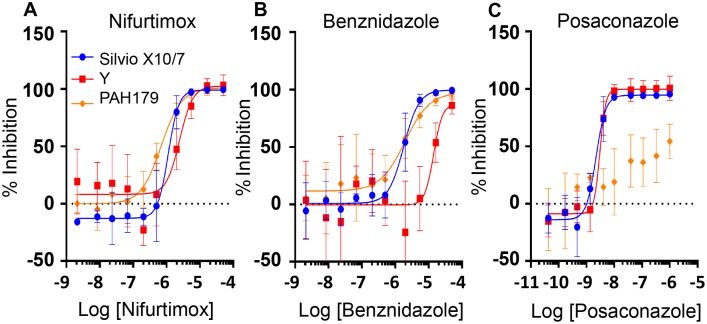
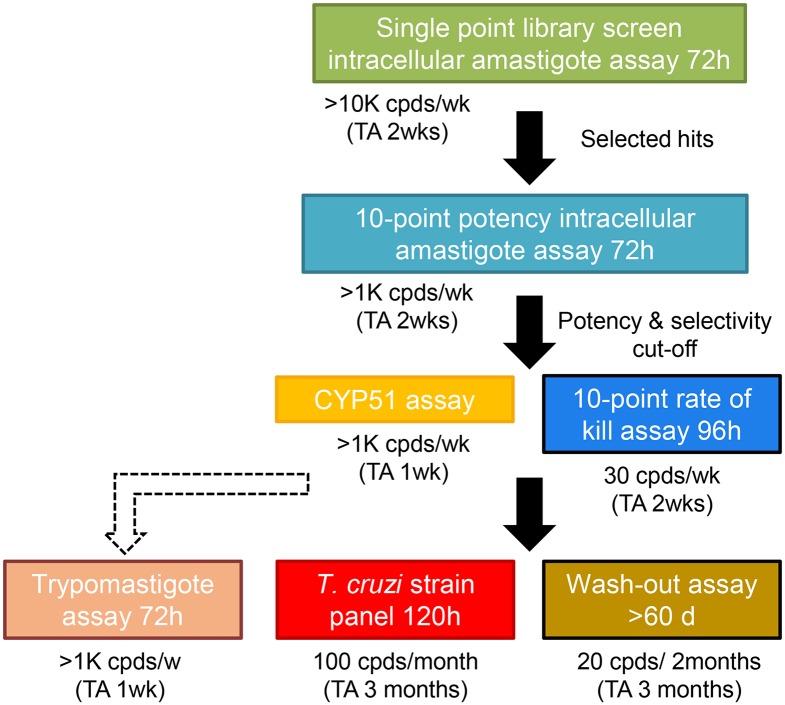
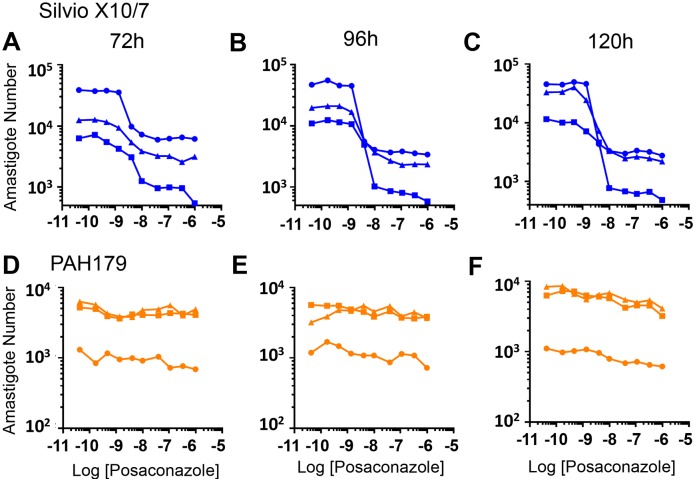
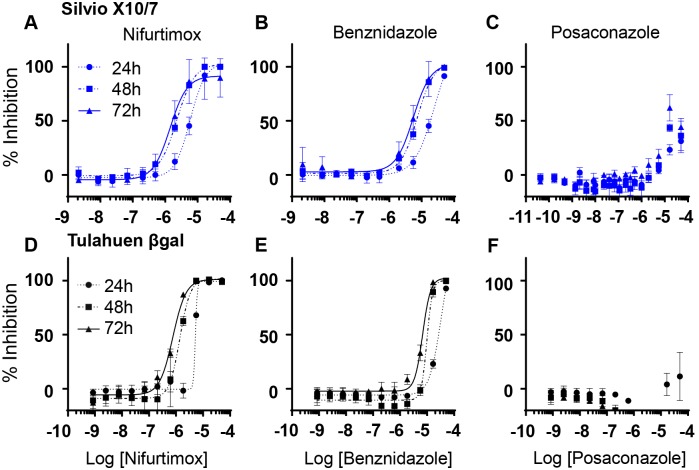
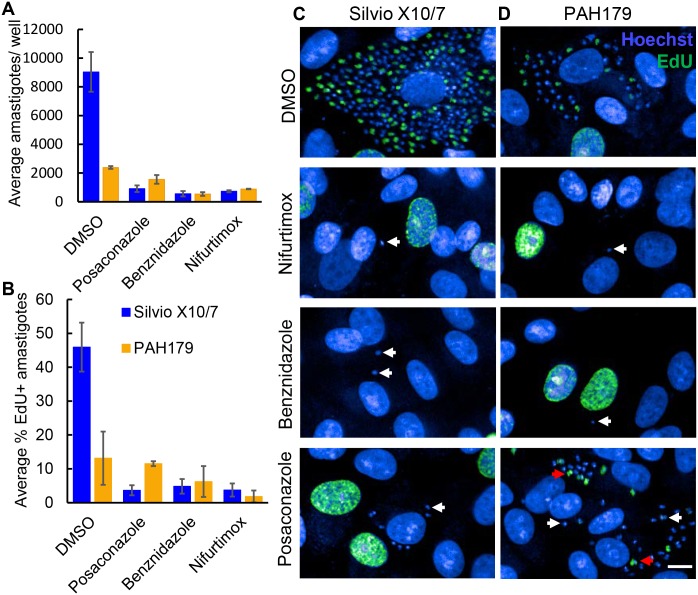
Chagas' disease is responsible for significant mortality and morbidity in Latin America. Current treatments display variable efficacy and have adverse side effects, hence more effective, better tolerated drugs are needed. However, recent efforts have proved unsuccessful with failure of the ergosterol biosynthesis inhibitor posaconazole in phase II clinical trials despite promising in vitro and in vivo studies. The lack of translation between laboratory experiments and clinical outcome is a major issue for further drug discovery efforts. Our goal was to identify cell-based assays that could differentiate current nitro-aromatic drugs nifurtimox and benznidazole from posaconazole. Using a panel of T. cruzi strains including the six major lineages (TcI-VI), we found that strain PAH179 (TcV) was markedly less susceptible to posaconazole in vitro. Determination of parasite doubling and cycling times as well as EdU labelling experiments all indicate that this lack of sensitivity is due to the slow doubling and cycling time of strain PAH179. This is in accordance with ergosterol biosynthesis inhibition by posaconazole leading to critically low ergosterol levels only after multiple rounds of division, and is further supported by the lack of effect of posaconazole on the non-replicative trypomastigote form. A washout experiment with prolonged posaconazole treatment showed that, even for more rapidly replicating strains, this compound cannot clear all parasites, indicative of a heterogeneous parasite population in vitro and potentially the presence of quiescent parasites. Benznidazole in contrast was able to kill all parasites. The work presented here shows clear differentiation between the nitro-aromatic drugs and posaconazole in several assays, and suggests that in vitro there may be clinically relevant heterogeneity in the parasite population that can be revealed in long-term washout experiments. Based on these findings we have adjusted our in vitro screening cascade so that only the most promising compounds are progressed to in vivo experiments.
恰加斯病在拉丁美洲造成了重大的死亡率和发病率。目前的治疗方法显示出疗效的可变性,并具有不良反应,因此需要更有效、耐受性更好的药物。然而,最近的努力都以失败告终,尽管在体外和体内研究中表现出了前景,但唑类固醇生物合成抑制剂泊沙康唑在二期临床试验中失败。实验室实验与临床结果之间缺乏转化是进一步药物发现努力的一个主要问题。我们的目标是确定基于细胞的测定法,这些测定法可以区分当前的硝基芳烃药物硝呋替莫和苯并咪唑与泊沙康唑。使用包括六个主要谱系(TcI-VI)的一组 T. cruzi 菌株,我们发现菌株 PAH179(TcV)在体外对泊沙康唑明显更不敏感。寄生虫倍增和循环时间的测定以及 EdU 标记实验均表明,这种敏感性缺乏是由于菌株 PAH179 的倍增和循环时间缓慢所致。这与泊沙康唑抑制麦角固醇生物合成一致,只有在多次分裂后,才会导致麦角固醇水平极低,并且泊沙康唑对非复制型锥虫形态没有影响,进一步支持了这一点。延长泊沙康唑处理的洗脱实验表明,即使对于复制速度更快的菌株,该化合物也不能清除所有寄生虫,这表明体外寄生虫群体存在异质性,并且可能存在静止的寄生虫。相比之下,苯并咪唑能够杀死所有寄生虫。本研究表明,在几种测定方法中,硝基芳烃药物和泊沙康唑之间存在明显的分化,并表明在体外,寄生虫群体中可能存在临床上相关的异质性,这可以通过长期洗脱实验来揭示。基于这些发现,我们调整了我们的体外筛选级联,以便只有最有前途的化合物才能进入体内实验。