Department of Physics, Korea University, Seoul, 02841, Korea.
Department of Anatomy, Korea University College of Medicine, Seoul, 02841, Korea.
Sci Rep. 2018 Jul 12;8(1):10503. doi: 10.1038/s41598-018-28963-0.
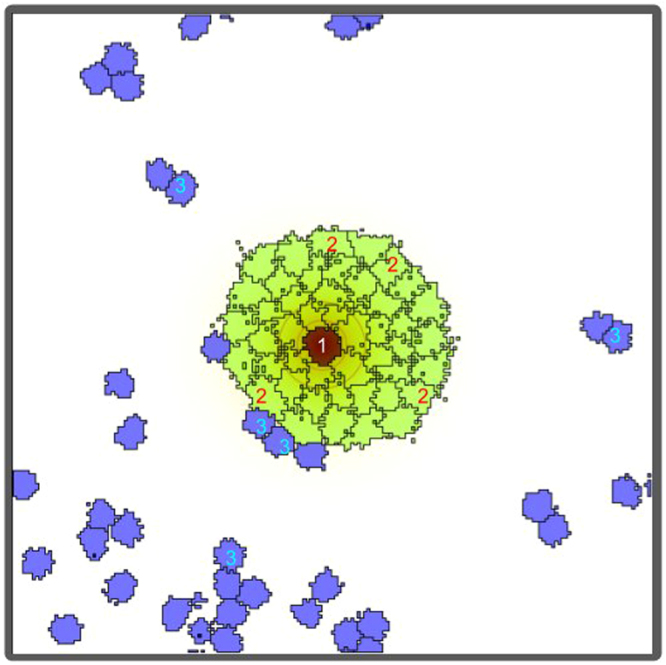
Cellular senescence, a permanent cell-cycle arrest, is a common yet intriguing phenomenon, in which its beneficial significance for biological organisms has only begun to be explored. Among others, senescent cells are able to transform tissue structures around them. Tumor cells, whose hallmark is their ability to proliferate indefinitely, are not free from the phenomenon. Here, we report a remarkable observation where senescent cells in a dense mono-layer of breast cancer colony act as aggregating centers for non-senescent cells in their vicinity. Consequently, the senescent cells actively form localized 3D cell-clusters in a confluent 2D tumor layer. The biophysical mechanism underpinning the surprising phenomenon primarily involves mitotic cell-rounding, dynamic and differential cell attachments, and cellular chemotaxis. By incorporating these few biophysical factors, we were able to recapitulate the experimental observation via a cellular Potts Model.
细胞衰老,即细胞周期的永久性停滞,是一种普遍而有趣的现象,其对生物机体的有益意义才刚刚开始被探索。衰老细胞能够改变其周围的组织结构,而肿瘤细胞的特征是能够无限增殖,也无法逃避这一现象。在这里,我们报告了一个惊人的观察结果,即在乳腺癌菌落的密集单层中,衰老细胞充当了附近非衰老细胞的聚集中心。因此,衰老细胞在密集的二维肿瘤层中积极形成局部三维细胞簇。支撑这一惊人现象的生物物理机制主要涉及有丝分裂细胞的圆形化、动态和差异细胞附着以及细胞趋化性。通过整合这几个生物物理因素,我们能够通过细胞 Potts 模型再现实验观察结果。