Yu Grace T, Ganier Clarisse, Allison David B, Tchkonia Tamara, Khosla Sundeep, Kirkland James L, Lynch Magnus D, Wyles Saranya P
Mayo Clinic Medical Scientist Training Program, Mayo Clinic Graduate School of Biomedical Sciences, Mayo Clinic Alix School of Medicine, Rochester, Minnesota, USA.
Centre for Gene Therapy and Regenerative Medicine, King's College London, Guy's Hospital, London, UK.
Aging Cell. 2025 Jan;24(1):e14358. doi: 10.1111/acel.14358. Epub 2024 Oct 6.
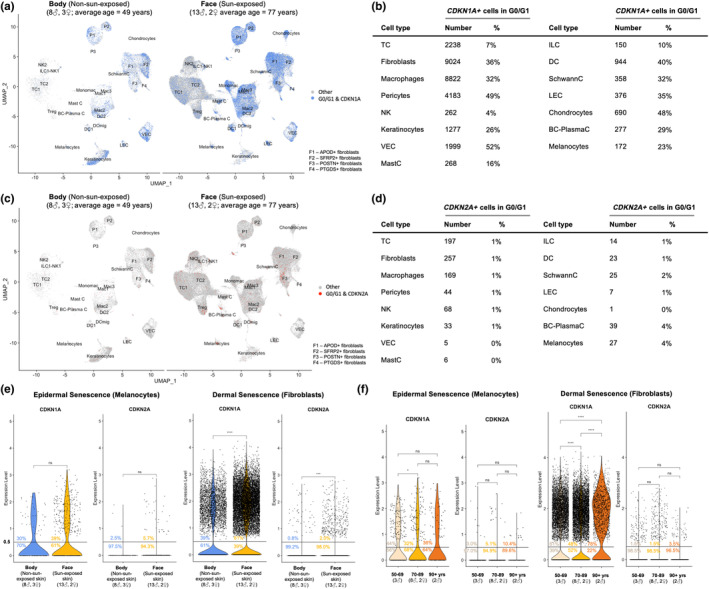
Single-cell RNA sequencing and spatial transcriptomics enable unprecedented insight into cellular and molecular pathways implicated in human skin aging and regeneration. Senescent cells are individual cells that are irreversibly cell cycle arrested and can accumulate across the human lifespan due to cell-intrinsic and -extrinsic stressors. With an atlas of single-cell RNA-sequencing and spatial transcriptomics, epidermal and dermal senescence and its effects were investigated, with a focus on melanocytes and fibroblasts. Photoaging due to ultraviolet light exposure was associated with higher burdens of senescent cells, a sign of biological aging, compared to chronological aging. A skin-specific cellular senescence gene set, termed SenSkin™, was curated and confirmed to be elevated in the context of photoaging, chronological aging, and non-replicating CDKN1A+ (p21) cells. In the epidermis, senescent melanocytes were associated with elevated melanin synthesis, suggesting haphazard pigmentation, while in the dermis, senescent reticular dermal fibroblasts were associated with decreased collagen and elastic fiber synthesis. Spatial analysis revealed the tendency for senescent cells to cluster, particularly in photoaged skin. This work proposes a strategy for characterizing age-related skin dysfunction through the lens of cellular senescence and suggests a role for senescent epidermal cells (i.e., melanocytes) and senescent dermal cells (i.e., reticular dermal fibroblasts) in age-related skin sequelae.
单细胞RNA测序和空间转录组学能够以前所未有的方式洞察与人类皮肤衰老和再生相关的细胞和分子途径。衰老细胞是不可逆地停滞在细胞周期中的单个细胞,由于细胞内在和外在应激源,它们会在人类寿命中不断积累。借助单细胞RNA测序和空间转录组学图谱,研究了表皮和真皮衰老及其影响,重点关注黑素细胞和成纤维细胞。与自然衰老相比,紫外线照射引起的光老化与更高的衰老细胞负担相关,这是生物衰老的一个标志。一个名为SenSkin™的皮肤特异性细胞衰老基因集被整理出来,并证实在光老化、自然衰老和非复制性CDKN1A+(p21)细胞的背景下会升高。在表皮中,衰老的黑素细胞与黑色素合成增加相关,提示色素沉着紊乱,而在真皮中,衰老的网状真皮成纤维细胞与胶原蛋白和弹性纤维合成减少相关。空间分析揭示了衰老细胞聚集的趋势,尤其是在光老化皮肤中。这项工作提出了一种通过细胞衰老视角来表征与年龄相关的皮肤功能障碍的策略,并提示衰老的表皮细胞(即黑素细胞)和衰老的真皮细胞(即网状真皮成纤维细胞)在与年龄相关的皮肤后遗症中所起的作用。