Lichtenstein Mia Beck, Nielsen Rasmus Oestergaard, Gudex Claire, Hinze Cecilie Juul, Jørgensen Uffe
Department of Psychology, University of Southern Denmark, J. B. Winsløws Vej 18, 220 B, DK-5000 Odense C, Denmark.
Department of Public Health - Sport Science, Aarhus University, Dalgas Avenue 4, building 3410, DK-8000 Aarhus C, Denmark.
Addict Behav Rep. 2018 Jun 18;8:33-39. doi: 10.1016/j.abrep.2018.06.001. eCollection 2018 Dec.
Exercise addiction is characterized by the use of physical activity to cope with emotions and mood, while sports injuries can lead to psychological distress such as depression and anxiety. The aim of the present study was to investigate the association between risk of exercise addiction and psychological distress, and whether this association was modified by injury status.
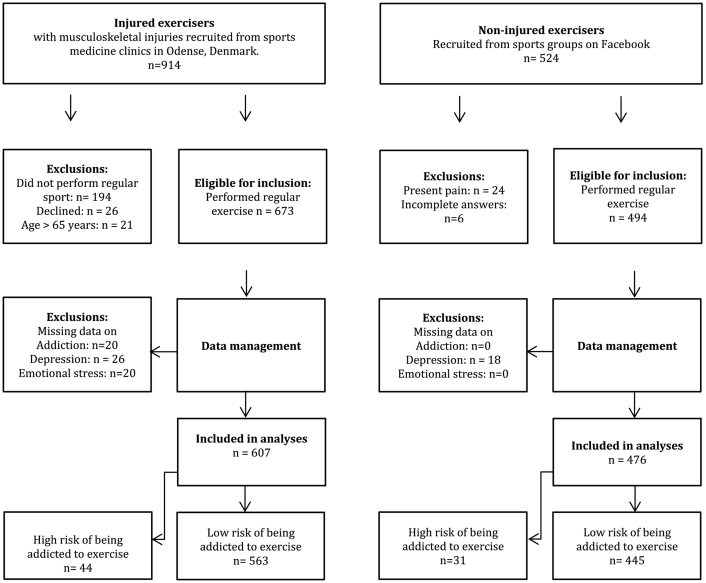
A cross-sectional study with injured and non-injured recreational exercisers (n = 1083). Using the Exercise Addiction Inventory participants were classified into the following groups: High risk of exercise addiction (HREA) with musculoskeletal injury (n = 44); HREA without musculoskeletal injury (n = 31); Low risk of addiction (LREA) with injury (n = 563); LREA without injury (n = 445). The outcomes were depression using the Major Depression Inventory, and emotional stress using the Perceived Stress Scale. Data were analyzed using binomial regression analysis with prevalence proportion difference (PPD) as measure of association.
Compared with LREA-exercisers, more HREA exercisers were depressed (PPD = 13% points [95%CI 3.6; 22.4]) or experienced emotional stress (PPD = 26.2% points [95%CI 14.5; 37.8]). Amongst injured exercisers, more HREA exercisers had depression (PPD = 15.9% points [95%CI 2.5; 29.3]) compared with LREA-exercisers.
Recreational exercisers with high risk of exercise addiction reported more symptoms of depression and emotional stress, and this relationship seemed exacerbated in the presence of musculoskeletal injury. Psychological assessment and counseling may be useful supplements to somatic injury interventions for addressing emotional distress.
运动成瘾的特征是通过体育活动来应对情绪和心境,而运动损伤可能导致抑郁和焦虑等心理困扰。本研究的目的是调查运动成瘾风险与心理困扰之间的关联,以及这种关联是否因损伤状况而有所改变。
对受伤和未受伤的休闲锻炼者进行横断面研究(n = 1083)。使用运动成瘾量表将参与者分为以下几组:有肌肉骨骼损伤的运动成瘾高风险组(HREA)(n = 44);无肌肉骨骼损伤的运动成瘾高风险组(n = 31);有损伤的成瘾低风险组(LREA)(n = 563);无损伤的成瘾低风险组(n = 445)。采用《重度抑郁量表》评估抑郁情况,采用《感知压力量表》评估情绪应激。使用二项回归分析,以患病率比例差异(PPD)作为关联指标对数据进行分析。
与LREA锻炼者相比,更多的HREA锻炼者患有抑郁症(PPD = 13个百分点[95%CI 3.6;22.4])或经历情绪应激(PPD = 26.2个百分点[95%CI 14.5;37.8])。在受伤的锻炼者中,与LREA锻炼者相比,更多的HREA锻炼者患有抑郁症(PPD = 15.9个百分点[95%CI 2.5;29.3])。
运动成瘾高风险的休闲锻炼者报告了更多的抑郁和情绪应激症状,并且这种关系在存在肌肉骨骼损伤的情况下似乎会加剧。心理评估和咨询可能是躯体损伤干预措施的有用补充,以解决情绪困扰。