Tonin Alessandro, Birbaumer Niels, Chaudhary Ujwal
Institute of Medical Psychology and Behavioral Neurobiology, University of Tübingen, 72076 Tübingen, Germany.
Wyss-Center for Bio- and Neuro-Engineering, 1202 Geneva, Switzerland.
Brain Sci. 2018 Jul 2;8(7):126. doi: 10.3390/brainsci8070126.
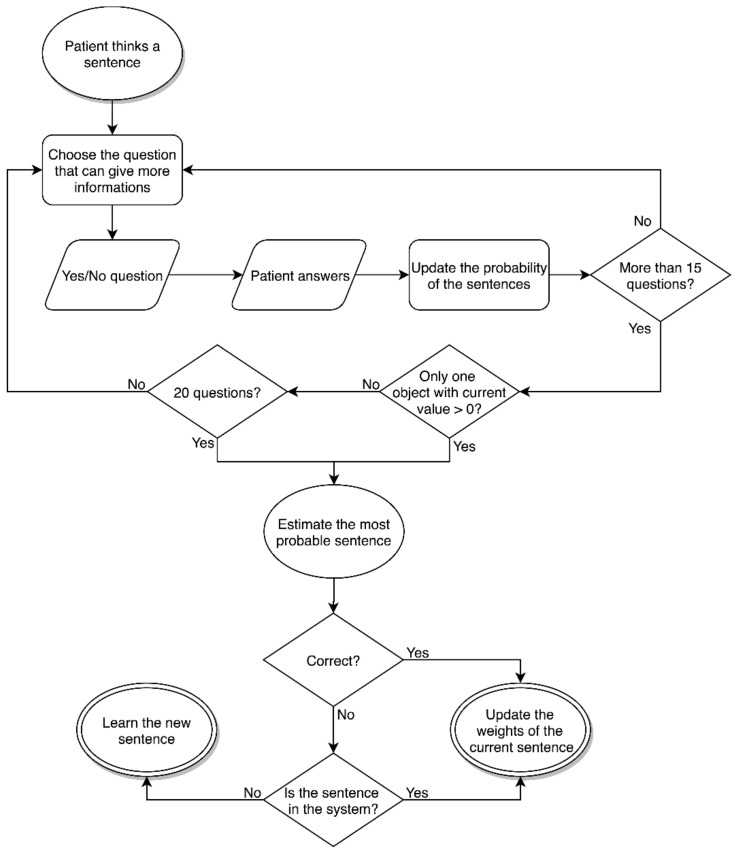
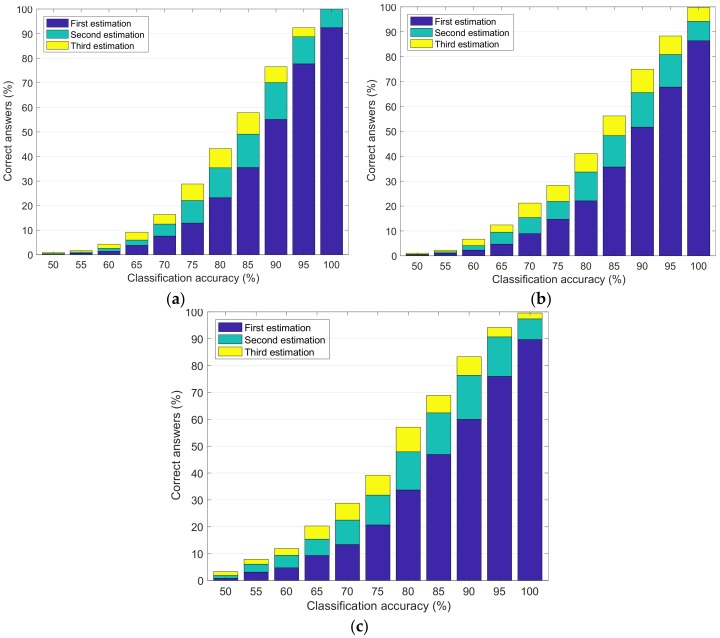
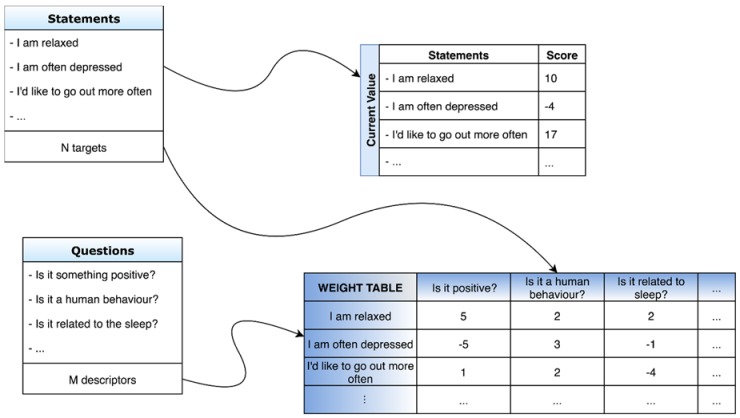
Brain computer interfaces (BCIs) enables people with motor impairments to communicate using their brain signals by selecting letters and words from a screen. However, these spellers do not work for people in a complete locked-in state (CLIS). For these patients, a near infrared spectroscopy-based BCI has been developed, allowing them to reply to "yes"/"no" questions with a classification accuracy of 70%. Because of the non-optimal accuracy, a usual character-based speller for selecting letters or words cannot be used. In this paper, a novel spelling interface based on the popular 20-questions-game has been presented, which will allow patients to communicate using only "yes"/"no" answers, even in the presence of poor classification accuracy. The communication system is based on an artificial neural network (ANN) that estimates a statement thought by the patient asking less than 20 questions. The ANN has been tested in a web-based version with healthy participants and in offline simulations. Both results indicate that the proposed system can estimate a patient's imagined sentence with an accuracy that varies from 40%, in the case of a "yes"/"no" classification accuracy of 70%, and up to 100% in the best case. These results show that the proposed spelling interface could allow patients in CLIS to express their own thoughts, instead of only answer to "yes"/"no" questions.
脑机接口(BCIs)使运动功能受损的人能够通过从屏幕上选择字母和单词,利用大脑信号进行交流。然而,这些拼写器对处于完全闭锁状态(CLIS)的人不起作用。对于这些患者,已经开发出一种基于近红外光谱的脑机接口,使他们能够以70%的分类准确率回答“是”/“否”问题。由于准确率不理想,无法使用常用的基于字符的拼写器来选择字母或单词。在本文中,提出了一种基于流行的20个问题游戏的新型拼写界面,即使在分类准确率较低的情况下,也能让患者仅用“是”/“否”回答进行交流。该通信系统基于一个人工神经网络(ANN),该网络通过询问少于20个问题来估计患者所想的陈述。该人工神经网络已在基于网络的版本中对健康参与者进行了测试,并进行了离线模拟。两个结果均表明,所提出的系统能够估计患者想象的句子,准确率在“是”/“否”分类准确率为70%的情况下为40%,在最佳情况下可达100%。这些结果表明,所提出的拼写界面可以让处于CLIS状态的患者表达自己的想法,而不仅仅是回答“是”/“否”问题。