Department of Psychiatry, Campus Charité Mitte, Charité - Universitätsmedizin Berlin, Berlin, Germany.
Division of Psychiatry, University College London, London, United Kingdom.
Biol Psychiatry. 2018 Nov 1;84(9):634-643. doi: 10.1016/j.biopsych.2018.05.015. Epub 2018 May 25.
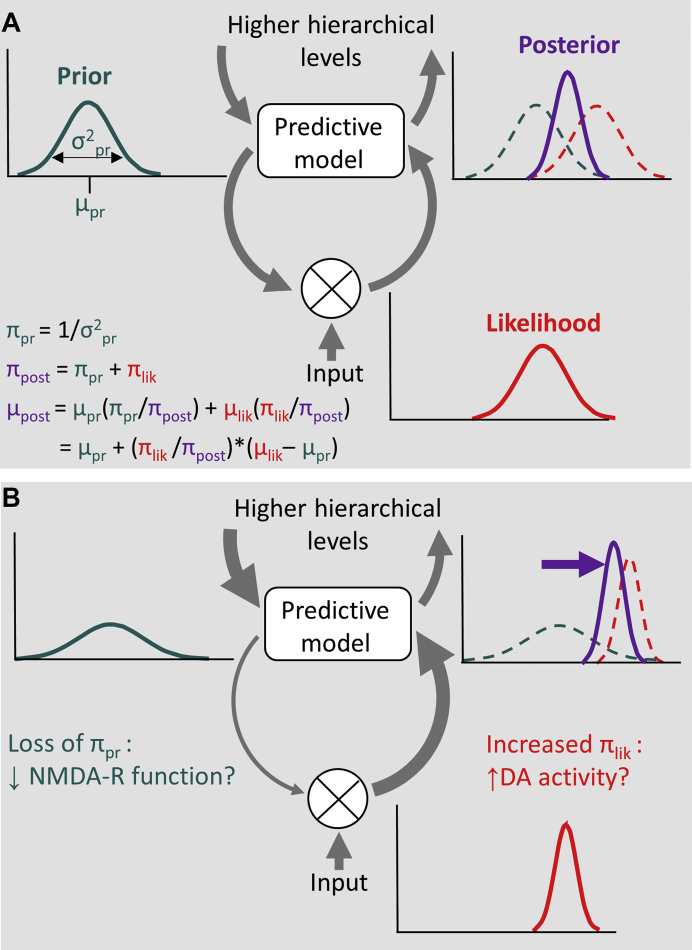
Fueled by developments in computational neuroscience, there has been increasing interest in the underlying neurocomputational mechanisms of psychosis. One successful approach involves predictive coding and Bayesian inference. Here, inferences regarding the current state of the world are made by combining prior beliefs with incoming sensory signals. Mismatches between prior beliefs and incoming signals constitute prediction errors that drive new learning. Psychosis has been suggested to result from a decreased precision in the encoding of prior beliefs relative to the sensory data, thereby garnering maladaptive inferences. Here, we review the current evidence for aberrant predictive coding and discuss challenges for this canonical predictive coding account of psychosis. For example, hallucinations and delusions may relate to distinct alterations in predictive coding, despite their common co-occurrence. More broadly, some studies implicate weakened prior beliefs in psychosis, and others find stronger priors. These challenges might be answered with a more nuanced view of predictive coding. Different priors may be specified for different sensory modalities and their integration, and deficits in each modality need not be uniform. Furthermore, hierarchical organization may be critical. Altered processes at lower levels of a hierarchy need not be linearly related to processes at higher levels (and vice versa). Finally, canonical theories do not highlight active inference-the process through which the effects of our actions on our sensations are anticipated and minimized. It is possible that conflicting findings might be reconciled by considering these complexities, portending a framework for psychosis more equipped to deal with its many manifestations.
受计算神经科学发展的推动,人们对精神分裂症的潜在神经计算机制越来越感兴趣。一种成功的方法涉及预测编码和贝叶斯推理。在这里,通过将先验信念与传入的感觉信号相结合,对当前世界状态的推断进行。先验信念与传入信号之间的不匹配构成了预测误差,从而推动新的学习。有人认为,精神分裂症是由于在先验信念的编码中精度降低相对于感觉数据,从而产生适应性推断。在这里,我们回顾了目前关于异常预测编码的证据,并讨论了这一经典预测编码精神分裂症理论所面临的挑战。例如,幻觉和妄想可能与预测编码的不同改变有关,尽管它们经常同时发生。更广泛地说,一些研究表明精神分裂症患者的先验信念较弱,而另一些研究则发现先验信念较强。这些挑战可以通过更细致的预测编码观点来回答。不同的先验可以为不同的感觉模态及其整合指定,每个模态的缺陷不一定是均匀的。此外,层次组织可能至关重要。层次结构较低层次的过程不一定与较高层次的过程线性相关(反之亦然)。最后,规范理论并没有强调主动推理——即我们对自己感觉的行动影响的预期和最小化过程。通过考虑这些复杂性,可能会调和相互矛盾的发现,预示着一个更能应对其多种表现的精神分裂症框架。