Díaz P, Varcasia A, Pipia A P, Tamponi C, Sanna G, Prieto A, Ruiu A, Spissu P, Díez-Baños P, Morrondo P, Scala A
Investigation in Animal Health: Galicia (INVESAGA Group), School of Veterinary Medicine, Universidade de Santiago de Compostela, Lugo, Spain.
Laboratory of Parasitology, Veterinary Teaching Hospital, Department of Veterinary Medicine, University of Sassari, Sassari, Italy.
Parasitol Res. 2018 Oct;117(10):3081-3090. doi: 10.1007/s00436-018-6000-x. Epub 2018 Jul 14.
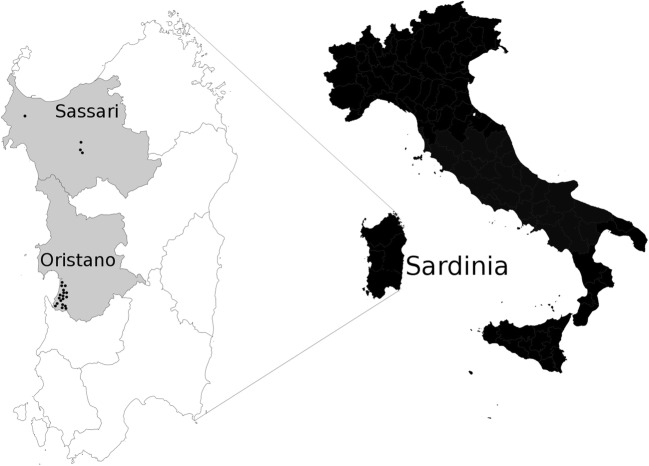
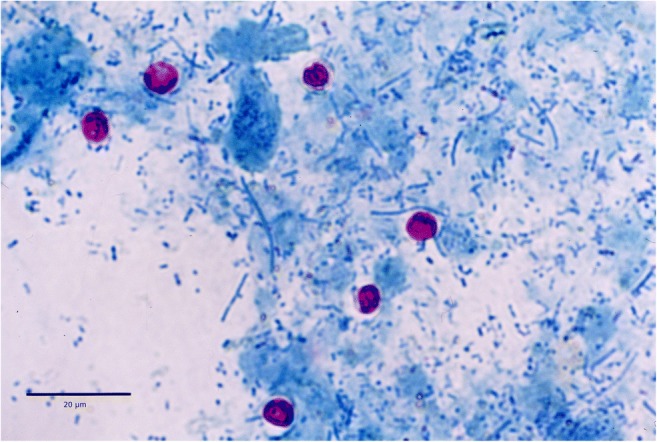
To provide up-to-date information on the occurrence of Cryptosporidium in pre-weaned calves from Sardinia (Italy), the species implicated and their zoonotic potential, 147 faecal samples from 22 cattle herds were microscopically examined for Cryptosporidium oocysts; positive isolates were molecularly characterised. A questionnaire was developed to identify risk factors for Cryptosporidium infection. Overall, the percentage of positive calves and farms was 38.8 and 68.2%, respectively. The SSU rRNA-based PCR identified two Cryptosporidium species, Cryptosporidium parvum (95.8%) and C. bovis (4.2%). Sequence analyses of the glycoprotein (gp60) gene revealed that all C. parvum isolates belonged to the subtype family IIa (IIaA15G2R1 and IIaA16G3R1), with the exception of three isolates that belonged to the subtype family IId (IIdA20G1b and IIdA20). Mixed logistic regression results indicated that calves aged 15-21 days were more likely to be Cryptosporidium-positive. The risk of being positive was also significantly higher in herds from Central Sardinia and in farms using non-slatted flooring. In addition, the application of disinfectants and milk replacers was significantly associated with higher Cryptosporidium prevalence. In contrast, the risk of being positive was significantly reduced in halofuginone-treated calves. Our results reveal that a significant percentage of suckling calves are carriers of zoonotic subtypes of C. parvum. Thus, both healthy and diarrhoeic calves younger than 1 month may represent a risk for the transmission of cryptosporidiosis in humans and animals.
为了提供有关意大利撒丁岛断奶前犊牛隐孢子虫的发生情况、相关种类及其人畜共患病潜力的最新信息,对来自22个牛群的147份粪便样本进行了显微镜检查,以查找隐孢子虫卵囊;对阳性分离株进行了分子特征分析。编制了一份问卷,以确定隐孢子虫感染的风险因素。总体而言,阳性犊牛和农场的百分比分别为38.8%和68.2%。基于小亚基核糖体RNA(SSU rRNA)的聚合酶链反应(PCR)鉴定出两种隐孢子虫,即微小隐孢子虫(95.8%)和牛隐孢子虫(4.2%)。糖蛋白(gp60)基因的序列分析表明,除了三个属于亚型家族IId(IIdA20G1b和IIdA20)的分离株外,所有微小隐孢子虫分离株均属于亚型家族IIa(IIaA15G2R1和IIaA16G3R1)。混合逻辑回归结果表明,15至21日龄的犊牛更有可能感染隐孢子虫呈阳性。撒丁岛中部牛群以及使用非板条地板的农场中,阳性风险也显著更高。此外,使用消毒剂和代乳粉与隐孢子虫较高的流行率显著相关。相比之下,用常山酮治疗的犊牛呈阳性的风险显著降低。我们的结果表明,相当比例的哺乳犊牛是微小隐孢子虫人畜共患亚型的携带者。因此,1月龄以下的健康和腹泻犊牛都可能对人和动物隐孢子虫病的传播构成风险。