Arjona Jose M, Royo Conxita, Dreisigacker Susanne, Ammar Karim, Villegas Dolors
Sustainable Field Crops Programme, Institute for Food and Agricultural Research and Technology (IRTA), Lleida, Spain.
International Maize and Wheat Improvement Center (CIMMYT), Texcoco, Mexico.
Front Plant Sci. 2018 Jun 29;9:888. doi: 10.3389/fpls.2018.00888. eCollection 2018.
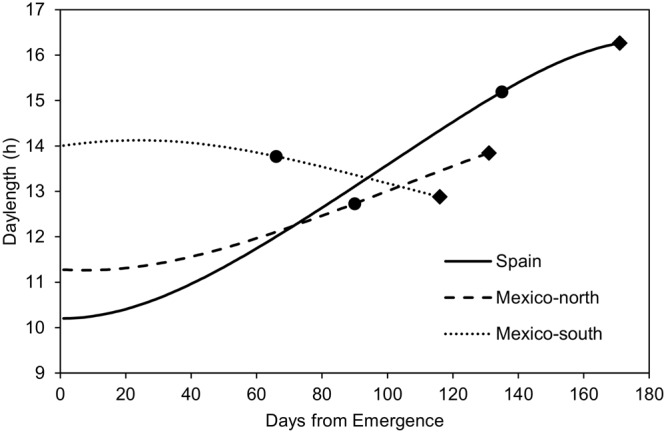
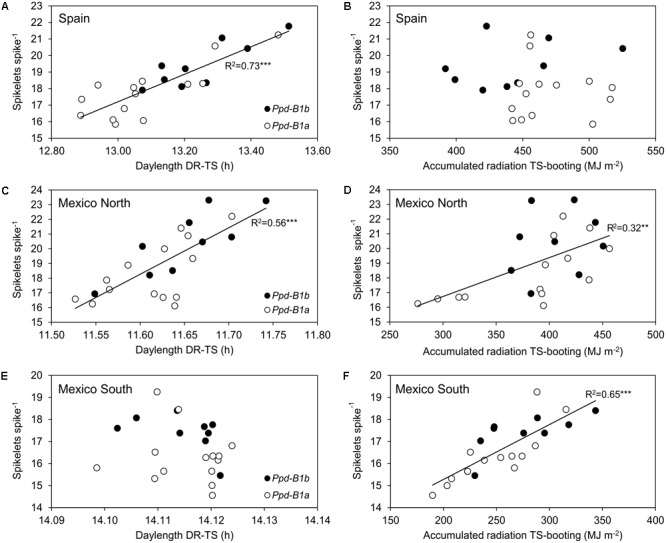
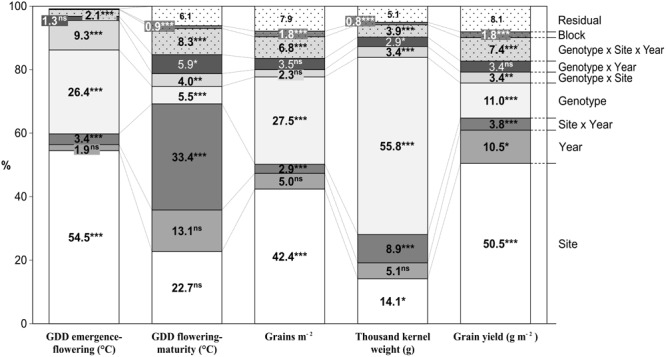
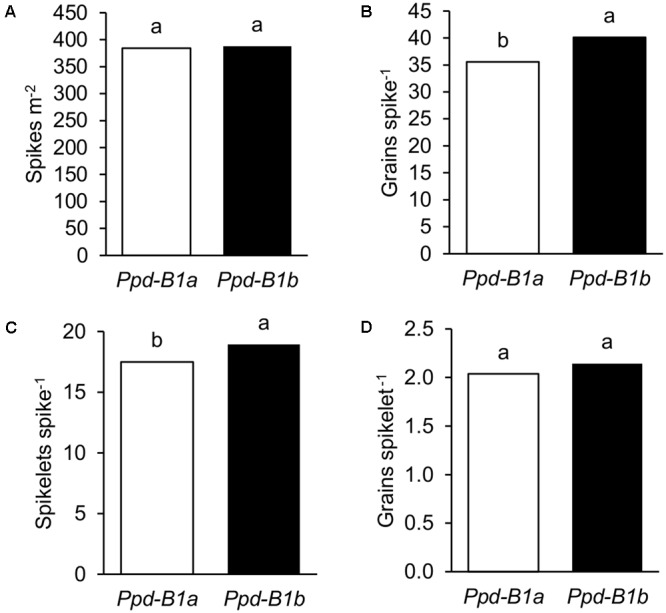
The main yield components in durum wheat are grain number per unit area (GN) and thousand kernel weight (TKW), both of which are affected by environmental conditions. The most critical developmental stage for their determination is flowering time, which partly depends on photoperiod sensitivity genes at loci. Fifteen field experiments, involving 23 spring durum wheat genotypes containing all known allelic variants at the PHOTOPERIOD RESPONSE LOCUS ( and ) were carried out at three sites at latitudes ranging from 41° to 27° N (Spain, Mexico-north, and Mexico-south, the latter in spring planting). Allele at , which causes photoperiod insensitivity and results in early-flowering genotypes, tended to increase TKW and yield, albeit not substantially. Allele , also causing photoperiod insensitivity, did not affect flowering time or grain yield. Genotypes carrying the allele conferring photoperiod sensitivity had consistently higher GN, which did not translate into higher yield due to under-compensation in TKW. This increased GN was due to a greater number of grains spike as a result of a higher number of spikelets spike. Daylength from double ridge to terminal spikelet stage was strongly and positively associated with the number of spikelets spike in Spain. This association was not found in the Mexico sites, thereby indicating that had an intrinsic effect on spikelets spike independently of environmental cues. Our results suggest that, in environments where yield is limited by the incapacity to produce a high GN, selecting for may be advisable.
硬粒小麦的主要产量构成要素是单位面积穗数(GN)和千粒重(TKW),这两个要素都会受到环境条件的影响。决定它们的最关键发育阶段是开花时间,而开花时间部分取决于位于某些位点的光周期敏感基因。在北纬41°至27°的三个地点(西班牙、墨西哥北部和墨西哥南部,后者为春季种植)开展了15项田间试验,涉及23个春性硬粒小麦基因型,这些基因型包含光周期反应位点(和)的所有已知等位基因变体。位于处的等位基因会导致光周期不敏感,并产生早花基因型,该等位基因往往会增加千粒重和产量,尽管增幅不大。同样会导致光周期不敏感的等位基因,对开花时间或籽粒产量没有影响。携带赋予光周期敏感性的等位基因的基因型始终具有较高的单位面积穗数,但由于千粒重的补偿不足,并未转化为更高的产量。单位面积穗数的增加是由于每个穗的小穗数增加,从而导致每个穗的籽粒数增多。在西班牙,从双棱期到顶小穗期的日长与每个穗的小穗数呈强烈正相关。在墨西哥的试验地点未发现这种相关性,这表明该基因对每个穗的小穗数具有独立于环境线索的内在影响。我们的结果表明,在产量受限于无法产生高单位面积穗数的环境中,选择该基因可能是可取的。