Luo Ting, Chen Xiaoyi, Zeng Shufei, Guan Baozhang, Hu Bo, Meng Yu, Liu Fanna, Wong Taksui, Lu Yongpin, Yun Chen, Hocher Berthold, Yin Lianghong
Department of Nephrology, The First Affiliated Hospital of Jinan University, Jinan University, Guangzhou, Guangdong 510632, P.R. China.
Department of Nephrology, Charité-Universitätsmedizin Berlin, Campus Mitte, D-10117 Berlin, Germany.
Oncol Lett. 2018 Aug;16(2):1747-1757. doi: 10.3892/ol.2018.8842. Epub 2018 May 30.
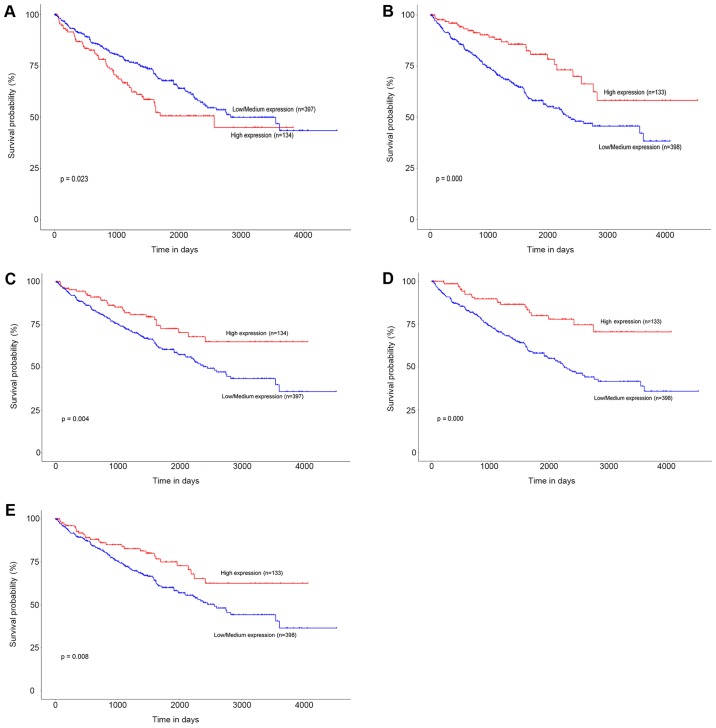
The present study aimed to identify new key genes as potential biomarkers for the diagnosis, prognosis or targeted therapy of clear cell renal cell carcinoma (ccRCC). Three expression profiles (GSE36895, GSE46699 and GSE71963) were collected from Gene Expression Omnibus. GEO2R was used to identify differentially expressed genes (DEGs) in ccRCC tissues and normal samples. The Database for Annotation, Visualization and Integrated Discovery was utilized for functional and pathway enrichment analysis. STRING v10.5 and Molecular Complex Detection were used for protein-protein interaction (PPI) network construction and module analysis, respectively. Regulation network analyses were performed with the WebGestal tool. UALCAN web-portal was used for expression validation and survival analysis of hub genes in ccRCC patients from The Cancer Genome Atlas (TCGA). A total of 65 up- and 164 downregulated genes were identified as DEGs. DEGs were enriched with functional terms and pathways compactly related to ccRCC pathogenesis. Seventeen hub genes and one significant module were filtered out and selected from the PPI network. The differential expression of hub genes was verified in TCGA patients. Kaplan-Meier plot showed that high mRNA expression of enolase 2 () was associated with short overall survival in ccRCC patients (P=0.023). High mRNA expression of cyclin D1 () (P<0.001), fms related tyrosine kinase 1 () (P=0.004), plasminogen () (P<0.001) and von Willebrand factor () (P=0.008) appeared to serve as favorable factors in survival. These findings indicate that the DEGs may be key genes in ccRCC pathogenesis and five genes, including and , may serve as potential prognostic biomarkers in ccRCC.
本研究旨在鉴定新的关键基因,作为透明细胞肾细胞癌(ccRCC)诊断、预后或靶向治疗的潜在生物标志物。从基因表达综合数据库(Gene Expression Omnibus)收集了三个表达谱(GSE36895、GSE46699和GSE71963)。使用GEO2R来鉴定ccRCC组织和正常样本中的差异表达基因(DEG)。利用注释、可视化和综合发现数据库(Database for Annotation, Visualization and Integrated Discovery)进行功能和通路富集分析。分别使用STRING v10.5和分子复合物检测(Molecular Complex Detection)进行蛋白质-蛋白质相互作用(PPI)网络构建和模块分析。使用WebGestal工具进行调控网络分析。利用UALCAN网络平台对来自癌症基因组图谱(TCGA)的ccRCC患者的核心基因进行表达验证和生存分析。共鉴定出65个上调基因和164个下调基因作为DEG。DEG富集了与ccRCC发病机制紧密相关的功能术语和通路。从PPI网络中筛选并选出了17个核心基因和一个显著模块。在TCGA患者中验证了核心基因的差异表达。Kaplan-Meier曲线显示,烯醇化酶2(ENO2)的高mRNA表达与ccRCC患者较短的总生存期相关(P = 0.023)。细胞周期蛋白D1(CCND1)(P < 0.001)、fms相关酪氨酸激酶1(FLT1)(P = 0.004)、纤溶酶原(PLG)(P < 0.001)和血管性血友病因子(VWF)(P = 0.008)的高mRNA表达似乎是生存的有利因素。这些发现表明,DEG可能是ccRCC发病机制中的关键基因,包括ENO2和CCND1在内的五个基因可能作为ccRCC潜在的预后生物标志物。