McCaffery Jennifer M, Robertson David J, Young Andrew W, Burton A Mike
1School of Psychology, University of Aberdeen, Aberdeen, UK.
2Department of Psychology, University of York, York, YO10 5DD UK.
Cogn Res Princ Implic. 2018 Jun 27;3:21. doi: 10.1186/s41235-018-0112-9. eCollection 2018 Dec.
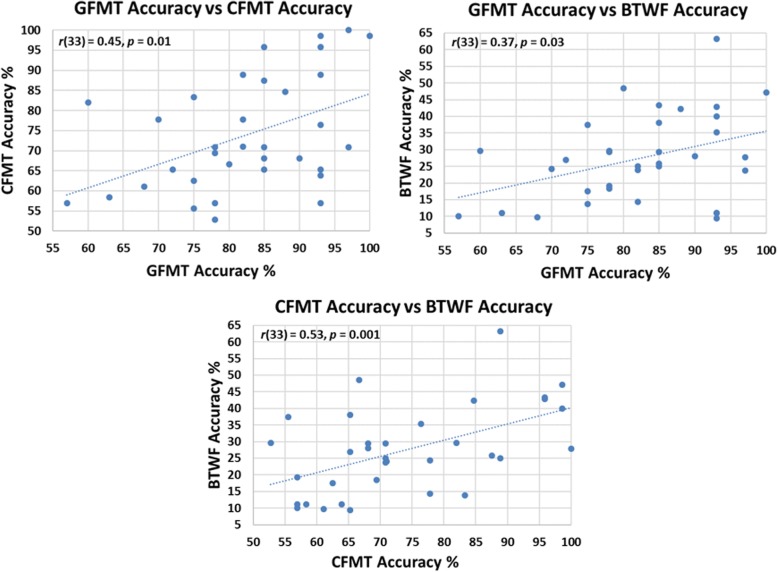
We investigated the relationships between individual differences in different aspects of face-identity processing, using the Glasgow Face Matching Test (GFMT) as a measure of unfamiliar face perception, the Cambridge Face Memory Test (CFMT) as a measure of new face learning, and the Before They Were Famous task (BTWF) as a measure of familiar face recognition. These measures were integrated into two separate studies examining the relationship between face processing and other tasks. For Study 1 we gathered participants' subjective ratings of their own face perception abilities. In Study 2 we used additional measures of perceptual and cognitive abilities, and personality factors to place individual differences in a broader context. Performance was significantly correlated across the three face-identity tasks in both studies, suggesting some degree of commonality of underlying mechanisms. For Study 1 the participants' self-ratings correlated poorly with performance, reaching significance only for judgements of familiar face recognition. In Study 2 there were few associations between face tasks and other measures, with task-level influences seeming to account for the small number of associations present. In general, face tasks correlated with each other, but did not show an overall relation with other perceptual, cognitive or personality tests. Our findings are consistent with the existence of a general face-perception factor, able to account for around 25% of the variance in scores. However, other relatively task-specific influences are also clearly operating.
我们使用格拉斯哥面部匹配测试(GFMT)作为陌生面孔感知的度量、剑桥面部记忆测试(CFMT)作为新面孔学习的度量、以及成名前任务(BTWF)作为熟悉面孔识别的度量,来研究面部身份识别不同方面的个体差异之间的关系。这些度量被整合到两项独立研究中,以检验面部处理与其他任务之间的关系。在研究1中,我们收集了参与者对自身面部感知能力的主观评分。在研究2中,我们使用了感知和认知能力以及人格因素的额外度量,以便在更广泛的背景下考察个体差异。在两项研究中,三项面部身份任务的表现均显著相关,这表明潜在机制在一定程度上具有共性。对于研究1,参与者的自我评分与表现的相关性较差,仅在熟悉面孔识别的判断上达到显著水平。在研究2中,面部任务与其他度量之间几乎没有关联,任务层面的影响似乎解释了仅有的少数关联。总体而言,面部任务之间相互关联,但与其他感知、认知或人格测试没有整体关系。我们的研究结果与存在一个一般面部感知因素的观点一致,该因素能够解释约25%的分数方差。然而,其他相对特定于任务的影响显然也在起作用。