Department of Psychiatry, University of Florida, Gainesville, FL, 32610, USA.
Department of Neuroscience, University of Florida, Gainesville, FL, 32610, USA.
Neuropharmacology. 2018 Sep 1;139:205-216. doi: 10.1016/j.neuropharm.2018.07.018. Epub 2018 Jul 20.
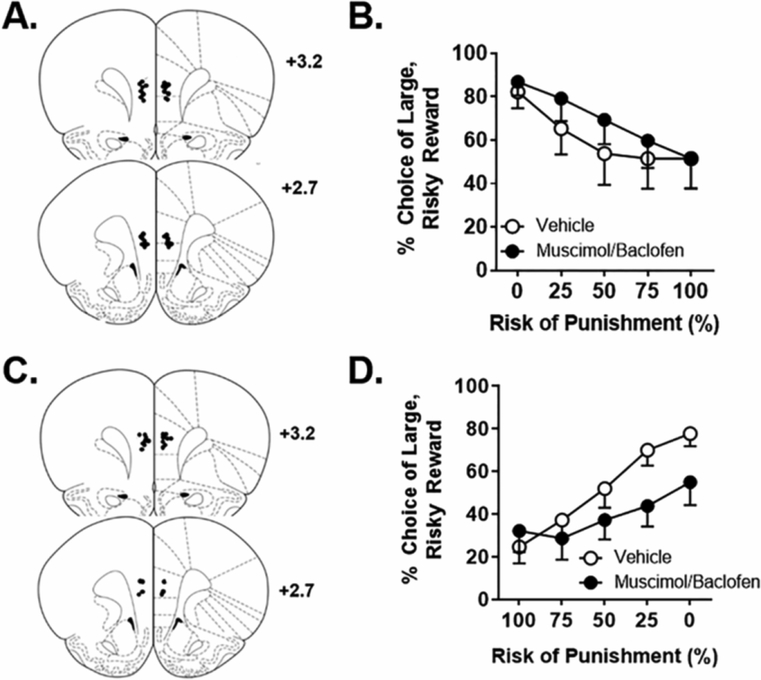
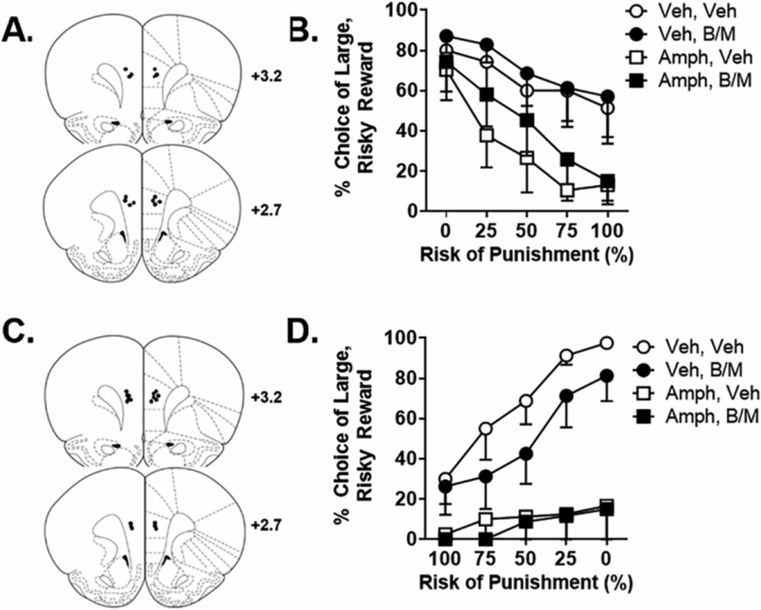
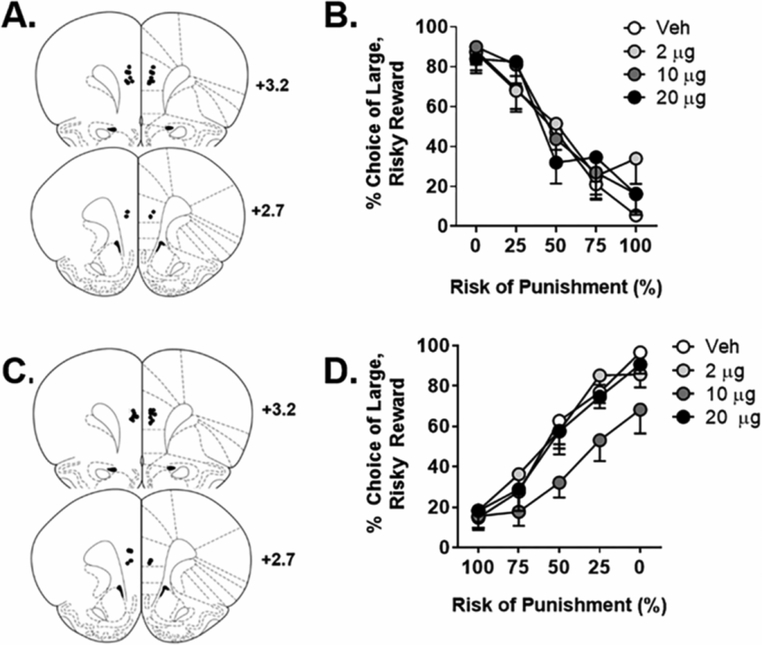
The prefrontal cortex (PFC) plays an important role in several forms of cost-benefit decision making. Its contributions to decision making under risk of explicit punishment, however, are not well understood. A rat model was used to investigate the role of the medial PFC (mPFC) and its monoaminergic innervation in a Risky Decision-making Task (RDT), in which rats chose between a small, "safe" food reward and a large, "risky" food reward accompanied by varying probabilities of mild footshock punishment. Inactivation of mPFC increased choice of the large, risky reward when the punishment probability increased across the session ("ascending RDT"), but decreased choice of the large, risky reward when the punishment probability decreased across the session ("descending RDT"). In contrast, enhancement of monoamine availability via intra-mPFC amphetamine reduced choice of the large, risky reward only in the descending RDT. Systemic administration of amphetamine reduced choice of the large, risky reward in both the ascending and descending RDT; however, this reduction was not attenuated by concurrent mPFC inactivation, indicating that mPFC is not a critical locus of amphetamine's effects on risk taking. These findings suggest that mPFC plays an important role in adapting choice behavior in response to shifting risk contingencies, but not necessarily in risk-taking behavior per se.
前额皮质(prefrontal cortex,PFC)在多种形式的成本效益决策中发挥着重要作用。然而,人们对其在明确惩罚风险下的决策贡献还不太了解。本研究采用大鼠模型,通过风险决策任务(Risky Decision-making Task,RDT),探讨了内侧前额皮质(medial prefrontal cortex,mPFC)及其单胺能神经支配在其中的作用。在该任务中,大鼠可以在小的“安全”食物奖励和大的“风险”食物奖励之间做出选择,同时伴随着不同概率的轻度足底电击惩罚。mPFC 的抑制增加了惩罚概率在整个任务中增加时大鼠对大的、风险奖励的选择(“上升 RDT”),但降低了惩罚概率在整个任务中减少时大鼠对大的、风险奖励的选择(“下降 RDT”)。相比之下,内侧前额皮质内的安非他命增强单胺能可用性仅降低了下降 RDT 中大鼠对大的、风险奖励的选择。系统给予安非他命降低了大鼠在上升和下降 RDT 中对大的、风险奖励的选择;然而,这种降低并没有被同期 mPFC 抑制所减弱,这表明 mPFC 不是安非他命对冒险行为影响的关键部位。这些发现表明,mPFC 在适应选择行为以响应不断变化的风险关联方面发挥着重要作用,但不一定是在冒险行为本身。