Pan Meng-Xian, Tang Jun-Chun, Liu Rui, Feng Yu-Gong, Wan Qi
Department of Physiology, Collaborative Innovation Center for Brain Science, School of Basic Medical Sciences, Wuhan University School of Medicine, Wuhan 430071, China.
Institute of Neuroregeneration & Neurorehabilitation, Department of Neurosurgery, Qingdao University, Qingdao 266071, China.
Chin J Traumatol. 2018 Aug;21(4):224-228. doi: 10.1016/j.cjtee.2018.04.003. Epub 2018 May 18.
To investigate the effects of estrogen G protein-coupled receptor 30 (GPR30) agonist G1 on hippocampal neuronal apoptosis and microglial polarization in rat traumatic brain injury (TBI).
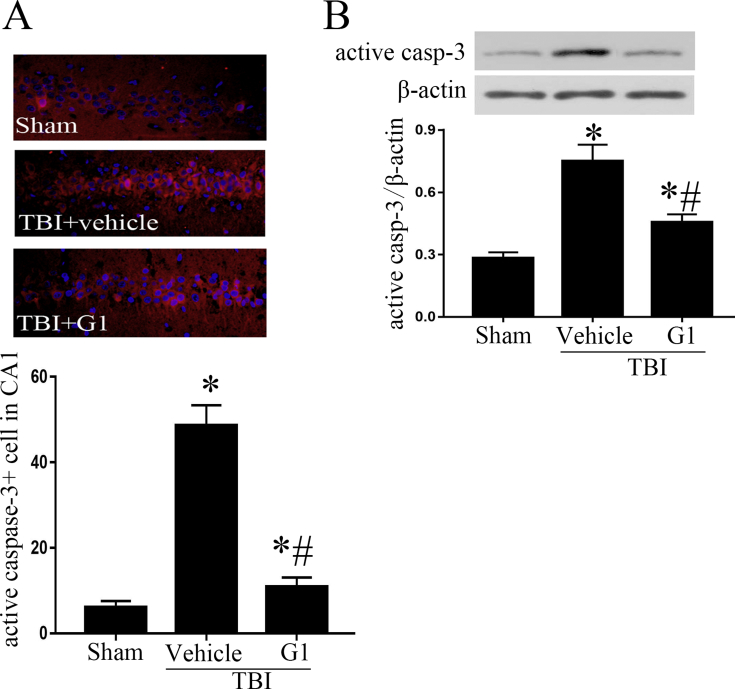
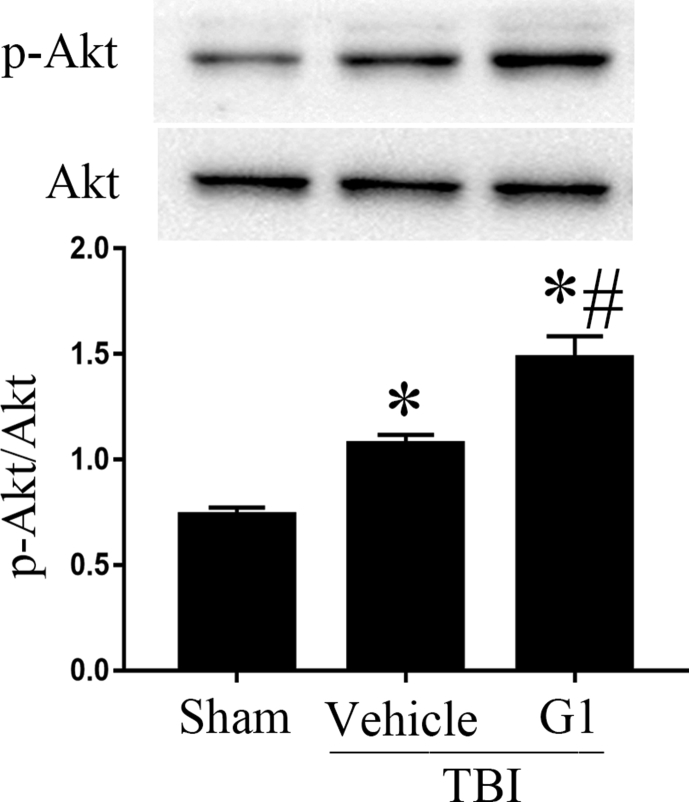
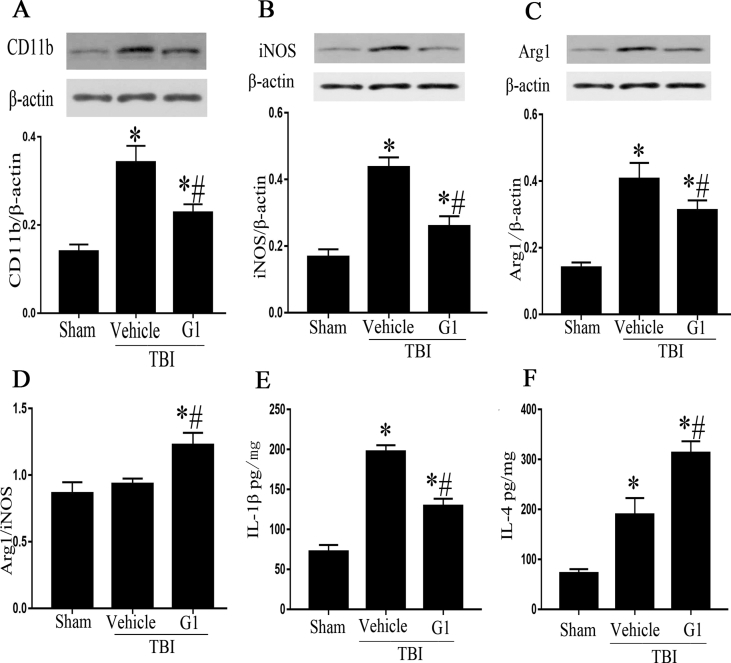
Male SD rats were randomly divided into sham group, TBI + vehicle group, TBI + G1 group. Experimental moderate TBI was induced using Feeney's weigh-drop method. G1 (100μg/kg) or vehicle was intravenously injected from femoral vein at 30 min post-injury. Rats were sacrificed at 24 h after injury for detection of neuronal apoptosis and microglia polarization. Neuronal apoptosis was assayed by immunofluorescent staining of active caspase-3. M1 type microglia markers (iNOS and IL-1β) and M2 type markers (Arg1 and IL-4) were examined by immunoblotting or ELISA. Total protein level of Akt and phosphorylated Akt were assayed by immunoblotting.
G1 significantly reduced active caspase-3 positive neurons in hippocampus. Meanwhile G1 increased the ratio of Arg1/iNOS. IL-1β production was decreased but IL-4 was increased after G1 treatment. G1 treatment also increased the active form of Akt.
GPR30 agonist G1 inhibited neuronal apoptosis and favored microglia polarization to M2 type.
探讨雌激素G蛋白偶联受体30(GPR30)激动剂G1对大鼠创伤性脑损伤(TBI)后海马神经元凋亡及小胶质细胞极化的影响。
将雄性SD大鼠随机分为假手术组、TBI+溶剂组、TBI+G1组。采用Feeney自由落体法诱导实验性中度TBI。伤后30分钟经股静脉静脉注射G1(100μg/kg)或溶剂。伤后24小时处死大鼠,检测神经元凋亡及小胶质细胞极化情况。通过活性半胱天冬酶-3免疫荧光染色检测神经元凋亡。通过免疫印迹法或酶联免疫吸附测定法检测M1型小胶质细胞标志物(诱导型一氧化氮合酶和白细胞介素-1β)和M2型标志物(精氨酸酶1和白细胞介素-4)。通过免疫印迹法检测Akt和磷酸化Akt的总蛋白水平。
G1显著减少海马中活性半胱天冬酶-3阳性神经元。同时,G1增加了精氨酸酶1/诱导型一氧化氮合酶的比值。G1处理后白细胞介素-1β的产生减少,但白细胞介素-4增加。G1处理还增加了Akt的活性形式。
GPR30激动剂G1抑制神经元凋亡,并有利于小胶质细胞向M2型极化。