Key Laboratory of Prevention and Treatment of Cardiovascular and Cerebrovascular Diseases of Ministry of Education, Gannan Medical University, Ganzhou, 341000, China.
Ganzhou Key Laboratory of Neuroinflammation Research, Gannan Medical University, Ganzhou, 341000, China.
Mol Med. 2022 Nov 26;28(1):142. doi: 10.1186/s10020-022-00573-7.
Activated microglia play a key role in initiating the inflammatory cascade following ischemic stroke and exert proinflammatory or anti-inflammatory effects, depending on whether they are polarized toward the M1 or M2 phenotype. The present study investigated the regulatory effect of icaritin (ICT) on microglial polarization in rats after cerebral ischemia/reperfusion injury (CI/RI) and explored the possible anti-inflammatory mechanisms of ICT.
A rat model of transient middle cerebral artery occlusion (tMCAO) was established. Following treatment with ICT, a G protein-coupled estrogen receptor (GPER) inhibitor or an extracellular signal-regulated kinase (ERK) inhibitor, the Garcia scale and rotarod test were used to assess neurological and locomotor function. 2,3,5-Triphenyltetrazolium chloride (TTC) and Fluoro-Jade C (FJC) staining were used to evaluate the infarct volume and neuronal death. The levels of inflammatory factors in the ischemic penumbra were evaluated using enzyme-linked immunosorbent assays (ELISAs). In addition, western blotting, immunofluorescence staining and quantitative PCR (qPCR) were performed to measure the expression levels of markers of different microglial phenotypes and proteins related to the GPER-ERK-nuclear factor kappa B (NF-κB) signaling pathway.
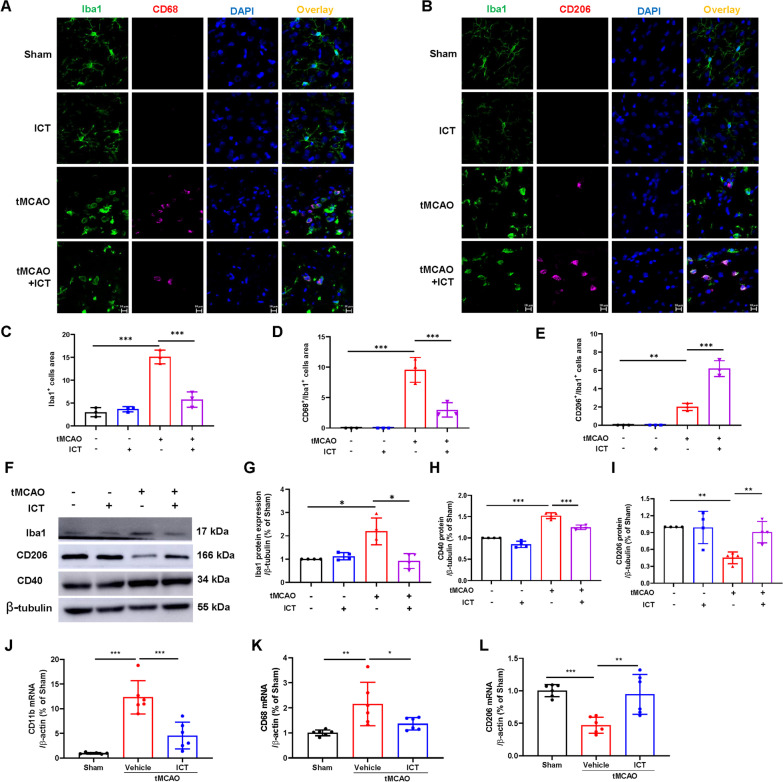
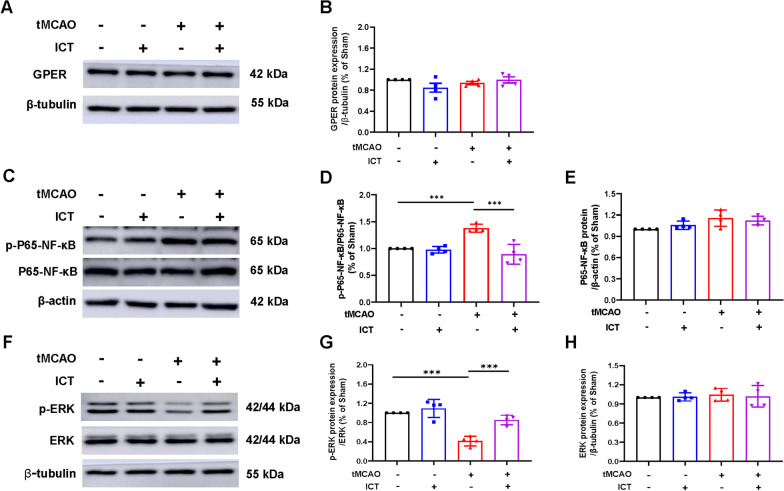
ICT treatment significantly decreased the cerebral infarct volume, brain water content and fluorescence intensity of FJC; improved the Garcia score; increased the latency to fall and rotation speed in the rotarod test; decreased the levels of interleukin-1 beta (IL-1β), tumor necrosis factor-alpha (TNF-α), Iba1, CD40, CD68 and p-P65-NF-κB; and increased the levels of CD206 and p-ERK. U0126 (an inhibitor of ERK) and G15 (a selective antagonist of GPER) antagonized these effects.
These findings indicate that ICT plays roles in inhibiting the inflammatory response and achieving neuroprotection by regulating GPER-ERK-NF-κB signaling and then inhibiting microglial activation and M1 polarization while promoting M2 polarization, which provides a new therapeutic for against cerebral ischemic stroke.
在缺血性中风后,激活的小胶质细胞在启动炎症级联反应中发挥关键作用,并根据其极化到 M1 或 M2 表型而发挥促炎或抗炎作用。本研究探讨了淫羊藿次苷(ICT)对脑缺血再灌注损伤(CI/RI)后大鼠小胶质细胞极化的调节作用,并探讨了 ICT 的可能抗炎机制。
建立大鼠短暂性大脑中动脉闭塞(tMCAO)模型。在 ICT 治疗后,使用 G 蛋白偶联雌激素受体(GPER)抑制剂或细胞外信号调节激酶(ERK)抑制剂,通过 Garcia 评分和转棒试验评估神经和运动功能。2,3,5-三苯基四氮唑氯化物(TTC)和氟代-Jade C(FJC)染色评估梗死体积和神经元死亡。采用酶联免疫吸附试验(ELISA)评估缺血半影区炎症因子水平。此外,通过 Western blot、免疫荧光染色和定量 PCR(qPCR)检测不同小胶质细胞表型标志物和与 GPER-ERK-核因子 kappa B(NF-κB)信号通路相关蛋白的表达水平。
ICT 治疗显著降低脑梗死体积、脑水含量和 FJC 荧光强度;改善 Garcia 评分;增加转棒试验中的跌落潜伏期和旋转速度;降低白细胞介素-1β(IL-1β)、肿瘤坏死因子-α(TNF-α)、Iba1、CD40、CD68 和 p-P65-NF-κB 水平;增加 CD206 和 p-ERK 水平。U0126(ERK 抑制剂)和 G15(GPER 选择性拮抗剂)拮抗了这些作用。
这些发现表明,ICT 通过调节 GPER-ERK-NF-κB 信号通路,抑制炎症反应和实现神经保护作用,从而抑制小胶质细胞激活和 M1 极化,同时促进 M2 极化,为治疗脑缺血性中风提供了新的治疗靶点。