Department of Urology, Fudan University Shanghai Cancer Center, Shanghai 200032, China.
Department of Oncology, Shanghai Medical College, Fudan University, Shanghai 200032, China.
Asian J Androl. 2018 Nov-Dec;20(6):551-554. doi: 10.4103/aja.aja_52_18.
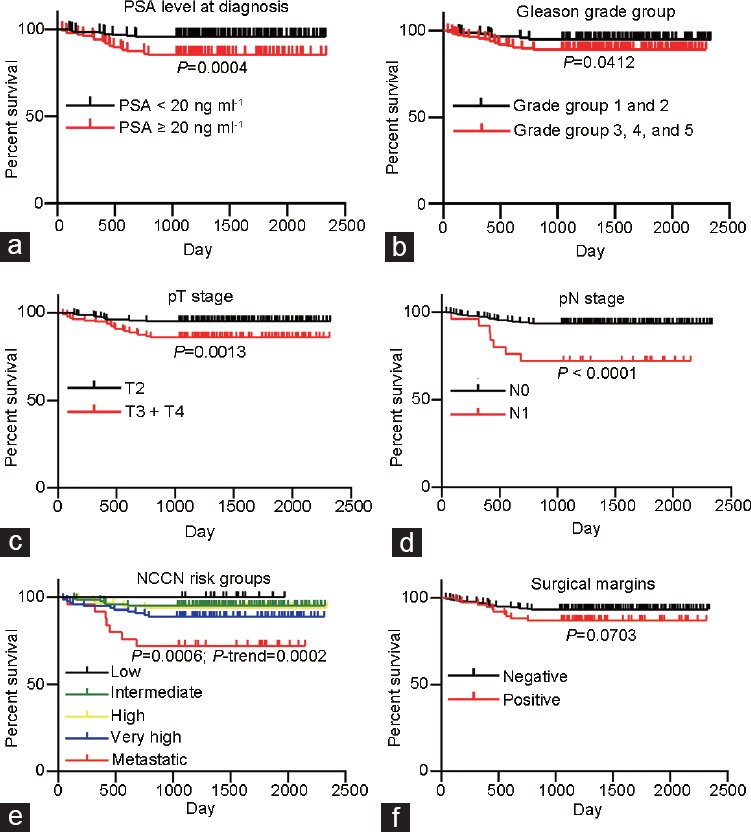
This study aimed to assess the role of the National Comprehensive Cancer Network (NCCN) risk classification in predicting biochemical recurrence (BCR) after radical prostatectomy (RP) in Chinese prostate cancer patients. We included a consecutive cohort of 385 patients with prostate cancer who underwent RP at Fudan University Shanghai Cancer Center (Shanghai, China) from March 2011 to December 2014. Gleason grade groups were applied at analysis according to the 2014 International Society of Urological Pathology Consensus. Risk groups were stratified according to the NCCN Clinical Practice Guidelines in Oncology: Prostate Cancer version 1, 2017. All 385 patients were divided into BCR and non-BCR groups. The clinicopathological characteristics were compared using an independent sample t-test, Chi-squared test, and Fisher's exact test. BCR-free survival was compared using the log-rank test and multivariable Cox proportional hazard analysis. During median follow-up of 48 months (range: 1-78 months), 31 (8.05%) patients experienced BCR. The BCR group had higher prostate-specific antigen level at diagnosis (46.54 ± 39.58 ng ml vs 21.02 ± 21.06 ng ml, P= 0.001), more advanced pT stage (P = 0.002), and higher pN1 rate (P < 0.001). NCCN risk classification was a significant predictor of BCR (P = 0.0006) and BCR-free survival (P = 0.003) after RP. As NCCN risk level increased, there was a significant decreasing trend in BCR-free survival rate (P = 0.0002). This study confirmed and validated that NCCN risk classification was a significant predictor of BCR and BCR-free survival after RP.
本研究旨在评估美国国家综合癌症网络(NCCN)风险分类在预测中国前列腺癌患者根治性前列腺切除术后(RP)生化复发(BCR)中的作用。我们纳入了 2011 年 3 月至 2014 年 12 月在复旦大学附属肿瘤医院(上海,中国)接受 RP 的连续队列的 385 例前列腺癌患者。根据 2014 年国际泌尿病理学会共识,分析时应用 Gleason 分级组。根据 NCCN 临床实践指南在肿瘤学:前列腺癌 1 版,2017 年,分层风险组。所有 385 例患者分为 BCR 和非 BCR 组。使用独立样本 t 检验、卡方检验和 Fisher 确切检验比较临床病理特征。使用对数秩检验和多变量 Cox 比例风险分析比较 BCR 无复发生存率。在中位随访 48 个月(范围:1-78 个月)期间,31 例(8.05%)患者发生 BCR。BCR 组诊断时前列腺特异性抗原水平更高(46.54±39.58ng/ml 比 21.02±21.06ng/ml,P=0.001),pT 分期更晚(P=0.002),pN1 率更高(P<0.001)。NCCN 风险分类是 RP 后 BCR(P=0.0006)和 BCR 无复发生存(P=0.003)的显著预测因子。随着 NCCN 风险水平的增加,BCR 无复发生存率呈显著下降趋势(P=0.0002)。本研究证实和验证了 NCCN 风险分类是 RP 后 BCR 和 BCR 无复发生存的显著预测因子。