Department of Public Health, Jijiga Health Science College, PO Box 504, Jijiga, Ethiopia.
Department of Epidemiology and Biostatistics, College of Public Health and Medical Sciences, Jimma University, PO.Box 1104, Jimma, Ethiopia.
BMC Pregnancy Childbirth. 2018 Jul 20;18(1):305. doi: 10.1186/s12884-018-1937-4.
In Ethiopia, female genital mutilation (FGM) remains a serious concern and has affected 23.8 million women and girls, with the highest prevalence in Somali regional state. Even though FGM is reported to be associated with a range of obstetric complications, little is known about its effects on childbirth in the region. Therefore, the objective of this study was to test the hypothesis that FGM is a contributing factor to the increased risk of complication during childbirth.
Facility based cohort study, involving 142 parturients with FGM and 139 parturients without FGM, was conducted in Jijiga town from October to December, 2014. The study participants were recruited by consecutive sampling technique. Data were collected using a structured interviewer administered questionnaire and observational checklists. Data were analyzed using SPSS version 16 and STATA version 11.
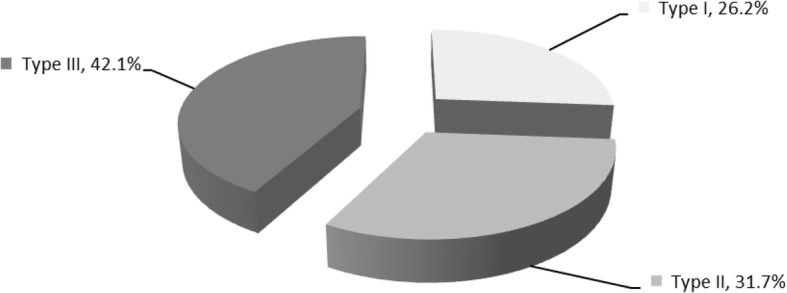
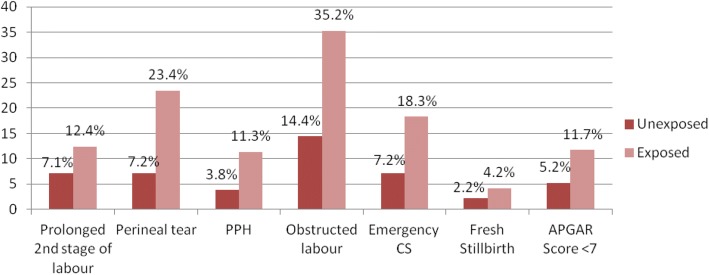
The existence of FGM was significantly associated with perinealtear [RR = 2.52 (95% CI 1.26-5.02)], postpartum blood loss [RR = 3.14 (95% CI 1.27-7.78)], outlet obstruction [RR = 1.83 (95% CI 1.19-2.79)] and emergency caesarean section [RR = 1.52 (95% CI 1.04-2.22)]. FGM type I and FGM type II did not demonstrate any association with prolonged 2nd stage of labour, emergency caesarean section, postpartum blood loss, and APGAR score < 7. FGM type III however was significantly associated with prolonged 2nd stage of labour [RR = 2.47 (95% CI 1.06-5.76)], emergency caesarean section [RR = 3.60 (95% CI 1.65-7.86)], postpartum blood loss [RR = 6.37 (95% CI 2.11-19.20] and APGAR score < 7 [RR = 4.41 (95% CI, 1.84-10.60)]. FGM type II and type III were significantly associated with perinealtear [RR = 2.45(95% CI 1.03-5.83)], [RR = 4.91(95% CI 2.46-9.77)] and outlet obstruction [RR = 2.38(95% CI 1.39-4.08)], [RR = 2.94(95% CI 1.84-4.71)] respectively.
Women with FGM are significantly more likely than those without FGM to have adverse obstetric outcomes. Risks seem to be greater with more extensive form of FGM. Adverse obstetric outcomes can therefore be added to the known harmful immediate and long-term effects of FGM.
在埃塞俄比亚,女性割礼仍然是一个严重的问题,影响了 2380 万妇女和女孩,其中索马里州的流行率最高。尽管女性割礼与一系列产科并发症有关,但人们对其在该地区分娩的影响知之甚少。因此,本研究的目的是检验女性割礼是增加分娩并发症风险的一个因素的假设。
2014 年 10 月至 12 月,在吉吉加镇进行了一项基于设施的队列研究,涉及 142 名接受女性割礼的产妇和 139 名未接受女性割礼的产妇。研究参与者通过连续抽样技术招募。使用结构化访谈者管理的问卷和观察检查表收集数据。使用 SPSS 版本 16 和 STATA 版本 11 进行数据分析。
女性割礼的存在与会阴撕裂[RR=2.52(95%置信区间 1.26-5.02)]、产后出血[RR=3.14(95%置信区间 1.27-7.78)]、出口梗阻[RR=1.83(95%置信区间 1.19-2.79)]和紧急剖宫产[RR=1.52(95%置信区间 1.04-2.22)]显著相关。I 型和 II 型女性割礼与第二产程延长、紧急剖宫产、产后出血和 Apgar 评分<7 无关。然而,III 型女性割礼与第二产程延长[RR=2.47(95%置信区间 1.06-5.76)]、紧急剖宫产[RR=3.60(95%置信区间 1.65-7.86)]、产后出血[RR=6.37(95%置信区间 2.11-19.20)]和 Apgar 评分<7[RR=4.41(95%置信区间,1.84-10.60)]显著相关。II 型和 III 型女性割礼与会阴撕裂[RR=2.45(95%置信区间 1.03-5.83)]、[RR=4.91(95%置信区间 2.46-9.77)]和出口梗阻[RR=2.38(95%置信区间 1.39-4.08)]、[RR=2.94(95%置信区间 1.84-4.71)]显著相关。
接受女性割礼的妇女与未接受女性割礼的妇女相比,发生不良产科结局的可能性显著更高。风险似乎随着女性割礼形式的更加广泛而增加。因此,不良产科结局可以作为女性割礼已知的有害即时和长期影响之外的另一个因素。