Li Lan, Zhong Hua, Li Jun, Li Cai-Rui, Pan Chen-Wei
Department of Ophthalmology, the First People's Hospital of Kunming City, Kunming, China.
Department of Ophthalmology, the First Affiliated Hospital of Kunming Medical University, Kunming, China.
BMC Ophthalmol. 2018 Jul 20;18(1):178. doi: 10.1186/s12886-018-0836-9.
To determine the one-year incidence and progression rates of myopia and its association with baseline ocular biometric parameters in school-based samples of children and adolescents in China.
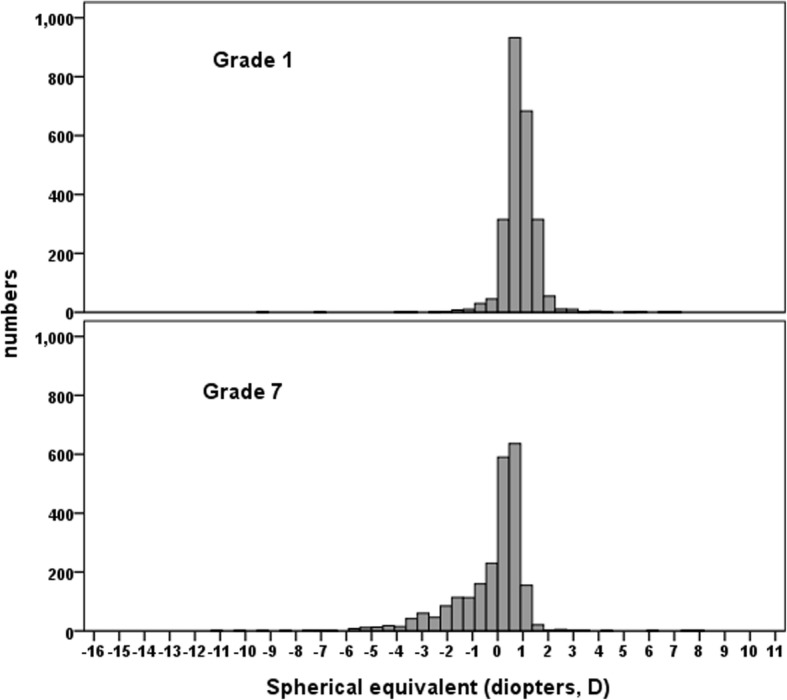
Two thousand four hundred thirty two grade 1 and 2346 grade 7 students living in the southwest part of China participated in the baseline survey. After 1 year, 2310 (95.0%) grade 1 and 2191 (93.4%) grade 7 students attended the follow-up examination. Refractive error was measured after cycloplegia using the same autorefractor and by the same optometrists in the baseline and follow-up examination. Myopia was defined as spherical equivalent of less than - 0.50 diopter.
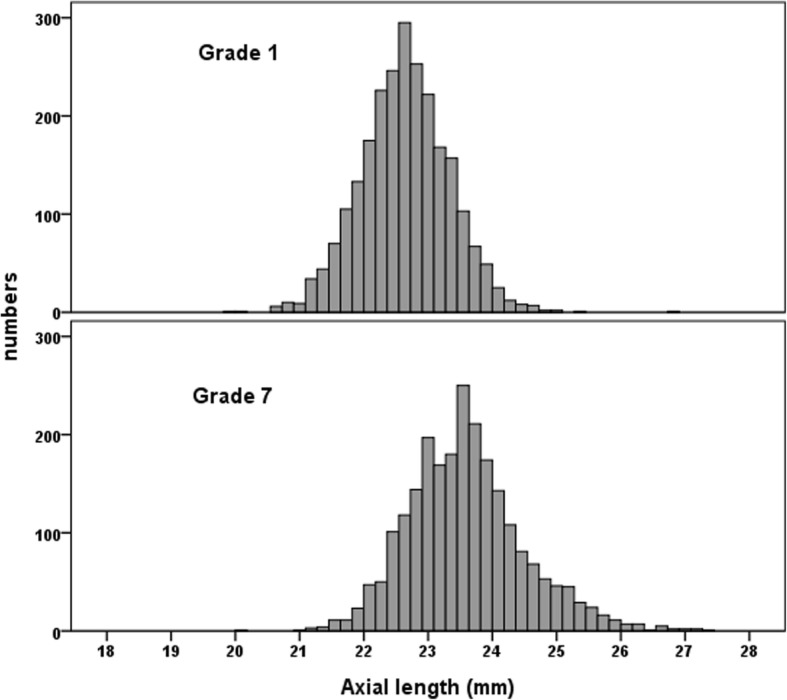
The overall one-year incidence of myopia was 33.6% (95% confidence interval [CI]: 31.7-35.5) among grade 1 students and 54.0% (95% CI: 51.5-56.5) for grade 7 students. The one-year myopia progression rate was - 0.97 D (95% CI: -1.22 to - 0.71) in grade 1 students and - 1.02 D (95% CI: -1.07 to - 0.96) in grade 7 students. Per mm increase in baseline axial lengths increased the risk of myopia onset by 28% among grade 1 students and 22% among grade 7 students after 1 year. The incidence rates of myopia were found to be higher in grade 7 students with thinner premyopic lenses.
The incidence and progression rates of myopia were very high in Chinese children and adolescents in recent years. Premyopic eyes were characterized with longer axial lengths and thinner lenses. These data had considerable implications for formulating myopia prevention strategies in China.
确定中国儿童和青少年在校样本中近视的一年发病率和进展率及其与基线眼生物测量参数的关联。
居住在中国西南部的2432名一年级学生和2346名七年级学生参加了基线调查。1年后,2310名(95.0%)一年级学生和2191名(93.4%)七年级学生参加了随访检查。在基线和随访检查中,使用相同的自动验光仪并由同一名验光师在睫状肌麻痹后测量屈光不正。近视定义为等效球镜小于-0.50屈光度。
一年级学生近视的总体一年发病率为33.6%(95%置信区间[CI]:31.7 - 35.5),七年级学生为54.0%(95%CI:51.5 - 56.5)。一年级学生的一年近视进展率为-0.97D(95%CI:-1.22至-0.71),七年级学生为-1.02D(95%CI:-1.07至-0.96)。基线眼轴长度每增加1mm,一年级学生1年后近视发病风险增加28%,七年级学生增加22%。近视前期晶状体较薄的七年级学生近视发病率更高。
近年来中国儿童和青少年的近视发病率和进展率非常高。近视前期眼睛的特征是眼轴长度较长和晶状体较薄。这些数据对中国制定近视预防策略具有重要意义。