Department of Health Sciences, Division of Nursing, Luleå University of Technology, The OLIN Studies, Robertsviksgatan 9, Luleå, S-971 89, Sweden.
Department of Public Health and Clinical Medicine, The OLIN Unit/Division of Medicine, Umeå University, Umeå, Sweden.
Ther Adv Respir Dis. 2018 Jan-Dec;12:1753466618787380. doi: 10.1177/1753466618787380.
Fatigue is one of the most common symptoms among subjects with chronic obstructive pulmonary disease (COPD), but is rarely identified in clinical practice. The aim of this study was to evaluate the association between fatigue and health-related quality of life (HRQoL) assessed with clinically useful instruments, both among subjects with and without COPD. Further, to investigate the association between fatigue and the COPD Assessment Test (CAT)-energy question.
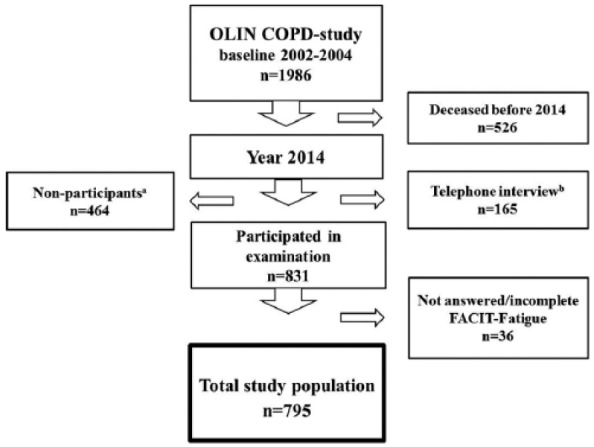
Data were collected in 2014 within the population-based OLIN COPD study. Subjects with ( n = 367) and without ( n = 428) COPD participated in clinical examinations including spirometry and completed questionnaires about fatigue (FACIT-Fatigue, clinically relevant fatigue ⩽43), and HRQoL (EQ-5D-VAS, lower score = worse health; CAT, lower score = fewer symptoms/better health).
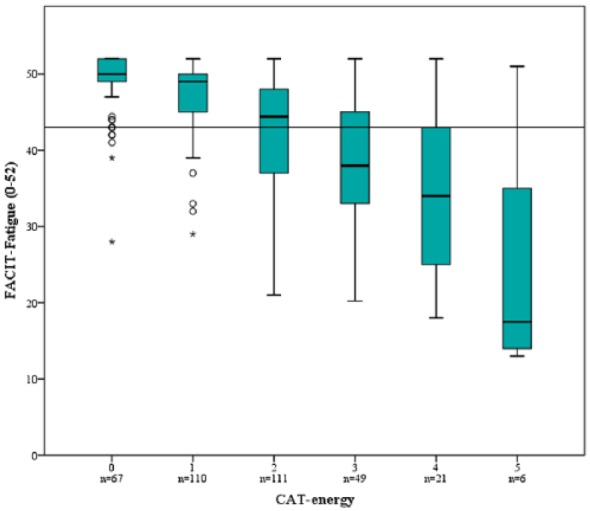
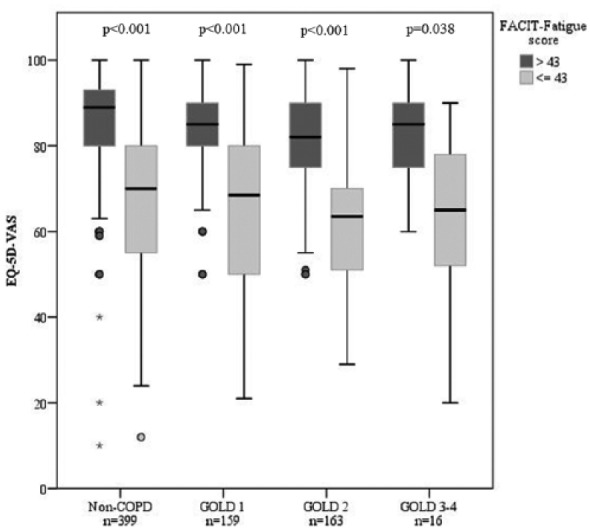
Subjects with clinically relevant fatigue had worse HRQoL measured with EQ-5D-VAS, regardless of having COPD or not. Decreasing EQ-5D-VAS scores, any respiratory symptoms and anxiety/depression were associated with clinically relevant fatigue also when adjusted for confounders. Among subjects with COPD, clinically relevant fatigue was associated with increasing total CAT score, and CAT score ⩾10. The proportion of subjects with clinically relevant fatigue increased significantly, with a higher score on the CAT-energy question, and nearly 50% of those with a score of 2, and 70% of those with a score of ⩾3, had clinically relevant fatigue.
Fatigue was associated with respiratory symptoms, anxiety/depression and worse HRQoL when using the clinically useful instruments EQ-5D-VAS and CAT. The CAT-energy question can be used to screen for fatigue in clinical practice, using a cut-off of ⩾2.
疲劳是慢性阻塞性肺疾病(COPD)患者最常见的症状之一,但在临床实践中很少被发现。本研究旨在评估在有和没有 COPD 的患者中,使用临床有用的工具评估疲劳与健康相关生活质量(HRQoL)之间的关系。此外,还研究了疲劳与 COPD 评估测试(CAT)-能量问题之间的关系。
数据于 2014 年在基于人群的 OLIN COPD 研究中收集。有(n=367)和没有(n=428)COPD 的患者参加了临床检查,包括肺量测定,并完成了关于疲劳(FACIT-Fatigue,临床相关疲劳 ⩽43)和 HRQoL(EQ-5D-VAS,得分越低表示健康状况越差;CAT,得分越低表示症状越少/健康状况越好)的问卷。
无论是否患有 COPD,有临床相关疲劳的患者的 HRQoL 评分均较差(EQ-5D-VAS)。当调整混杂因素后,EQ-5D-VAS 评分降低、任何呼吸系统症状和焦虑/抑郁与临床相关疲劳有关。在 COPD 患者中,临床相关疲劳与总 CAT 评分增加和 CAT 评分 ⩾10 有关。随着 CAT 能量问题得分的升高,具有临床相关疲劳的患者比例显著增加,得分 ⩾2 的患者中约有 50%具有临床相关疲劳,得分 ⩾3 的患者中则有 70%具有临床相关疲劳。
使用临床有用的 EQ-5D-VAS 和 CAT 工具时,疲劳与呼吸系统症状、焦虑/抑郁和较差的 HRQoL 有关。CAT 能量问题可用于临床实践中的疲劳筛查,采用 ⩾2 的截断值。