Center for Genomic Medicine, Massachusetts General Hospital, Boston, MA, USA.
Department of Psychiatry, Harvard Medical School, Boston, MA, USA.
Transl Psychiatry. 2018 Jul 25;8(1):135. doi: 10.1038/s41398-018-0182-y.
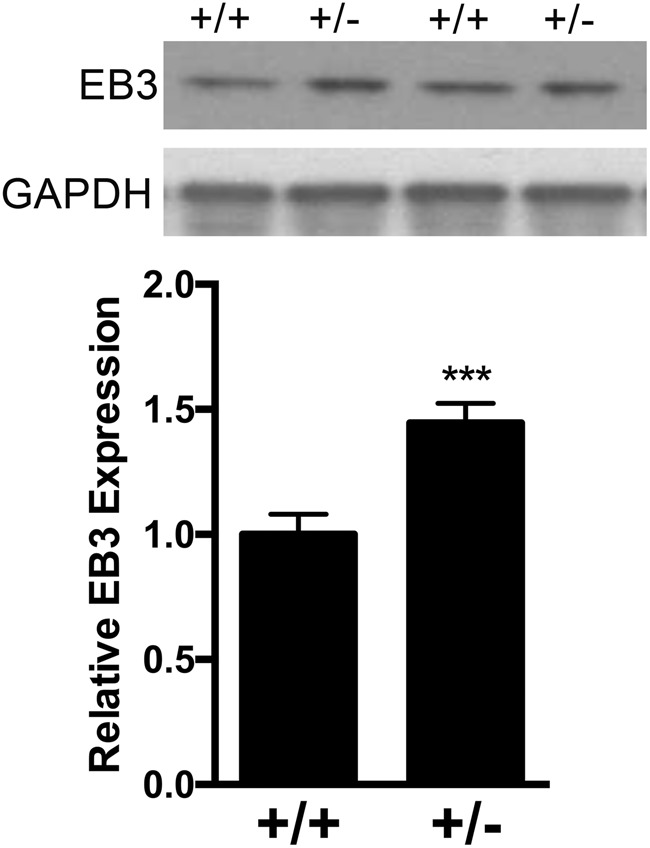
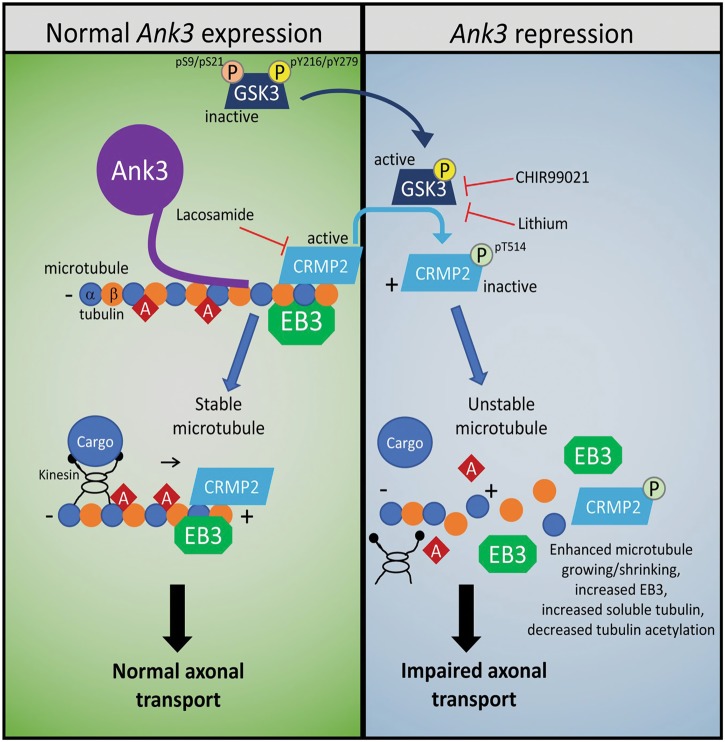
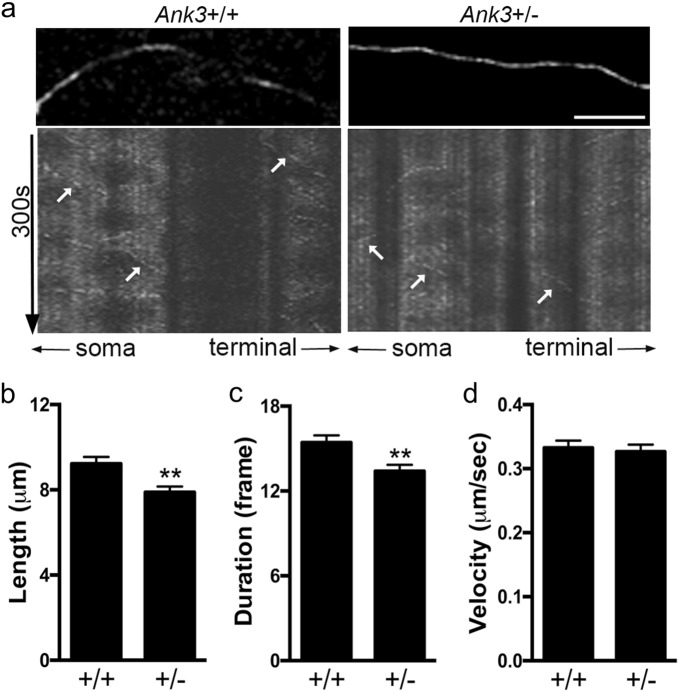
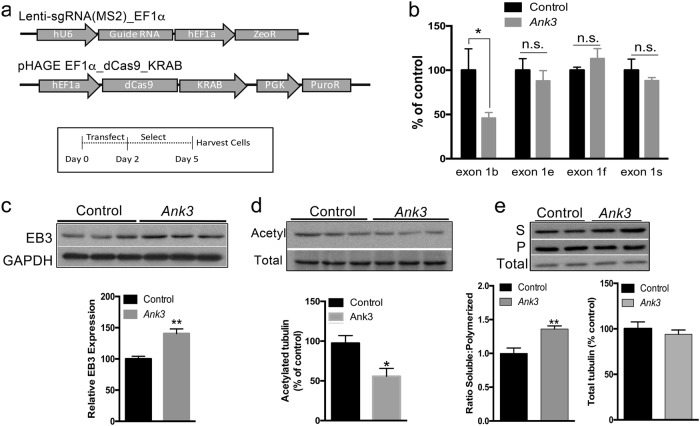
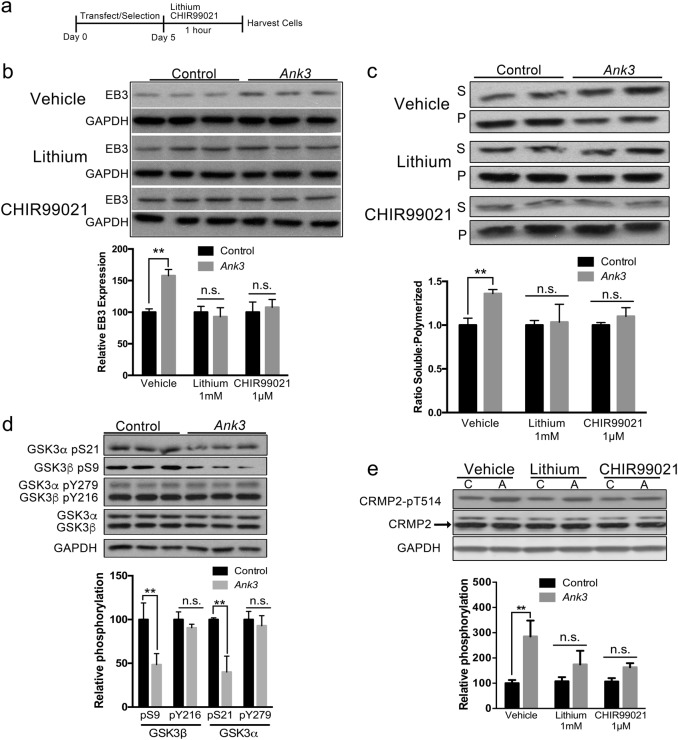
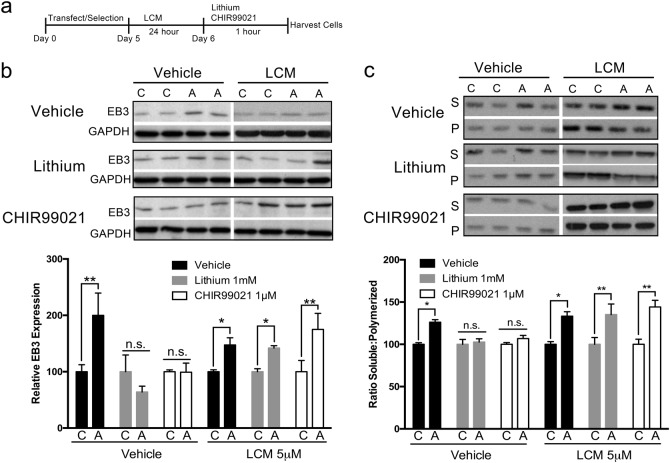
The ankyrin 3 gene (ANK3) is a well-established risk gene for psychiatric illness, but the mechanisms underlying its pathophysiology remain elusive. We examined the molecular effects of disrupting brain-specific Ank3 isoforms in mouse and neuronal model systems. RNA sequencing of hippocampus from Ank3+/- and Ank3+/+ mice identified altered expression of 282 genes that were enriched for microtubule-related functions. Results were supported by increased expression of microtubule end-binding protein 3 (EB3), an indicator of microtubule dynamics, in Ank3+/- mouse hippocampus. Live-cell imaging of EB3 movement in primary neurons from Ank3+/- mice revealed impaired elongation of microtubules. Using a CRISPR-dCas9-KRAB transcriptional repressor in mouse neuro-2a cells, we determined that repression of brain-specific Ank3 increased EB3 expression, decreased tubulin acetylation, and increased the soluble:polymerized tubulin ratio, indicating enhanced microtubule dynamics. These changes were rescued by inhibition of glycogen synthase kinase 3 (GSK3) with lithium or CHIR99021, a highly selective GSK3 inhibitor. Brain-specific Ank3 repression in neuro-2a cells increased GSK3 activity (reduced inhibitory phosphorylation) and elevated collapsin response mediator protein 2 (CRMP2) phosphorylation, a known GSK3 substrate and microtubule-binding protein. Pharmacological inhibition of CRMP2 activity attenuated the rescue of EB3 expression and tubulin polymerization in Ank3-repressed cells by lithium or CHIR99021, suggesting microtubule instability induced by Ank3 repression is dependent on CRMP2 activity. Taken together, our data indicate that ANK3 functions in neuronal microtubule dynamics through GSK3 and its downstream substrate CRMP2. These findings reveal cellular and molecular mechanisms underlying brain-specific ANK3 disruption that may be related to its role in psychiatric illness.
ankyrin 3 基因(ANK3)是精神疾病的一个既定风险基因,但它的病理生理学机制仍不清楚。我们在小鼠和神经元模型系统中研究了破坏大脑特异性 Ank3 异构体的分子效应。ANK3+/-和 Ank3+/+小鼠海马体的 RNA 测序确定了 282 个基因的表达发生改变,这些基因富集于微管相关功能。ANK3+/-小鼠海马体中微管末端结合蛋白 3(EB3)的表达增加,支持了这一结果,EB3 是微管动力学的一个指标。ANK3+/-小鼠原代神经元中 EB3 运动的活细胞成像显示微管伸长受损。在小鼠神经-2a 细胞中使用 CRISPR-dCas9-KRAB 转录抑制剂,我们确定大脑特异性 Ank3 的抑制增加了 EB3 的表达,降低了微管蛋白乙酰化,增加了可溶性:聚合微管的比例,表明增强了微管动力学。这些变化可通过用锂或高度选择性的 GSK3 抑制剂 CHIR99021 抑制糖原合成酶激酶 3(GSK3)得到挽救。神经-2a 细胞中大脑特异性 Ank3 的抑制增加了 GSK3 的活性(减少了抑制性磷酸化),并升高了 collapsin 反应介质蛋白 2(CRMP2)的磷酸化,这是一种已知的 GSK3 底物和微管结合蛋白。CRMP2 活性的药理学抑制减弱了锂或 CHIR99021 对 Ank3 抑制细胞中 EB3 表达和微管聚合的挽救作用,表明 Ank3 抑制诱导的微管不稳定性依赖于 CRMP2 活性。综上所述,我们的数据表明,ANK3 通过 GSK3 及其下游底物 CRMP2 发挥神经元微管动力学的作用。这些发现揭示了大脑特异性 ANK3 破坏的细胞和分子机制,这可能与其在精神疾病中的作用有关。