Guérin-Dugué Anne, Roy Raphaëlle N, Kristensen Emmanuelle, Rivet Bertrand, Vercueil Laurent, Tcherkassof Anna
GIPSA-lab, Institute of Engineering, Université Grenoble Alpes, Centre National de la Recherche Scientifique, Grenoble INP, Grenoble, France.
Department of Conception and Control of Aeronautical and Spatial Vehicles, Institut Supérieur de l'Aéronautique et de l'Espace, Université Fédérale de Toulouse, Toulouse, France.
Front Psychol. 2018 Jul 12;9:1190. doi: 10.3389/fpsyg.2018.01190. eCollection 2018.
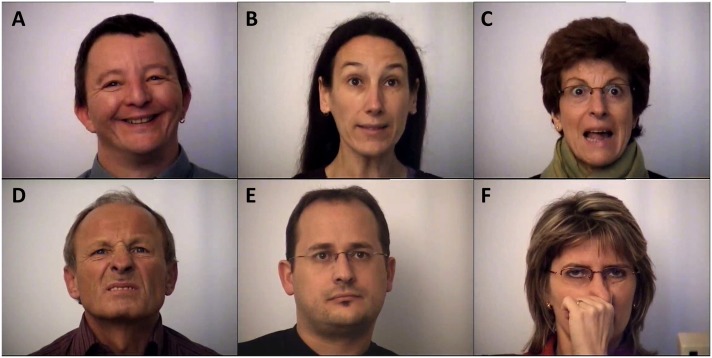
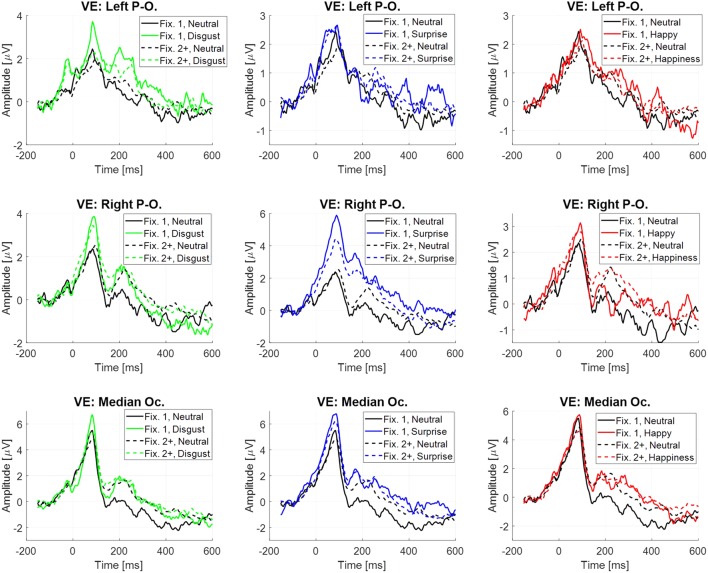
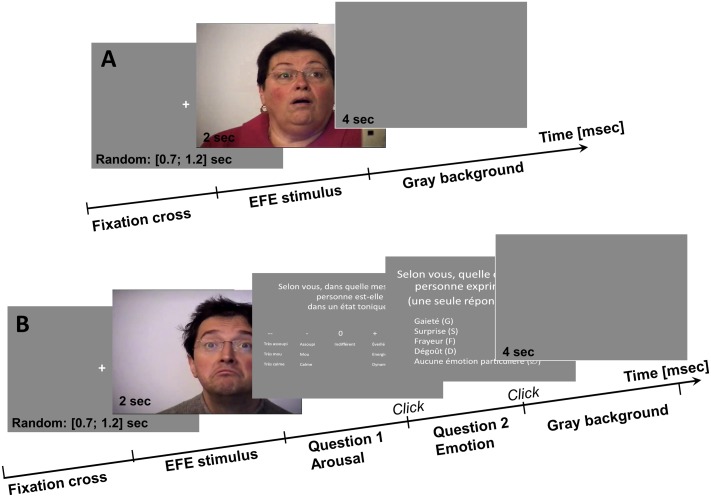
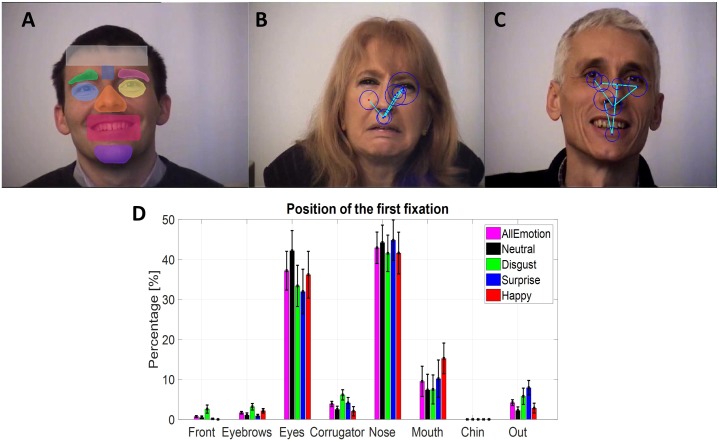
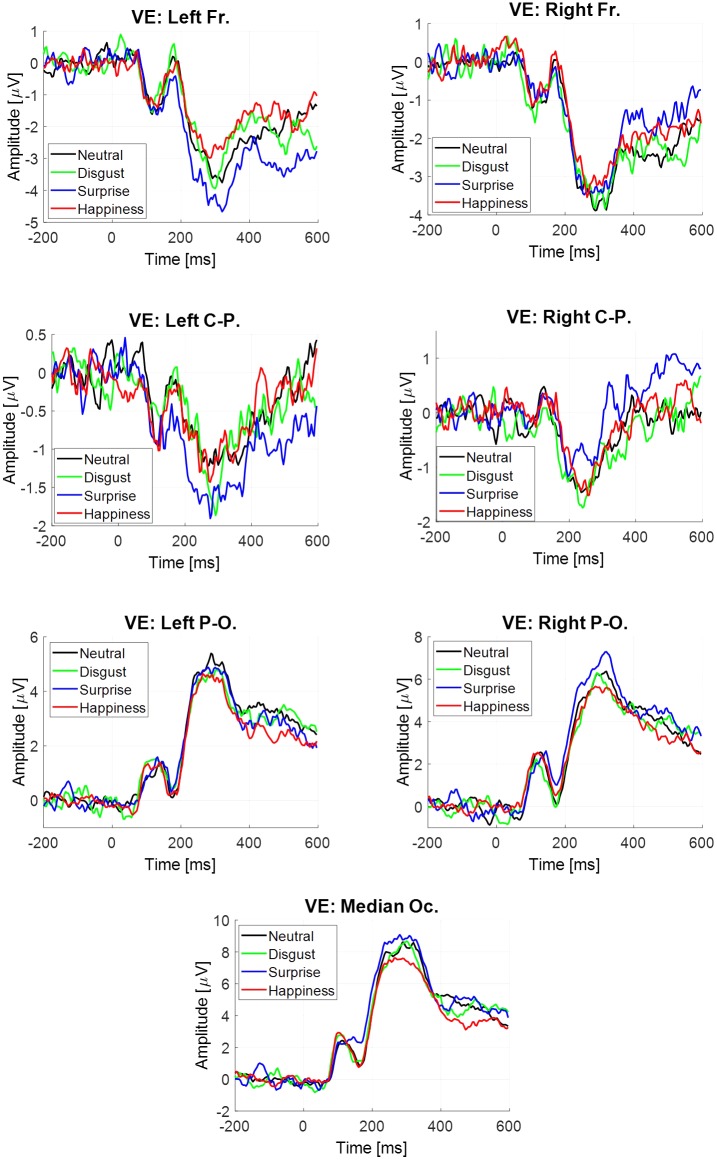
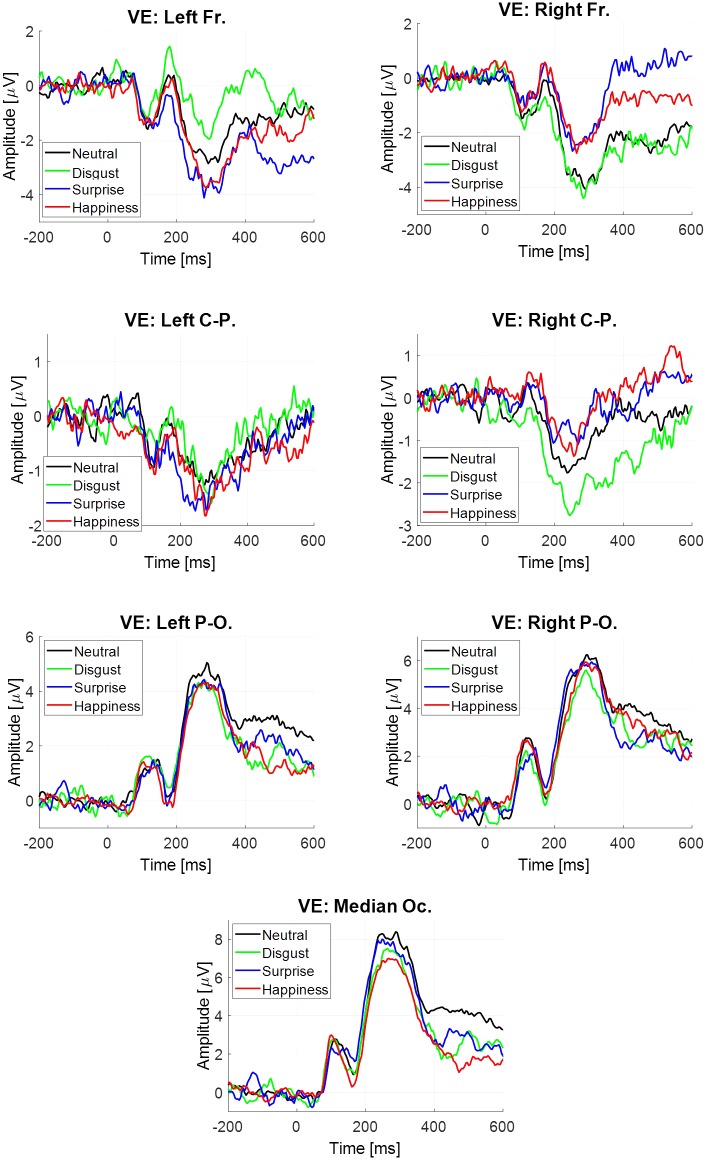
This study aims at examining the precise temporal dynamics of the emotional facial decoding as it unfolds in the brain, according to the emotions displayed. To characterize this processing as it occurs in ecological settings, we focused on unconstrained visual explorations of natural emotional faces (i.e., free eye movements). The General Linear Model (GLM; Smith and Kutas, 2015a,b; Kristensen et al., 2017a) enables such a depiction. It allows deconvolving adjacent overlapping responses of the eye fixation-related potentials (EFRPs) elicited by the subsequent fixations and the event-related potentials (ERPs) elicited at the stimuli onset. Nineteen participants were displayed with spontaneous static facial expressions of emotions (Neutral, Disgust, Surprise, and Happiness) from the DynEmo database (Tcherkassof et al., 2013). Behavioral results on participants' eye movements show that the usual diagnostic features in emotional decoding (eyes for negative facial displays and mouth for positive ones) are consistent with the literature. The impact of emotional category on both the ERPs and the EFRPs elicited by the free exploration of the emotional faces is observed upon the temporal dynamics of the emotional facial expression processing. Regarding the ERP at stimulus onset, there is a significant emotion-dependent modulation of the P2-P3 complex and LPP components' amplitude at the left frontal site for the ERPs computed by averaging. Yet, the GLM reveals the impact of subsequent fixations on the ERPs time-locked on stimulus onset. Results are also in line with the valence hypothesis. The observed differences between the two estimation methods (Average vs. GLM) suggest the predominance of the right hemisphere at the stimulus onset and the implication of the left hemisphere in the processing of the information encoded by subsequent fixations. Concerning the first EFRP, the Lambda response and the P2 component are modulated by the emotion of surprise compared to the neutral emotion, suggesting an impact of high-level factors, in parieto-occipital sites. Moreover, no difference is observed on the second and subsequent EFRP. Taken together, the results stress the significant gain obtained in analyzing the EFRPs using the GLM method and pave the way toward efficient ecological emotional dynamic stimuli analyses.
本研究旨在根据所展示的情绪,考察大脑中情绪面部解码展开时精确的时间动态。为了刻画这种在自然情境中发生的处理过程,我们聚焦于对自然情绪面孔的无约束视觉探索(即自由眼动)。通用线性模型(GLM;Smith和Kutas,2015a、b;Kristensen等人,2017a)能够实现这样的描绘。它允许对后续注视引发的与眼注视相关电位(EFRP)和刺激开始时引发的事件相关电位(ERP)的相邻重叠反应进行去卷积。向19名参与者展示了来自DynEmo数据库(Tcherkassof等人,2013)的自发静态情绪面部表情(中性、厌恶、惊讶和快乐)。参与者眼动的行为结果表明,情绪解码中常见的诊断特征(负面面部表情看眼睛,正面面部表情看嘴巴)与文献一致。在情绪面部表情处理的时间动态上,观察到情绪类别对自由探索情绪面孔所引发的ERP和EFRP都有影响。关于刺激开始时的ERP,通过平均计算得到的ERP在左额叶部位,P2 - P3复合波和LPP成分的幅度存在显著的情绪依赖性调制。然而,GLM揭示了后续注视对与刺激开始时间锁定的ERP的影响。结果也符合效价假说。两种估计方法(平均法与GLM)之间观察到的差异表明,在刺激开始时右半球占主导,而左半球参与后续注视所编码信息的处理。关于第一个EFRP,与中性情绪相比,惊讶情绪对顶枕部位的Lambda反应和P2成分有调制作用,表明高级因素的影响。此外,在第二个及后续EFRP上未观察到差异。综上所述,结果强调了使用GLM方法分析EFRP所获得的显著收获,并为高效的生态情绪动态刺激分析铺平了道路。