Reichert Sebastian, Ebner Patrick, Bonetti Eve-Julie, Luqman Arif, Nega Mulugeta, Schrenzel Jacques, Spröer Cathrin, Bunk Boyke, Overmann Jörg, Sass Peter, François Patrice, Götz Friedrich
Microbial Genetics, Interfaculty Institute of Microbiology and Infection Medicine, University of Tübingen, Tübingen, Germany.
Genomic Research Laboratory, Division of Infectious Diseases, Geneva University Hospital, Geneva, Switzerland.
Front Microbiol. 2018 Jul 12;9:1539. doi: 10.3389/fmicb.2018.01539. eCollection 2018.
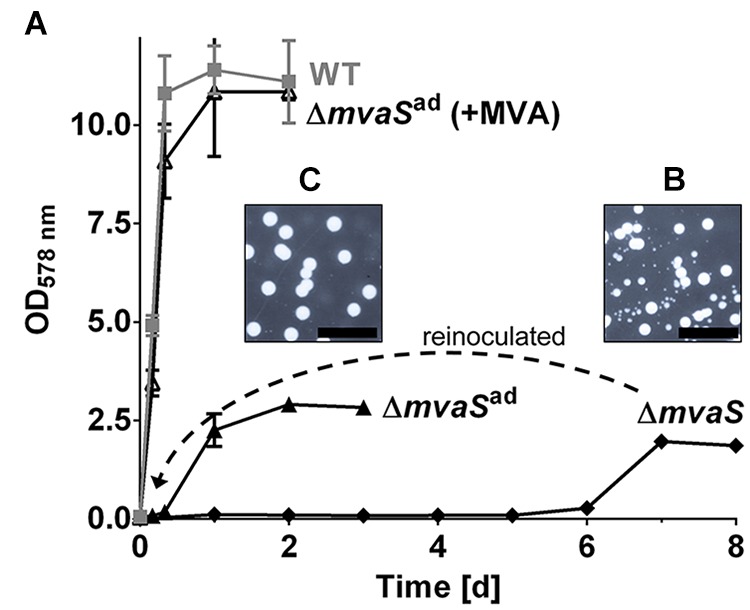
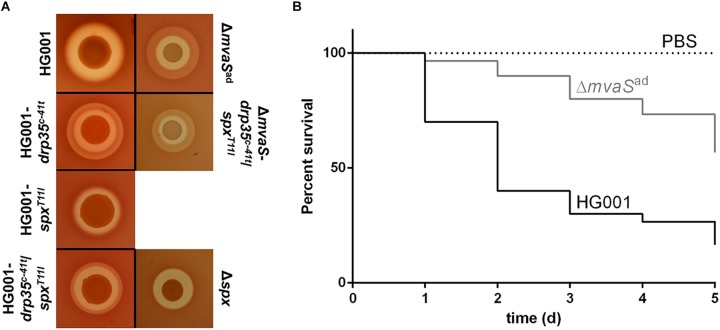
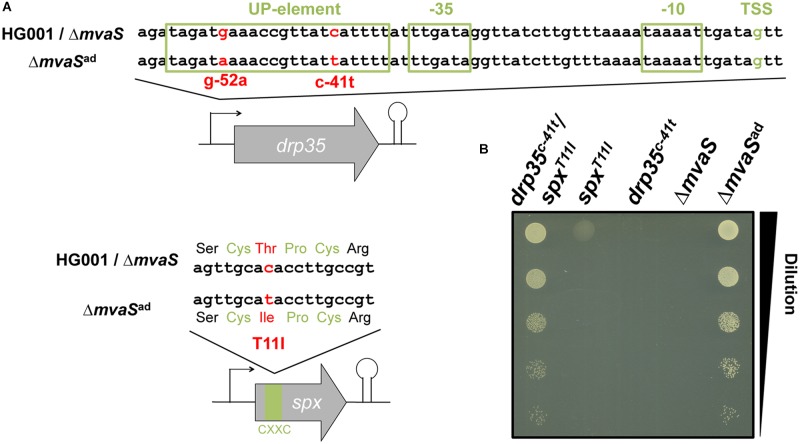
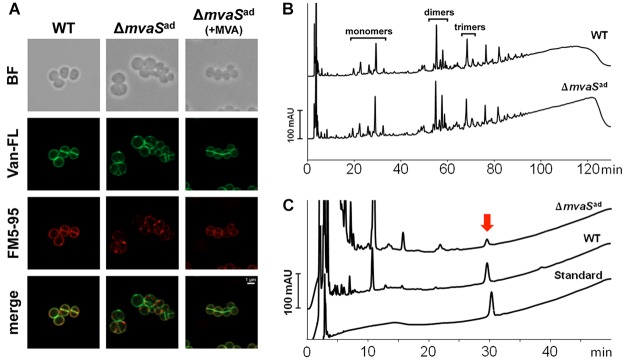
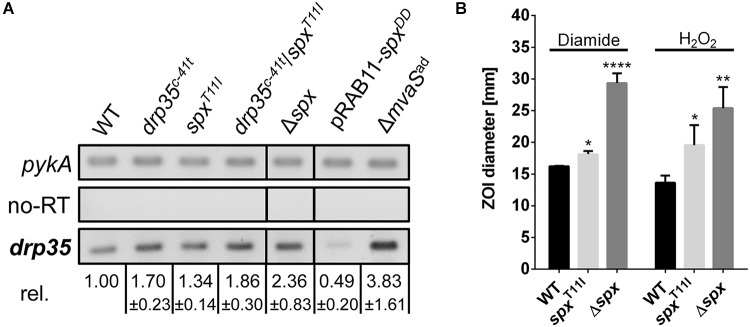
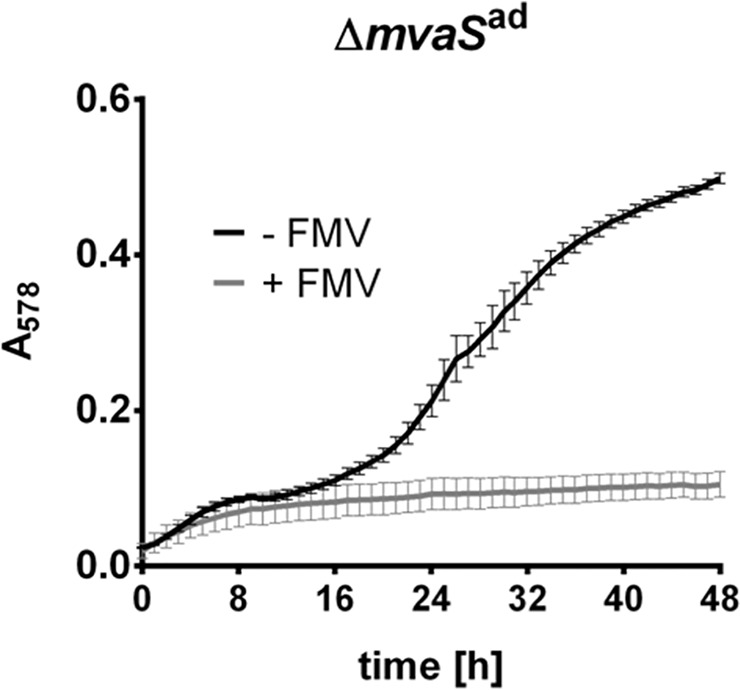
In this study we addressed the question how a mevalonate (MVA)-auxotrophic Δ mutant can revert to prototrophy. This mutant couldn't grow in the absence of MVA. However, after a long lag-phase of 4-6 days the mutant adapted from auxotrophic to prototrophic phenotype. During that time, it acquired two point mutations: One mutation in the coding region of the regulator gene , which resulted in an amino acid exchange that decreased Spx function. The other mutation in the upstream-element within the core-promoter of the mevalonolactone lactonase gene . This mutation led to an increased expression of . In repeated experiments the mutations always occurred in and and in the same order. The first detectable mutation appeared in and allowed slight growth; the second mutation, in , increased growth further. Phenotypical characterizations of the mutant showed that small amounts of the lipid-carrier undecaprenol are synthesized, despite the lack of . The growth of the adapted clone, Δ, indicates that the mutations reawake a rescue bypass. We think that this bypass enters the MVA pathway at the stage of MVA, because blocking the pathway downstream of MVA led to growth arrest of the mutant. In addition, the lactonase Drp35 is able to convert mevalonolactone to MVA. Summarized, we describe here a mutation-based two-step adaptation process that allows resuscitation of growth of the Δ mutant.
在本研究中,我们探讨了甲羟戊酸(MVA)营养缺陷型Δ突变体如何恢复为原养型的问题。该突变体在没有MVA的情况下无法生长。然而,经过4 - 6天的长时间延迟期后,该突变体从营养缺陷型适应为原养型表型。在此期间,它获得了两个点突变:一个在调节基因的编码区域,导致氨基酸交换,降低了Spx功能。另一个突变发生在甲羟戊酸内酯酶基因核心启动子内的上游元件。这个突变导致了 的表达增加。在重复实验中,突变总是以相同的顺序出现在 和 中。第一个可检测到的突变出现在 中,允许轻微生长;第二个突变出现在 中,进一步促进了生长。突变体的表型特征表明,尽管缺乏 ,但仍合成了少量的脂质载体十一异戊烯醇。适应后的克隆Δ的生长表明,这些突变重新激活了一条挽救旁路。我们认为这条旁路在MVA阶段进入MVA途径,因为阻断MVA下游的途径会导致突变体生长停滞。此外,内酯酶Drp35能够将甲羟戊酸内酯转化为MVA。总之,我们在此描述了一个基于突变的两步适应过程,该过程能够使Δ突变体恢复生长。