Zhao Chenglong, Zhang Zhichao, Zhong Nanzhe, Fan Tianqi, Gao Xin, Wu Zhipeng, Li Zhenxi, Liu Tielong, Xiao Jianru
Orthopaedic Oncology Center, Department of Orthopaedics, Changzheng Hospital, Second Military Medical University, Fengyang Rd 415#, Huangpu District, Shanghai, China.
J Bone Oncol. 2018 Apr 13;12:38-43. doi: 10.1016/j.jbo.2018.03.003. eCollection 2018 Sep.
The aim of this study is to provide some useful insights into the treatments, outcomes, and prognostic factors of patients with breast cancer spine metastases (BCSM).
We report a retrospective case series analyzing 87 patients with BCSM who underwent surgical interventions. Independent prognostic factors for SMFS and OS were extracted using univariate and multivariate analyses, the Kaplan-Meier method and the Cox proportional hazards model.
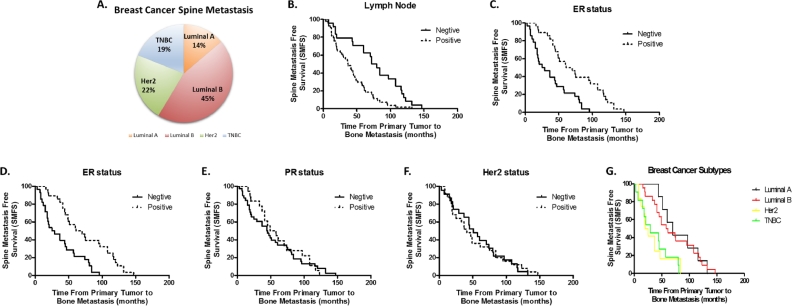
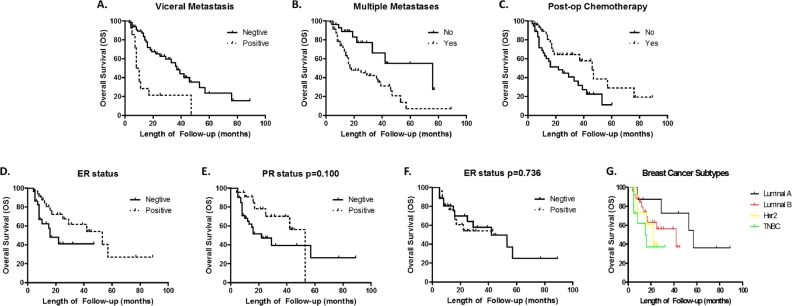
The mean time between primary diagnoses and spinal metastases was 46.8 (median 41, range 0-147 months) months. The analysis showed that lymph node metastasis ( = 0.043, HR 10.498, 95%CI 1.074-102.588) and estrogen receptor (ER) status ( = 0.004, HR 0.368, 95%CI 0.189-0.721) can significantly affect SMFS. Furthermore, visceral metastasis ( = 0.042, HR 2.383, 95%CI 1.032-5.501), multiple metastases ( = 0.035, HR 2.538, 95%CI 1.066-6.048) and post-op chemotherapy ( = 0.003, HR 0.312, 95%CI 0.144-0.675) have significant effects on OS. Lastly, patients identified as Luminal A subtype have longer OS.
Lymph node metastases and ER status are independent risk factors in predicting BCSM. Moreover, visceral metastasis, multiple metastases of the spine and post-op chemotherapy are independent prognostic factors. Luminal subtypes have higher rate, but late onset of spine metastases and prolonged survival.
本研究旨在为乳腺癌脊柱转移(BCSM)患者的治疗、结局及预后因素提供一些有用的见解。
我们报告了一项回顾性病例系列研究,分析了87例行手术干预的BCSM患者。使用单因素和多因素分析、Kaplan-Meier法和Cox比例风险模型提取无脊髓转移生存期(SMFS)和总生存期(OS)的独立预后因素。
初次诊断与脊柱转移之间的平均时间为46.8个月(中位数41个月,范围0 - 147个月)。分析表明,淋巴结转移(P = 0.043,HR = 10.498,95%CI 1.074 - 102.588)和雌激素受体(ER)状态(P = 0.004,HR = 0.368,95%CI 0.189 - 0.721)可显著影响SMFS。此外,内脏转移(P = 0.042,HR = 2.383,95%CI 1.032 - 5.501)、多发转移(P = 0.035,HR = 2.538,95%CI 1.066 - 6.048)和术后化疗(P = 0.003,HR = 0.312,95%CI 0.144 - 0.675)对OS有显著影响。最后,被确定为Luminal A亚型的患者OS更长。
淋巴结转移和ER状态是预测BCSM的独立危险因素。此外,内脏转移、脊柱多发转移和术后化疗是独立的预后因素。Luminal亚型发生率较高,但脊柱转移发病较晚且生存期延长。