Lung Cancer Center, Konkuk University Medical Center, 120-1 Hwayang-dong, Gwangjin-Gu, Seoul, 05030, Republic of Korea.
Department of Pulmonary Medicine, Konkuk University School of Medicine, 120-1 Hwayang-dong, Gwangjin-Gu, Seoul, 05030, Republic of Korea.
BMC Cancer. 2018 Jul 28;18(1):768. doi: 10.1186/s12885-018-4691-0.
Although lung adenocarcinoma with activating epidermal growth factor receptor (EGFR) mutations is common in never smokers, one-third of the patients are ever-smokers. We aimed to investigate the effect of cumulative smoking dose(CSD) on clinical outcomes, including progression-free survival (PFS) and overall survival (OS), in patients with EGFR-mutated lung adenocarcinoma receiving EGFR-tyrosine kinase inhibitors (TKIs).
We retrospectively analyzed 142 patients with EGFR-mutation positive advanced or recurrent lung adenocarcinoma who were administered gefitinib, erlotinib, afatinib, and osimertinib. These patients were classified based on their CSD as never smokers, light smokers (≤10 pack-years [PYs]), moderate smokers (11-30 PYs), and heavy smokers (> 30 PYs). PFS and OS were analyzed according to smoking subgroups via Kaplan-Meier curves.
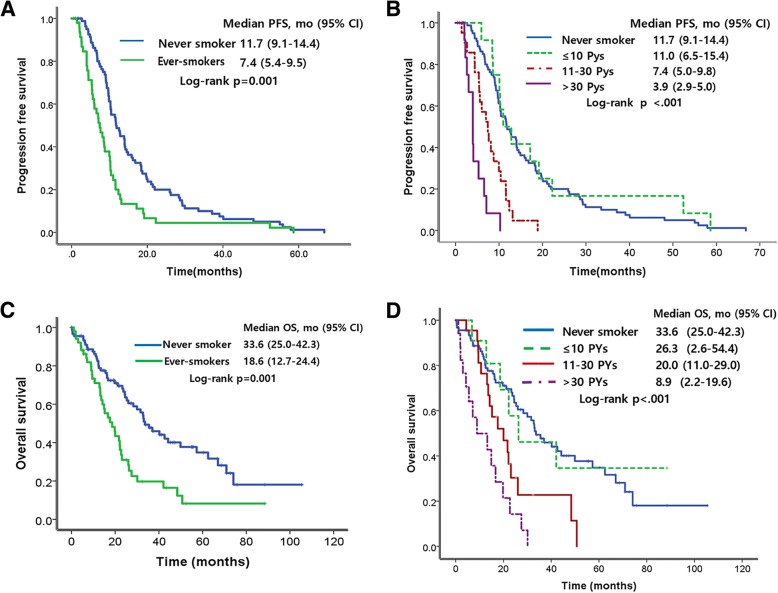
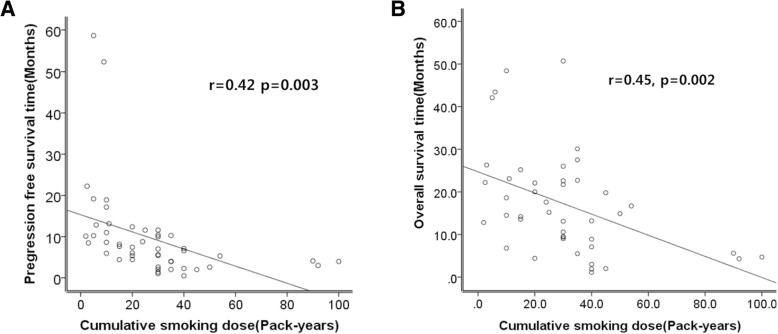
Among the 142 patients, 91 (64.1%), 12 (8.5%), 22 (15.5%), and 17 (12%) were never, light, moderate, and heavy smokers, respectively. CSD was inversely associated with median PFS in a statistically significant dose-dependent manner (11.8 months (mo), 11.0 mo, 7.4 mo, and 3.9 mo; p < 0.001). Statistically significant negative association was observed between CSD and median OS (33.6 mo, 26.3 mo, 20 mo, and 8.9 mo; p < 0.001). In the multivariate analysis adjusted for age, sex, performance status, stage, and timing of EGFR-TKIs, CSD was an independent predictive factor for disease progression (hazard ratio [HR], 4.00; 95% confidence interval [CI], 1.95-8.23; p = 0.012) and OS (HR, 3.9; 95% CI, 1.84-8.28; p < 0.001).
CSD is an important predictive and prognostic factor in patients with EGFR-mutated lung adenocarcinoma, and associated smoking-related gene signatures might affect the outcomes.
虽然从不吸烟的患者中常见具有激活表皮生长因子受体(EGFR)突变的肺腺癌,但其中有三分之一为吸烟患者。我们旨在研究累积吸烟剂量(CSD)对接受 EGFR 酪氨酸激酶抑制剂(TKI)治疗的 EGFR 突变型肺腺癌患者的无进展生存期(PFS)和总生存期(OS)等临床结局的影响。
我们回顾性分析了 142 例接受吉非替尼、厄洛替尼、阿法替尼和奥希替尼治疗的 EGFR 突变阳性晚期或复发性肺腺癌患者。根据 CSD,将这些患者分为从不吸烟、轻度吸烟(≤10 包年[PYs])、中度吸烟(11-30 PYs)和重度吸烟(>30 PYs)。通过 Kaplan-Meier 曲线根据吸烟亚组分析 PFS 和 OS。
在 142 例患者中,从不吸烟、轻度吸烟、中度吸烟和重度吸烟者分别为 91 例(64.1%)、12 例(8.5%)、22 例(15.5%)和 17 例(12%)。CSD 与中位 PFS 呈显著的负相关,且呈统计学意义的剂量依赖性(11.8 个月(mo)、11.0 mo、7.4 mo 和 3.9 mo;p<0.001)。CSD 与中位 OS 也存在显著负相关(33.6 mo、26.3 mo、20 mo 和 8.9 mo;p<0.001)。在调整年龄、性别、体能状态、分期和 EGFR-TKIs 时机后进行多变量分析,CSD 是疾病进展的独立预测因素(风险比[HR],4.00;95%置信区间[CI],1.95-8.23;p=0.012)和 OS(HR,3.9;95% CI,1.84-8.28;p<0.001)。
CSD 是 EGFR 突变型肺腺癌患者的重要预测和预后因素,与吸烟相关的基因特征可能会影响结局。