Department of Biology, Masaryk University, Brno, Czech Republic.
Department of Fundamental Neuroscience, University of Geneva, Geneva, Switzerland.
PLoS One. 2018 Jul 30;13(7):e0200773. doi: 10.1371/journal.pone.0200773. eCollection 2018.
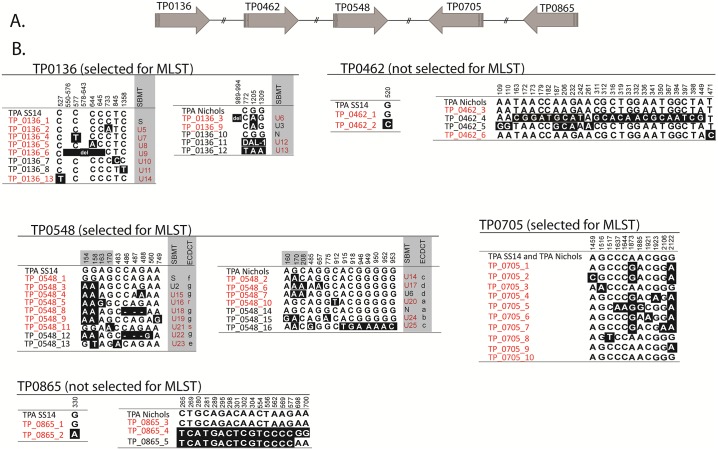
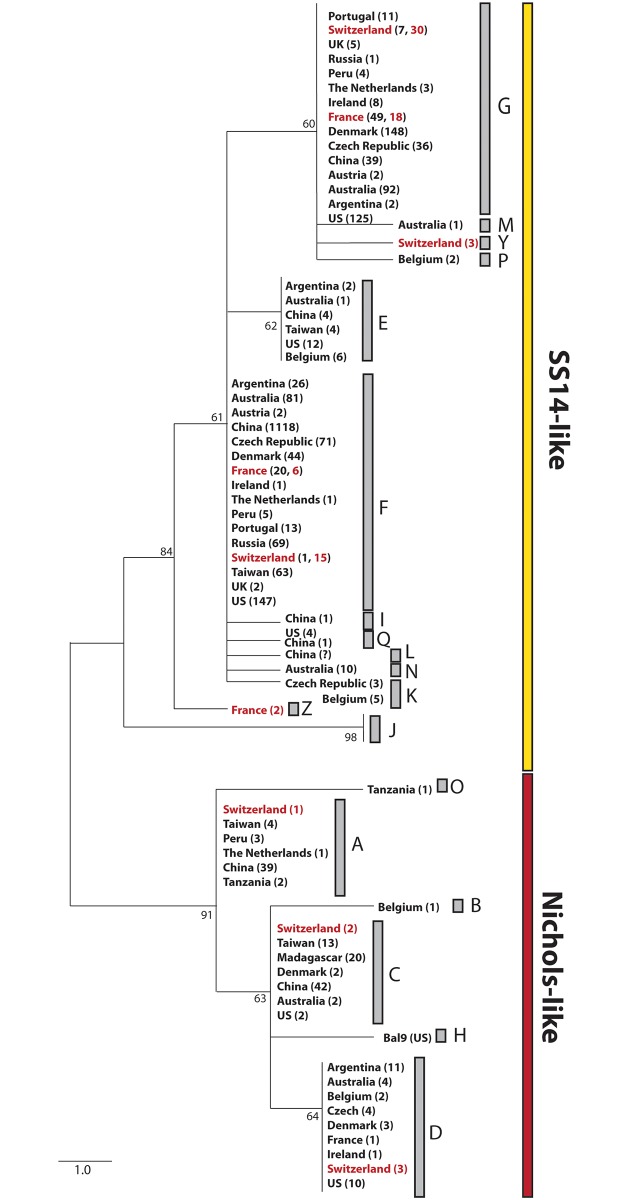
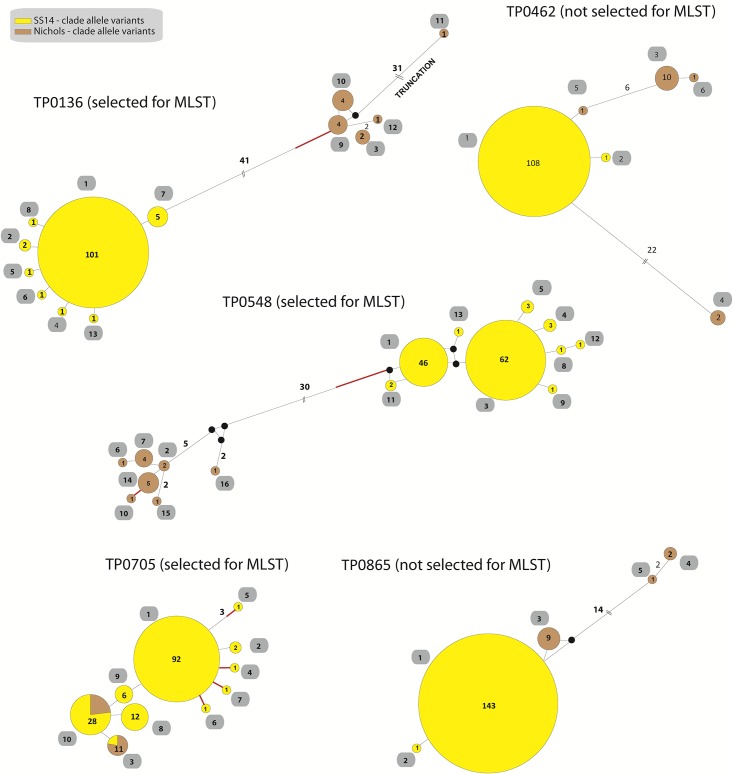
Syphilis is an important public health problem and an increasing incidence has been noted in recent years. Characterization of strain diversity through molecular data plays a critical role in the epidemiological understanding of this re-emergence. We here propose a new high-resolution multilocus sequence typing (MLST) scheme for Treponema pallidum subsp. pallidum (TPA). We analyzed 30 complete and draft TPA genomes obtained directly from clinical samples or from rabbit propagated strains to identify suitable typing loci and tested the new scheme on 120 clinical samples collected in Switzerland and France. Our analyses yielded three loci with high discriminatory power: TP0136, TP0548, and TP0705. Together with analysis of the 23S rRNA gene mutations for macrolide resistance, we propose these loci as MLST for TPA. Among clinical samples, 23 allelic profiles as well as a high percentage (80% samples) of macrolide resistance were revealed. The new MLST has higher discriminatory power compared to previous typing schemes, enabling distinction of TPA from other treponemal bacteria, distinction between the two main TPA clades (Nichols and SS14), and differentiation of strains within these clades.
梅毒是一个重要的公共卫生问题,近年来其发病率呈上升趋势。通过分子数据对菌株多样性进行特征描述,对于理解这种再现的流行病学具有关键作用。我们在此提出一种新的苍白密螺旋体亚种(TPA)的高分辨率多位点序列分型(MLST)方案。我们分析了 30 个直接从临床样本或从兔传代菌株中获得的完整和草图 TPA 基因组,以确定合适的分型基因座,并在瑞士和法国收集的 120 个临床样本中测试了新方案。我们的分析产生了三个具有高区分能力的基因座:TP0136、TP0548 和 TP0705。结合对大环内酯类耐药的 23S rRNA 基因突变的分析,我们建议将这些基因座作为 TPA 的 MLST。在临床样本中,揭示了 23 种等位基因谱和大环内酯类耐药的高比例(80%的样本)。与以前的分型方案相比,新的 MLST 具有更高的区分能力,能够区分 TPA 与其他密螺旋体细菌,区分 Nichols 和 SS14 这两个主要的 TPA 分支,以及区分这些分支内的菌株。