Department of Inorganic Chemistry, Faculty of Pharmacy, "Iuliu Haţieganu" University of Medicine and Pharmacy, 12 Ion Creangă St., Cluj-Napoca 400010, Romania.
Department of Analytical Chemistry, Faculty of Pharmacy, "Iuliu Haţieganu" University of Medicine and Pharmacy, 4 Pasteur St., Cluj-Napoca 400349, Romania.
Molecules. 2018 Jul 27;23(8):1875. doi: 10.3390/molecules23081875.
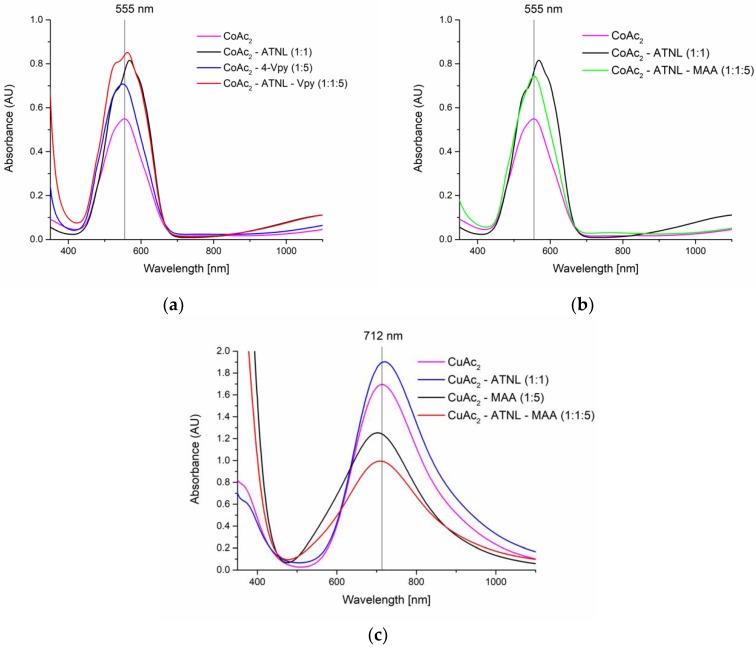
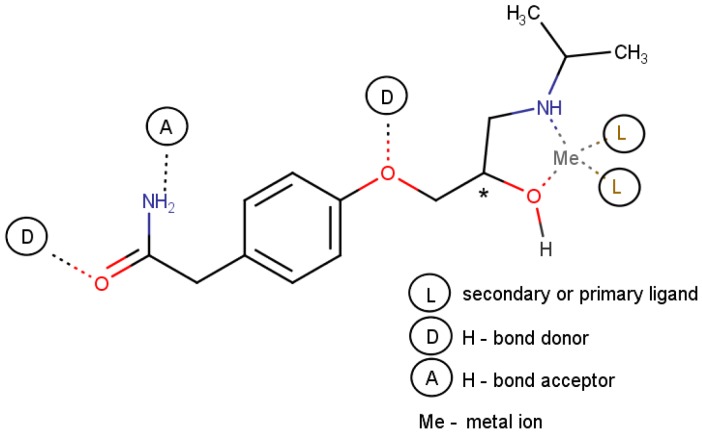
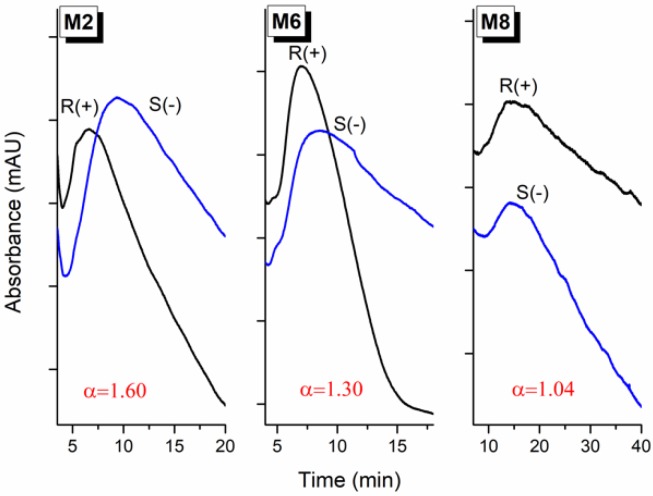
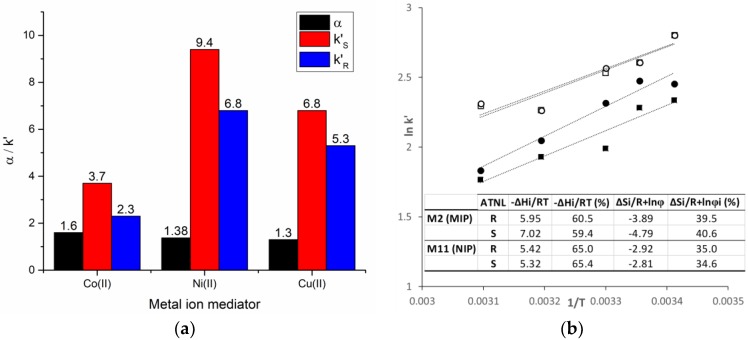
In the last few decades, molecular imprinting technology went through a spectacular evolution becoming a well-established tool for the synthesis of highly selective biomimetic molecular recognition platforms. Nevertheless, there is still room for advancement in the molecular imprinting of highly polar chiral compounds. The aim of the present work was to investigate the favorable kosmotropic effect of a ternary complex involving a polar chiral template (eutomer of atenolol) and a functional monomer, bridged by a central metal ion through well-defined, spatially directional coordinate bonds. The efficiency of the chiral molecular recognition was systematically assessed on polymers obtained both by non-covalent and metal-mediated molecular imprinting. The influence on the chromatographic retention and enantioselectivity of different experimental variables (functional monomers, cross-linkers, chaotropic agents, metal ions, porogenic systems, etc.) were studied on both slurry packed and monolithic HPLC columns. Deliberate changes in the imprinting and rebinding (chromatographic) processes, along with additional thermodynamic studies shed light on the particularities of the molecular recognition mechanism. The best performing polymer in terms of enantioselectivity (α = 1.60) was achieved using 4-vinyl pyridine as functional monomer and secondary ligand for the Co(II)-mediated imprinting of S-atenolol in the presence of EDMA as cross-linker in a porogenic mixture of [BMIM][BF₄]:DMF:DMSO = 10:1:5, //.
在过去的几十年中,分子印迹技术经历了一场引人瞩目的发展,成为合成高度选择性仿生分子识别平台的成熟工具。然而,在高度极性手性化合物的分子印迹方面仍有改进的空间。本工作的目的是研究涉及极性手性模板(阿替洛尔的对映体)和功能单体的三元配合物的有利共溶效应,该配合物通过中心金属离子通过明确的、空间定向配位键桥接。通过非共价和金属介导的分子印迹获得的聚合物系统地评估了手性分子识别的效率。研究了不同实验变量(功能单体、交联剂、离液剂、金属离子、致孔剂体系等)对填充和整体 HPLC 柱的色谱保留和对映选择性的影响。有意改变印迹和再结合(色谱)过程,并进行额外的热力学研究,阐明了分子识别机制的特殊性。在 4-乙烯基吡啶作为功能单体和 Co(II)介导的 S-阿替洛尔印迹的二级配体的存在下,使用 EDMA 作为交联剂,在 [BMIM][BF₄]:DMF:DMSO = 10:1:5 的致孔混合物中,以最佳的选择性(α=1.60)合成了聚合物。