Girum Tadele, Wasie Abebaw
Department of Public Health, College of Medicine and Health Sciences, Wolkite University, Wolkite City, Ethiopia.
Contracept Reprod Med. 2018 Jul 23;3:9. doi: 10.1186/s40834-018-0064-y. eCollection 2018.
Along with increasing availability and utilization of contraception, It is also important to confirm that the effects of contraception use on resumption of fertility after discontinuation However currently evidences on resumption of fertility after contraception use are inconclusive and practically fertility after termination of contraception remains a big concern for women who are using contraception. This fear poses a negative impact on utilization and continuation of contraception. Therefore, Estimating the rate of pregnancy resumption after contraceptive use from the available reports and identifying the associating factors are important for designing a strategy to overcome the problem.
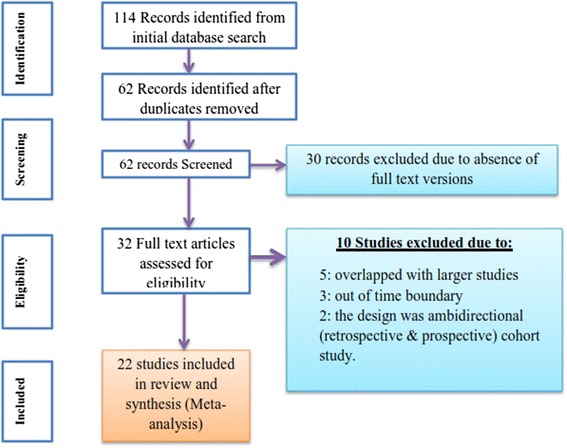
The review was conducted through a systematic literature search of articles published between 1985 and 2017. Five bibliographic databases and libraries: PubMed/Medline, Global Health Database, Embase, the Cochrane Library, and African Index Medicus were used. After cleaning and sorting, analysis was performed using STATA version 11. The pooled rate of conception was estimated with a random-effects model. Heterogeneity was assessed by the I and publication bias through funnel plot.
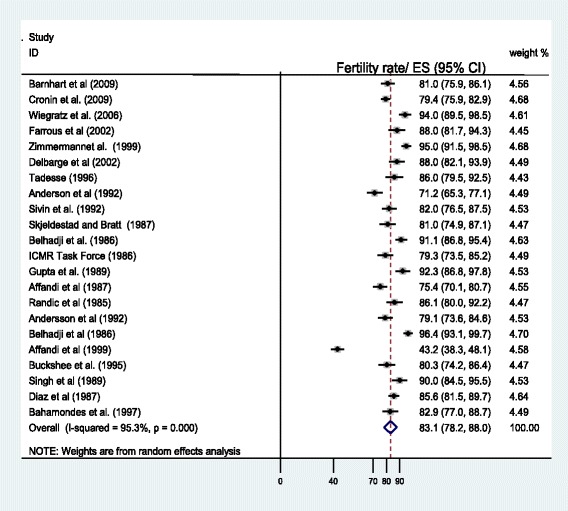
Twenty two studies that enrolled a total of 14,884 women who discontinued contraception were retained for final analysis. The pooled rate of pregnancy was 83.1% (95% CI = 78.2-88%) within the first 12 months of contraceptive discontinuation. It was not significantly different for hormonal methods and IUD users. Similarly the type of progesterone in specific contraception option and duration of oral-contraceptive use do not significantly influence the return of fertility following cessation of contraception. However the effect of parity in the resumption of pregnancy following cessation of contraception was inconclusive.
Contraceptive use regardless of its duration and type does not have a negative effect on the ability of women to conceive following termination of use and it doesn't significantly delay fertility. Therefore, appropriate counseling is important to assure the women to use the methods as to their interest.
随着避孕措施的可及性和使用率不断提高,确认避孕措施对停用后生育恢复的影响也很重要。然而,目前关于避孕措施使用后生育恢复的证据尚无定论,实际上,对于正在使用避孕措施的女性来说,避孕终止后的生育能力仍是一个重大担忧。这种担忧对避孕措施的使用和持续使用产生了负面影响。因此,根据现有报告估算避孕措施使用后恢复妊娠的比率,并确定相关因素,对于设计解决该问题的策略很重要。
通过对1985年至2017年发表的文章进行系统的文献检索来开展这项综述。使用了五个书目数据库和图书馆:PubMed/Medline、全球健康数据库、Embase、Cochrane图书馆和非洲医学索引。清理和排序后,使用STATA 11版进行分析。采用随机效应模型估算合并受孕率。通过I²评估异质性,并通过漏斗图评估发表偏倚。
共有22项研究纳入了14884名停用避孕措施的女性,保留这些研究用于最终分析。避孕措施停用后的前12个月内,合并妊娠率为83.1%(95%置信区间=78.2-88%)。激素避孕方法使用者和宫内节育器使用者之间无显著差异。同样,特定避孕方法中孕激素的类型以及口服避孕药的使用时长,对避孕措施停用后生育能力的恢复没有显著影响。然而,生育次数对避孕措施停用后恢复妊娠的影响尚无定论。
无论避孕措施的使用时长和类型如何,其使用对女性停用后受孕能力均无负面影响,也不会显著延迟生育。因此,进行适当的咨询对于确保女性根据自身意愿使用这些方法很重要。