Kim Young Saing, Kim Kyung, Kwon Ghee-Young, Lee Su Jin, Park Se Hoon
Division of Medical Oncology, Department of Internal Medicine, Gil Medical Center, Gachon University College of Medicine, Incheon, South Korea.
Division of Hematology-Oncology, Department of Medicine, Sungkyunkwan University Samsung Medical Center, Sungkyunkwan University School of Medicine, 81 Irwon-ro, Gangnam-gu, Seoul, 06351, South Korea.
BMC Urol. 2018 Jul 31;18(1):68. doi: 10.1186/s12894-018-0380-1.
Recent studies suggest that FGFR3 is a potential therapeutic target in urothelial carcinoma (UC). The purpose of this study was to evaluate the rates and types of FGFR3 aberrations in patients with muscle-invasive UC who received radical resection.
We analyzed surgical tumor samples from 74 UC patients who had received radical cystectomy (n = 40) or ureteronephrectomy (n = 34). Ion AmpliSeq Cancer Hotspot Panel v2 and nCounter Copy Number Variation Assay were used to detect FGFR3 aberrations.
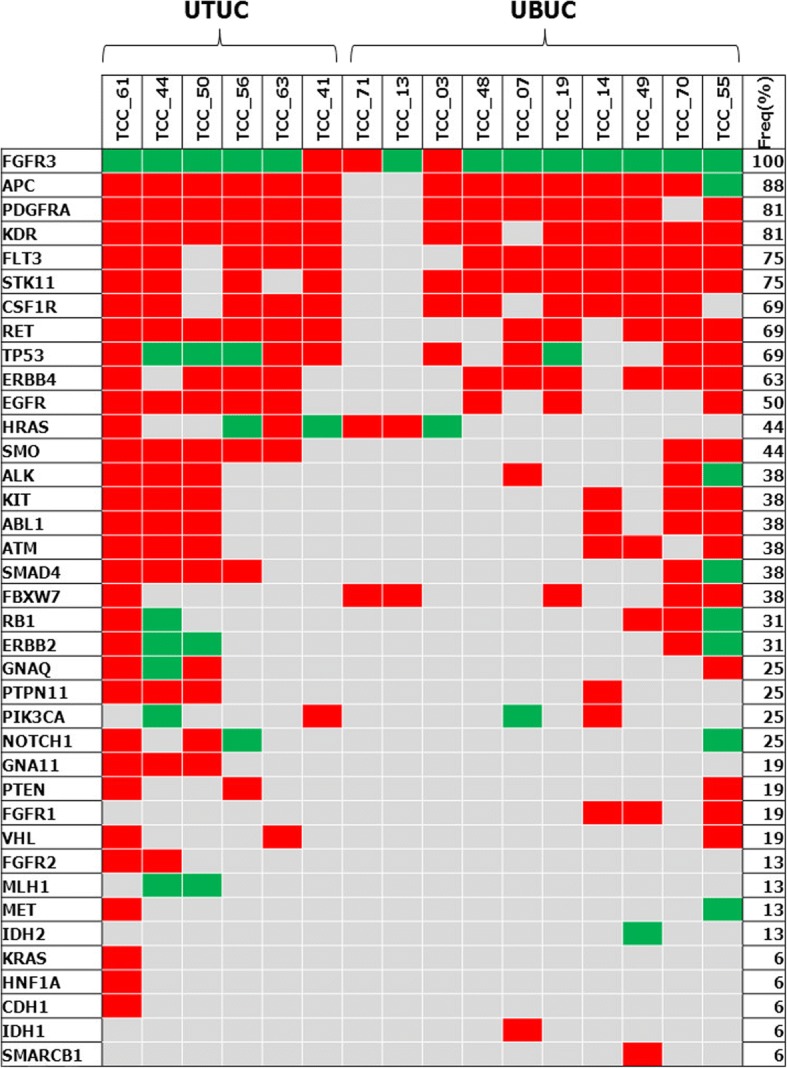
Fifty-four patients (73%) had high-grade tumors, and 62% had lymph node involvement. Sixteen patients (22%) harbored FGFR3 alterations, the most common of which was FGFR3 mutations (n = 13): Y373C (n = 3), N532D (n = 3), R248C (n = 2), S249C (n = 1), G370C (n = 1), S657S (n = 1), A797P (n = 1), and 746_747insG (n = 1). Three additional patients had a FGFR3-TACC3 rearrangement. The frequency of FGFR3 aberrations was higher in bladder UC (25%) than in UC of the renal pelvis and ureter (18%) but the difference was not statistically significant (P = 0.444). Genes that were co-aberrant with FGFR3 included APC (88%), PDGFRA (81%), RET (69%), and TP53 (69%).
We report the frequency and types of FGFR3 aberrations in Korean patients with UC. Patients with FGFR3 mutations or FGFR3-TACC3 fusion may constitute potential candidates for a novel FGFR-targeted therapy in the perioperative setting.
近期研究表明,FGFR3是尿路上皮癌(UC)的一个潜在治疗靶点。本研究的目的是评估接受根治性切除术的肌层浸润性UC患者中FGFR3畸变的发生率及类型。
我们分析了74例接受根治性膀胱切除术(n = 40)或输尿管肾盂切除术(n = 34)的UC患者的手术肿瘤样本。使用Ion AmpliSeq癌症热点Panel v2和nCounter拷贝数变异分析来检测FGFR3畸变。
54例患者(73%)患有高级别肿瘤,62%有淋巴结受累。16例患者(22%)存在FGFR3改变,其中最常见的是FGFR3突变(n = 13):Y373C(n = 3)、N532D(n = 3)、R248C(n = 2)、S249C(n = 1)、G370C(n = 1)、S657S(n = 1)、A797P(n = 1)和746_747insG(n = 1)。另外3例患者存在FGFR3 - TACC3重排。FGFR3畸变的频率在膀胱UC中(25%)高于肾盂和输尿管UC(18%),但差异无统计学意义(P = 0.444)。与FGFR3共同畸变的基因包括APC(88%)、PDGFRA(81%)、RET(69%)和TP53(69%)。
我们报告了韩国UC患者中FGFR3畸变的频率及类型。FGFR3突变或FGFR3 - TACC3融合的患者可能是围手术期新型FGFR靶向治疗的潜在候选者。