Verbeke Willem J, Belschak Frank, Ein-Dor Tsachi, Bagozzi Richard P, Schippers Michaéla
Erasmus School of Economics, Erasmus University Rotterdam, Rotterdam, Netherlands.
School of Economics and Management, University of Amsterdam, Amsterdam, Netherlands.
Front Psychol. 2018 Jul 17;9:1051. doi: 10.3389/fpsyg.2018.01051. eCollection 2018.
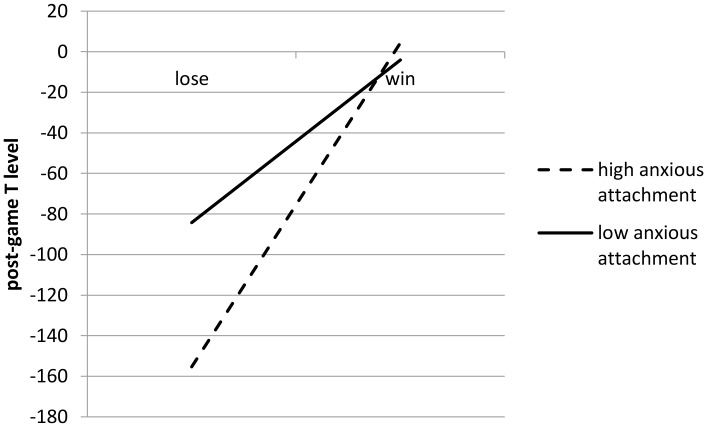
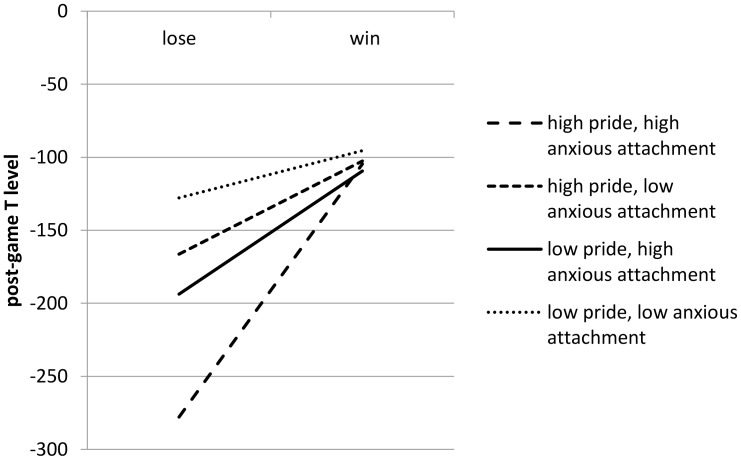
A person's ability to form relationships and seek and attain social status affects their chances of survival. We study how anxious and avoidant-attachment styles and subsequent winning or losing affects the testosterone (T) levels of team members playing two status contests. The first is a management game played by teams striving to earn the most profits. Winners and losers emerge due to the cognitive endeavor of the players, which provokes intense status dynamics. Avoidant-attached winners do not show higher T levels whereas anxious-attached winners do. The second is an economic game which is rigged and favors some teams to become richer than others; teams have the option though to trade with each other and reduce the self-perpetuating rich-poor dynamics embedded in the game. Besides attachment styles, we here also explore how authentic pride as a self-conscious emotion affects team members' T levels as players trade with others to create more fairness. As in the first status contest, players' T levels are not significantly affected by their avoidant attachment style, neither as a main effect nor in interaction with winning or losing the game. However, similar to the first game, players' anxious attachment style affects their T levels: anxious-attached players generate significantly higher T levels when winning the game, but only when experiencing high authentic pride during the game. In short, the moderating effects of attachment style on winners' T levels are partly replicated in both status games which allows us to better understand the functioning of working models of attachment styles during and after status contests and gives us a better understanding of working models of attachment styles in general.
一个人建立人际关系、寻求并获得社会地位的能力会影响其生存几率。我们研究焦虑型和回避型依恋风格以及随后的输赢如何影响参与两场地位竞争的团队成员的睾酮(T)水平。第一场是团队参与的管理游戏,目标是赚取最多利润。由于玩家的认知努力产生了赢家和输家,这引发了激烈的地位动态变化。回避型依恋的赢家的T水平没有升高,而焦虑型依恋的赢家则升高了。第二场是一场经济游戏,该游戏被操纵,使一些团队比其他团队更富有;不过团队可以选择相互交易,以减少游戏中固有的贫富差距自我延续的动态变化。除了依恋风格,我们还在此探讨作为一种自我意识情绪的真实自豪感如何在玩家相互交易以创造更多公平时影响团队成员的T水平。与第一场地位竞争一样,玩家的T水平不受其回避型依恋风格的显著影响,无论是作为主要效应还是与游戏输赢的交互作用。然而,与第一场游戏类似,玩家的焦虑型依恋风格会影响他们的T水平:焦虑型依恋的玩家在赢得游戏时会产生显著更高的T水平,但前提是在游戏过程中体验到高度的真实自豪感。简而言之,依恋风格对赢家T水平的调节作用在两场地位游戏中都有部分体现,这使我们能够更好地理解地位竞争期间及之后依恋风格工作模型的运作,并让我们对依恋风格的工作模型有更全面的了解。