Delgove Marie Af, Elford Matthew T, Bernaerts Katrien V, De Wildeman Stefaan Ma
Maastricht University Aachen-Maastricht Institute for Biobased Materials (AMIBM) Urmonderbaan The Netherlands.
J Chem Technol Biotechnol. 2018 Aug;93(8):2131-2140. doi: 10.1002/jctb.5623. Epub 2018 Apr 16.
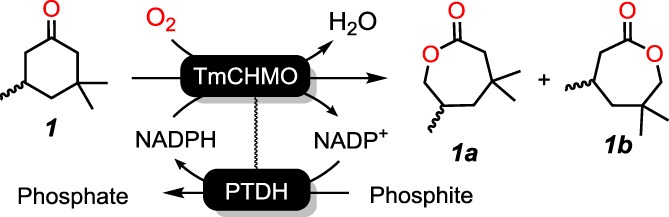
It is widely accepted that the poor thermostability of Baeyer-Villiger monooxygenases limits their use as biocatalysts for applied biocatalysis in industrial applications. The goal of this study was to investigate the biocatalytic oxidation of 3,3,5-trimethylcyclohexanone using a thermostable cyclohexanone monooxygenase from Thermocrispum municipale (TmCHMO) for the synthesis of branched ϵ-caprolactone derivatives as building blocks for tuned polymeric backbones. In this multi-enzymatic reaction, the thermostable cyclohexanone monooxygenase was fused to a phosphite dehydrogenase (PTDH) in order to ensure co-factor regeneration.
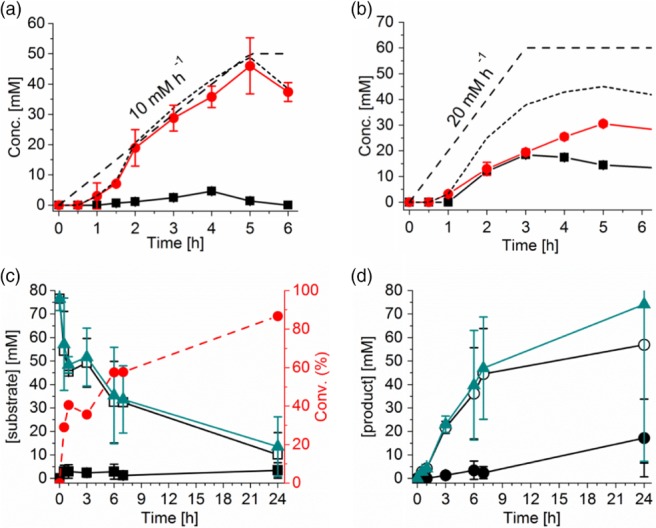
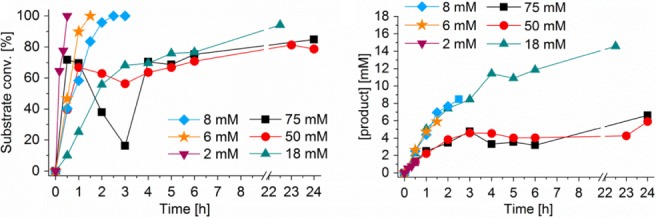
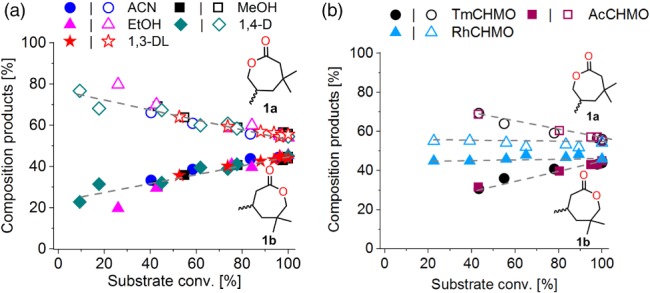
Using reaction engineering, the reaction rate and product formation of the regio-isomeric branched lactones were improved and the use of co-solvents and the initial substrate load were investigated. Substrate inhibition and poor product solubility were overcome using continuous substrate feeding regimes, as well as a biphasic reaction system with toluene as water-immiscible organic solvent. A maximum volumetric productivity, or space-time-yield, of 1.20 g L h was achieved with continuous feeding of substrate using methanol as co-solvent, while a maximum product concentration of 11.6 g L was achieved with toluene acting as a second phase and substrate reservoir.
These improvements in key process metrics therefore demonstrate progress towards the up-scaled Baeyer-Villiger monooxygenase-biocatalyzed synthesis of the target building blocks for polymer application. © 2018 The Authors. published by John Wiley & Sons Ltd on behalf of Society of Chemical Industry.
人们普遍认为,拜耳-维利格单加氧酶的热稳定性较差,这限制了它们在工业应用中作为生物催化剂用于应用生物催化的用途。本研究的目的是研究使用来自市政嗜热栖热菌的热稳定环己酮单加氧酶(TmCHMO)对3,3,5-三甲基环己酮进行生物催化氧化,以合成支链ε-己内酯衍生物,作为调节聚合物主链的构建单元。在这个多酶反应中,热稳定的环己酮单加氧酶与亚磷酸脱氢酶(PTDH)融合,以确保辅因子再生。
通过反应工程,提高了区域异构体支链内酯的反应速率和产物形成,并研究了共溶剂的使用和初始底物负载量。使用连续底物进料方式以及以甲苯作为与水不混溶的有机溶剂的双相反应体系,克服了底物抑制和产物溶解性差的问题。以甲醇作为共溶剂连续进料底物时,最大体积生产率或时空产率达到1.20 g L h,而以甲苯作为第二相和底物储存库时,最大产物浓度达到11.6 g L。
关键工艺指标的这些改进因此证明了在扩大规模的拜耳-维利格单加氧酶生物催化合成聚合物应用目标构建单元方面取得的进展。© 2018作者。由John Wiley & Sons Ltd代表化学工业协会出版。