Centro Nacional de Investigación Disciplinaria en Parasitología Veterinaria, Instituto Nacional de Investigaciones Forestales Agrícolas y Pecuarias, Jiutepec Morelos, Mexico.
Departamento de Ectoparásitos y Dípteros, Servicio Nacional de Sanidad, Inocuidad y Calidad Agroalimentaria SAGARPA, Jiutepec Morelos, Mexico.
Biomed Res Int. 2018 Jul 4;2018:8292465. doi: 10.1155/2018/8292465. eCollection 2018.
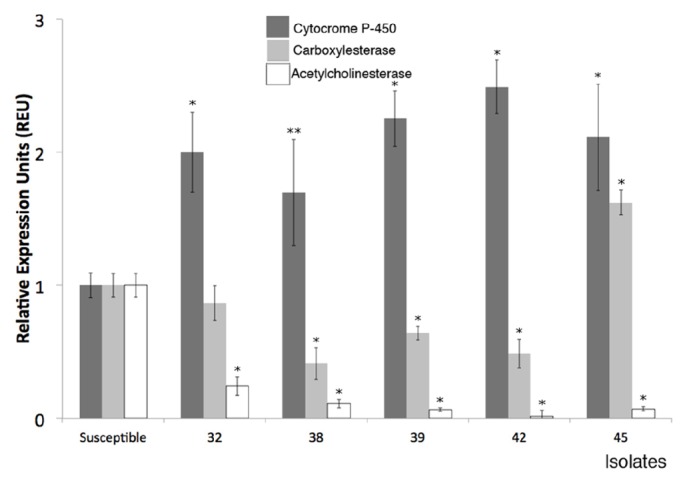
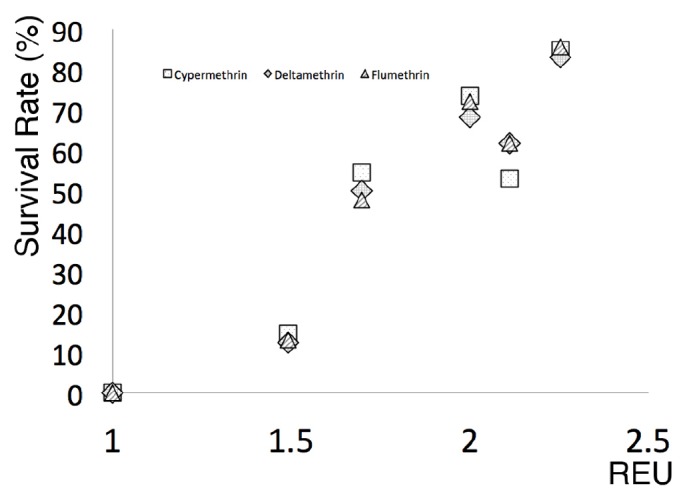
The goal of the present study was to assess the gene expression of xenobiotic metabolizing enzymes (XMEs) Cytochrome P-450 (CYP) and carboxylesterase (CE) related to detoxification of synthetic pyrethroids, plus acetylcholinesterase (AChE), in field isolates of acaricide-resistant Rhipicephalus microplus. The XMEs expression levels were assessed by mRNA measurement using quantitative reverse transcription PCR. The XME expression levels of field-isolated acaricide-resistant ticks were compared against acaricide-susceptible reference ticks used in this study as a gene expression baseline and represented as relative expression units (REU). Field isolates were subjected to toxicological bioassays and determined resistant to all the Pyr acaricides (Pyr), whereas most of them were found susceptible to organophosphorous acaricides (OP), with the exception of three isolates, which exhibited moderate resistance to Diazinon. Significantly higher levels of CYP were detected in pyrethroid-resistance ticks when compared to Su ticks (P<0.01). A linear regression analysis showed that pyrethroid acaricide resistance levels of R. microplus were proportional to the CYP expression levels (correlation coefficient (R):0.85; P<0.05). Analysis on CE expression levels showed only one isolate resistant to Pyr and OP with a statistically significant increase (P<0.01). AChE expression levels showed statistically significant (P<0.01) subexpression in all tick isolates when compared to the susceptible reference. Our results suggest that pyrethroid acaricide resistance in the cattle tick may be diagnosed by measuring the CYP expression levels using quantitative PCR.
本研究的目的是评估与拟除虫菊酯解毒相关的异生物质代谢酶(XME)细胞色素 P-450(CYP)和羧酸酯酶(CE),以及乙酰胆碱酯酶(AChE)在抗杀螨剂田间分离株中的基因表达。使用定量逆转录 PCR 测量 mRNA 来评估 XME 的表达水平。将田间分离的抗杀螨剂蜱的 XME 表达水平与本研究中用作基因表达基线的敏感参考蜱进行比较,并表示为相对表达单位(REU)。对田间分离株进行毒理学生物测定,结果发现所有拟除虫菊酯杀螨剂(Pyr)均具有抗性,而大多数对有机磷杀螨剂(OP)敏感,除了三个分离株对二嗪农表现出中等抗性。与 Su 蜱相比,在抗吡虫啉蜱中检测到更高水平的 CYP(P<0.01)。线性回归分析表明,蜱对拟除虫菊酯的抗药性水平与 CYP 表达水平成正比(相关系数(R):0.85;P<0.05)。对 CE 表达水平的分析表明,只有一个对 Pyr 和 OP 具有抗性的分离株表达水平显著增加(P<0.01)。与敏感参考相比,所有蜱分离株的 AChE 表达水平均表现出统计学意义上的亚表达(P<0.01)。我们的结果表明,使用定量 PCR 测量 CYP 表达水平可能有助于诊断牛蜱对拟除虫菊酯的抗药性。