The Blizard Institute, Barts and the London School of Medicine and Dentistry, Queen Mary University of London, London, UK.
The Blizard Institute, Barts and the London School of Medicine and Dentistry, Queen Mary University of London, London, UK.
Pharmacol Ther. 2019 Jan;193:83-90. doi: 10.1016/j.pharmthera.2018.08.004. Epub 2018 Aug 4.
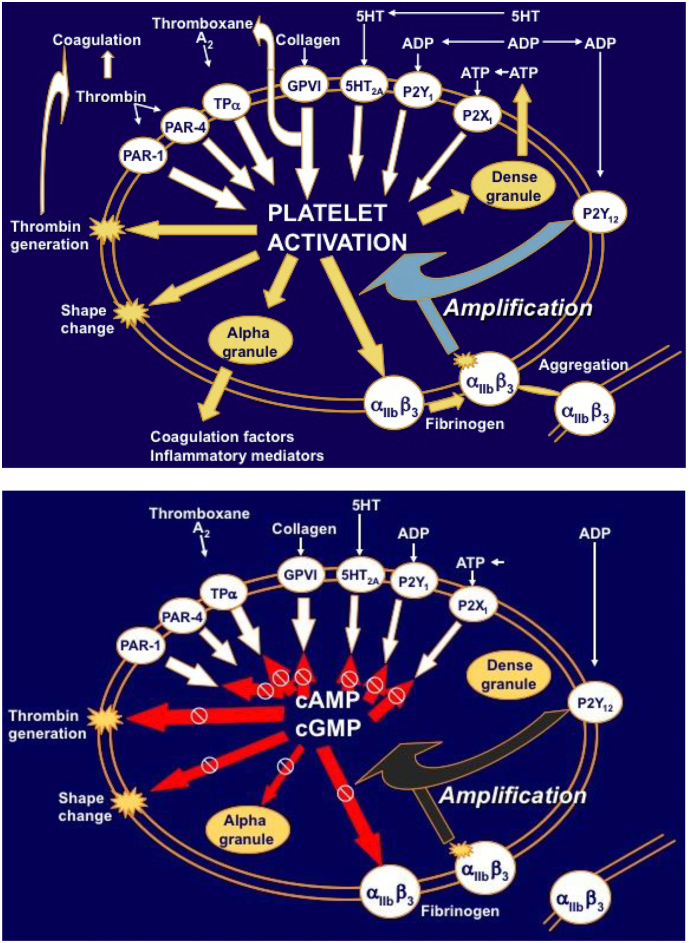
For many millions of patients at secondary risk of coronary thrombosis pharmaceutical protection is supplied by dual anti-platelet therapy. Despite substantial therapeutic developments over the last decade recurrent thrombotic events occur, highlighting the need for further optimisation of therapies. Importantly, but often ignored, anti-platelet drugs interact with cyclic nucleotide systems in platelets and these are the same systems that mediate key endogenous pathways of platelet regulation, notably those dependent upon the vascular endothelium. The aim of this review is to highlight interactions between the anti-platelet drugs, aspirin and P2Y receptor antagonists and endogenous pathways of platelet regulation at the level of cyclic nucleotides. These considerations are key to concepts such as anti-platelet drug resistance and individualized anti-platelet therapy which cannot be understood by study of platelets in isolation from the circulatory environment. We also explore novel and emerging therapies that focus on preserving haemostasis and how the concepts outlined in this review could be exploited therapeutically to improve anti-thrombotic efficacy whilst reducing bleeding risk.
对于数百万处于冠状动脉血栓形成二级风险的患者,药物保护通过双重抗血小板治疗提供。尽管在过去十年中取得了大量治疗进展,但仍会发生复发性血栓事件,这凸显了进一步优化治疗的必要性。重要的是,但经常被忽视的是,抗血小板药物与血小板中环核苷酸系统相互作用,而这些系统正是调节血小板的关键内源性途径的系统,特别是那些依赖血管内皮的途径。本综述的目的是强调抗血小板药物阿司匹林和 P2Y 受体拮抗剂与环核苷酸水平上血小板调节的内源性途径之间的相互作用。这些考虑因素是理解抗血小板药物耐药性和个体化抗血小板治疗等概念的关键,而这些概念不能通过将血小板与循环环境分开来研究来理解。我们还探讨了专注于维持止血的新型和新兴疗法,以及如何在治疗上利用本综述中概述的概念来提高抗血栓形成功效,同时降低出血风险。