Gonçalves Homero, Guerra Maximiliano Ribeiro, Duarte Cintra Jane Rocha, Fayer Vívian Assis, Brum Igor Vilela, Bustamante Teixeira Maria Teresa
Instituto Oncológico de Juiz de Fora/Hospital 9 de Julho, Juiz de Fora, Brazil.
Post-Graduate Program in Health, Faculty of Medicine, Universidade Federal de Juiz de Fora (UFJF), Juiz de Fora, Brazil.
Clin Med Insights Oncol. 2018 Jul 27;12:1179554918790563. doi: 10.1177/1179554918790563. eCollection 2018.
To analyze the clinical, pathological, and sociodemographic aspects between triple-negative breast cancer (TNBC) and non-TNBC in a Brazilian cohort and identify potential prognostic factors.
This hospital-based retrospective cohort study included 447 women with breast cancer treated at referral centers in Southeastern Brazil. Overall and disease-free survival were compared; prognostic factors were evaluated.
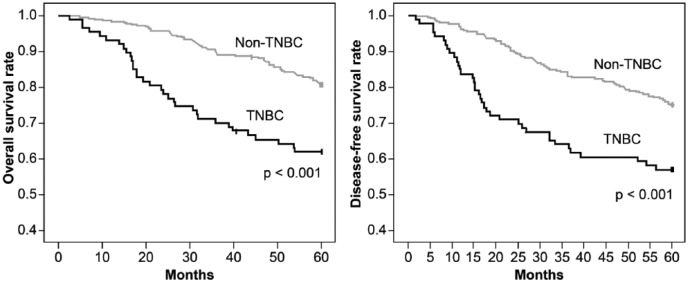
Triple-negative breast cancer corresponded to 19.5% of breast cancer diagnosis and was more prevalent among nonwhite and less educated women. The patients with TNBC tended to present with stage III cancer, high p53 expression, lymphocytic infiltration, and multifocality and treated with radical surgery and chemotherapy. The 5-year overall and disease-free survival were 62.1% and 57.5% for TNBC and 80.8% and 75.3% for non-TNBC, respectively ( < .001). The TNBC recurrence was associated with multicentricity, whereas lymph node involvement increased the risk of both recurrence and death. Non-TNBC worse clinical course was associated with nonwhite ethnicity, lower education level, lymph node involvement, and advanced stage.
Triple-negative breast cancer exhibited a more aggressive behavior, earlier and more frequent recurrence, and worse survival compared with non-TNBC. While biological and social variables were associated with poorer prognosis in non-TNBC, only lymph node involvement and multicentricity were correlated with worse clinical outcomes in TNBC.
分析巴西队列中三阴性乳腺癌(TNBC)与非三阴性乳腺癌在临床、病理及社会人口学方面的特征,并确定潜在的预后因素。
这项基于医院的回顾性队列研究纳入了447例在巴西东南部转诊中心接受治疗的乳腺癌女性患者。比较总生存率和无病生存率;评估预后因素。
三阴性乳腺癌占乳腺癌诊断病例的19.5%,在非白人和受教育程度较低的女性中更为普遍。TNBC患者倾向于表现为III期癌症、p53高表达、淋巴细胞浸润和多灶性,并接受根治性手术和化疗。TNBC的5年总生存率和无病生存率分别为62.1%和57.5%,非TNBC分别为80.8%和75.3%(P<0.001)。TNBC复发与多中心性相关,而淋巴结受累增加了复发和死亡风险。非TNBC较差的临床病程与非白人种族、较低教育水平、淋巴结受累和晚期有关。
与非TNBC相比,三阴性乳腺癌表现出更具侵袭性的行为、更早且更频繁的复发以及更差的生存率。虽然生物学和社会变量与非TNBC较差的预后相关,但在TNBC中只有淋巴结受累和多中心性与较差的临床结局相关。