Chen Xiao-Lin, Xie Xin, Wu Liye, Liu Caiyun, Zeng Lirong, Zhou Xueping, Luo Feng, Wang Guo-Liang, Liu Wende
State Key Laboratory for Biology of Plant Diseases and Insect Pests, Institute of Plant Protection, Chinese Academy of Agricultural Sciences, Beijing, China.
The Provincial Key Lab of Plant Pathology of Hubei Province, College of Plant Science and Technology, Huazhong Agricultural University, Wuhan, China.
Front Plant Sci. 2018 Jul 23;9:1064. doi: 10.3389/fpls.2018.01064. eCollection 2018.
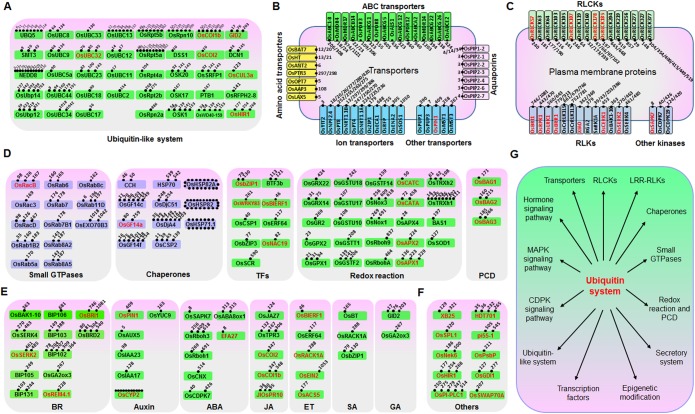
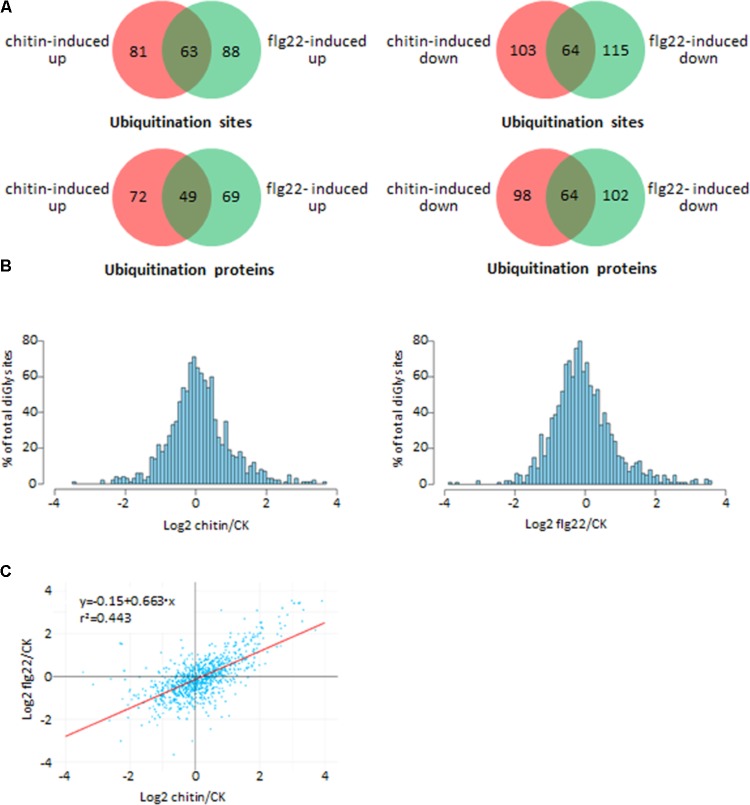
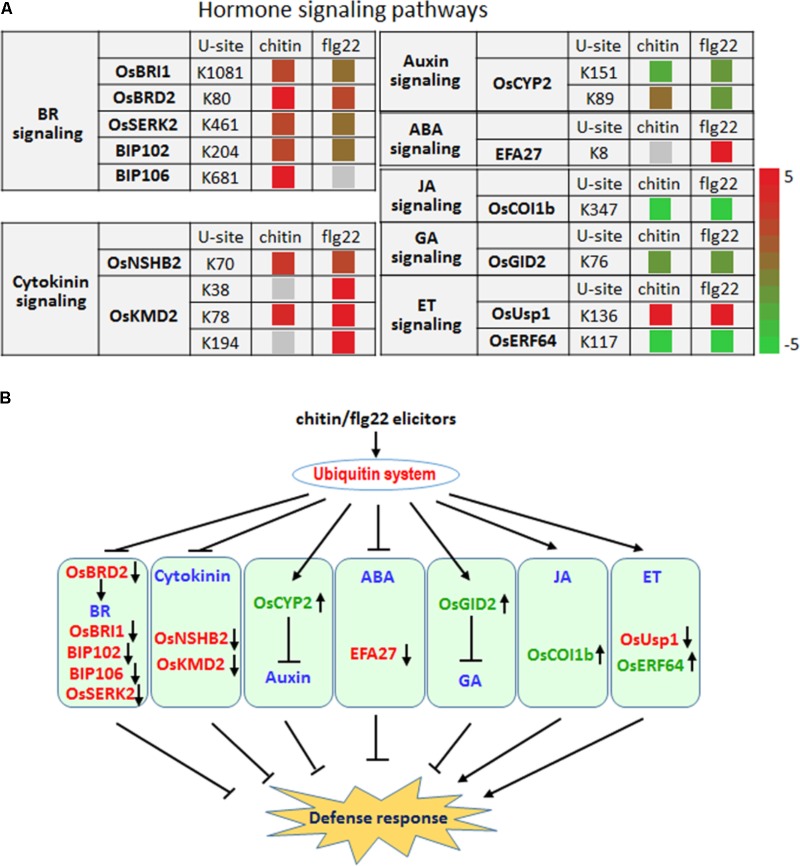
Reversible protein ubiquitination plays essential roles in regulating cellular processes. Although many reports have described the functions of ubiquitination in plant defense responses, few have focused on global changes in the ubiquitome. To better understand the regulatory roles of ubiquitination in rice pattern-triggered immunity (PTI), we investigated the ubiquitome of rice seedlings after treatment with two pathogen-associated molecular patterns, the fungal-derived chitin or the bacterial-derived flg22, using label-free quantitative proteomics. In chitin-treated samples, 144 and 167 lysine-ubiquitination sites in 121 and 162 proteins showed increased and decreased ubiquitination, respectively. In flg22-treated samples, 151 and 179 lysine-ubiquitination sites in 118 and 166 proteins showed increased and decreased ubiquitination, respectively. Bioinformatic analyses indicated diverse regulatory roles of these proteins. The ubiquitination levels of many proteins involved in the ubiquitination system, protein transportation, ligand recognition, membrane trafficking, and redox reactions were significantly changed in response to the elicitor treatments. Notably, the ubiquitination levels of many enzymes in the phenylpropanoid metabolic pathway were up-regulated, indicating that this pathway is tightly regulated by ubiquitination during rice PTI. Additionally, the ubiquitination levels of some key components in plant hormone signaling pathways were up- or down-regulated, suggesting that ubiquitination may fine-tune hormone pathways for defense responses. Our results demonstrated that ubiquitination, by targeting a wide range of proteins for degradation or stabilization, has a widespread role in modulating PTI in rice. The large pool of ubiquitination targets will serve as a valuable resource for understanding how the ubiquitination system regulates defense responses to pathogen attack.
可逆蛋白泛素化在调节细胞过程中发挥着重要作用。尽管许多报告描述了泛素化在植物防御反应中的功能,但很少有研究关注泛素组的整体变化。为了更好地理解泛素化在水稻模式触发免疫(PTI)中的调控作用,我们使用无标记定量蛋白质组学方法,研究了用两种病原体相关分子模式(真菌来源的几丁质或细菌来源的flg22)处理后的水稻幼苗的泛素组。在几丁质处理的样品中,121和162种蛋白质中的144和167个赖氨酸泛素化位点分别显示泛素化增加和减少。在flg22处理的样品中,118和166种蛋白质中的151和179个赖氨酸泛素化位点分别显示泛素化增加和减少。生物信息学分析表明这些蛋白质具有多种调控作用。许多参与泛素化系统、蛋白质运输、配体识别、膜运输和氧化还原反应的蛋白质的泛素化水平在诱导处理后发生了显著变化。值得注意的是,苯丙烷类代谢途径中许多酶的泛素化水平上调,表明该途径在水稻PTI过程中受到泛素化的严格调控。此外,植物激素信号通路中一些关键成分的泛素化水平上调或下调,表明泛素化可能对激素通路进行微调以应对防御反应。我们的结果表明,泛素化通过靶向多种蛋白质进行降解或稳定,在调节水稻PTI中具有广泛作用。大量的泛素化靶点将成为理解泛素化系统如何调节对病原体攻击的防御反应的宝贵资源。