Yoon Chang Ho, Kim Mee Kum
Department of Ophthalmology, Seoul National University College of Medicine, Seoul, Korea.
Laboratory of Ocular Regenerative Medicine and Immunology, Seoul Artificial Eye Center, Seoul National University Hospital Biomedical Research Institute, Seoul, Korea.
Korean J Ophthalmol. 2018 Aug;32(4):265-272. doi: 10.3341/kjo.2017.0108.
To investigate the effect of surgically induced corneal astigmatism (SICA) and total corneal astigmatism (TCA) estimation on the anterior corneal astigmatism (ACA)-based toric intraocular lens (IOL) calculation.
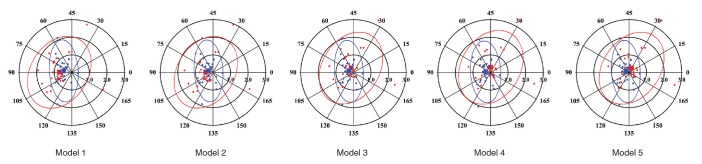
Data from preoperative and postoperative corneal astigmatism, postoperative visual acuities, and refractive outcomes were collected. The incision was superior in with the rule anterior corneal astigmatism (WTRA) eyes and temporal in against the rule anterior corneal astigmatism eyes. The following five methods of calculating the toric IOL were compared: (1) ACA only and estimated SICA; (2) ACA with a fixed posterior corneal astigmatism (PCA) and estimated SICA; (3) ACA with a fixed PCA value and actual SICA; (4) and (5) TCA derived from the regression equations of ACA and actual SICA. The residual astigmatism was simulated. The Alpins method was used to analyze the astigmatism.
Sixty eyes from 46 patients were enrolled. Thirty eyes had WTRA and the other thirty had against the rule anterior corneal astigmatism. The vector and arithmetic means of the difference vector decreased when the information regarding the actual SICA and PCA was added to the calculation (from 0.59 diopters [D] @ 87.5° to 0.15 D @ 48.5°, and from 0.95 ± 0.53 to 0.71 ± 0.63 D, respectively; p < 0.001). The mean difference vector across the whole sample was lowest using model 5. The correction index was significantly closest to 1.0 in the WTRA group.
Researchers may improve the accuracy of post-implantation predictions by calculating toric IOL using exact SICA and TCA, with consideration of the PCA derived from the regression equation of ACA.
探讨手术诱导的角膜散光(SICA)和总角膜散光(TCA)估计对基于前角膜散光(ACA)的散光型人工晶状体(IOL)计算的影响。
收集术前和术后角膜散光、术后视力和屈光结果的数据。切口在顺规性前角膜散光(WTRA)眼为上方,在逆规性前角膜散光眼为颞侧。比较了以下五种计算散光型IOL的方法:(1)仅ACA和估计的SICA;(2)具有固定后角膜散光(PCA)的ACA和估计的SICA;(3)具有固定PCA值和实际SICA的ACA;(4)和(5)由ACA和实际SICA的回归方程得出的TCA。模拟残余散光。使用Alpins方法分析散光。
纳入了46例患者的60只眼。30只眼为WTRA,另外30只眼为逆规性前角膜散光。在计算中加入实际SICA和PCA的信息时,差异向量的矢量和算术平均值降低(分别从0.59屈光度[D] @ 87.5°降至0.15 D @ 48.5°,以及从0.95±0.53降至0.71±0.63 D;p < 0.001)。使用模型5时,整个样本的平均差异向量最低。在WTRA组中,校正指数显著最接近1.0。
研究人员可以通过使用精确的SICA和TCA计算散光型IOL,并考虑从ACA回归方程得出的PCA,来提高植入后预测的准确性。