DST/NRF SARChi Programme on the Health Workforce, School of Public Health, Faculty of Health Sciences, University of the Witswatersrand, Johannesburg, South Africa.
Global Health. 2018 Aug 9;14(1):81. doi: 10.1186/s12992-018-0397-y.
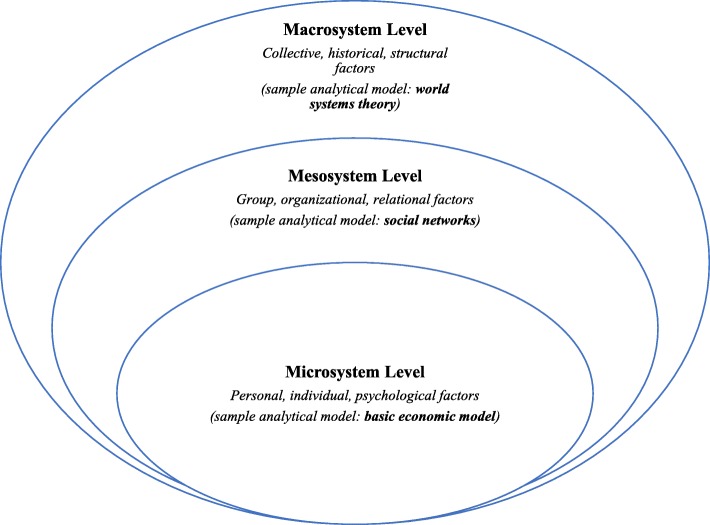
The Commission on Social Determinants of Health (CSDH) identifies the maldistribution of power, money, and resources as main drivers of health inequities. The CSDH further observes that tackling these drivers effectively requires interventions to focus at local, national, and global levels. Consistent with the CSDH's observation, this paper describes the eco-psychopolitical validity (EPV) paradigm, a multilevel and transdisciplinary model for research and action, thus far insufficiently tapped, but with the potential to systematize the exploration of the social determinants of health.
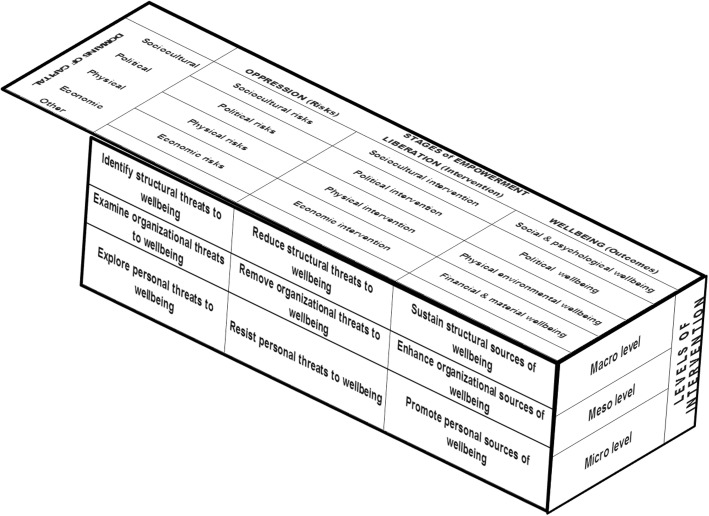
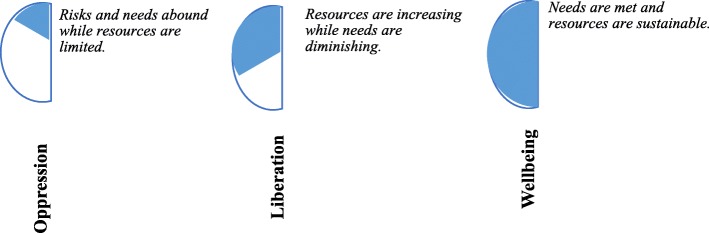
Using the physician migration from Sub-Saharan Africa (SSA) to the United States as illustration, this paper articulates how the EPV model can be applied to the systematic analysis of a complex social problem with health inequity implications. To help explore potential determinants of physician migration, a comprehensive coding matrix is developed; with the organizing metaphors of the EPV model-namely oppression, liberation, and wellbeing-serving as analytical categories. Through the lens of the EPV model, migrating physicians are revealed as both ecological subjects enmeshed in a vast web of transnational processes linking source and destination countries, and potential change agents pursuing liberation and wellbeing. While migration may expand the opportunities of émigré physicians, it is argued that, the pursuit of wellbeing by way of migration cannot fully materialize abroad without some efforts to return home, physically or socially.
Clarifying the relationship between various social determinants of health and health inequities at different levels of analysis is a more complex but essential endeavor to knowledge generation than using a one-dimensional frame. With its roots in interdisciplinary thinking and its emphasis on both individual and contextual factors, the EPV paradigm holds promise as a model for examining the social determinants of health.
健康社会决定因素委员会(CSDH)确定权力、金钱和资源的分配不均是造成健康不平等的主要驱动因素。CSDH 还观察到,要有效解决这些驱动因素,需要在地方、国家和全球各级采取干预措施。本文件与 CSDH 的意见一致,描述了生态心理政治有效性(EPV)范式,这是一个多层次和跨学科的研究和行动模型,迄今为止尚未得到充分利用,但具有将健康决定因素的探索系统化的潜力。
本文以撒哈拉以南非洲(SSA)医生向美国移民为例,阐述了 EPV 模型如何应用于对具有健康不平等影响的复杂社会问题进行系统分析。为了帮助探索医生移民的潜在决定因素,开发了一个全面的编码矩阵;以 EPV 模型的组织隐喻——压迫、解放和促进健康——作为分析类别。通过 EPV 模型的视角,移民医生被揭示为处于连接来源国和目的地国的跨国进程网络中的生态主体,也是追求解放和促进健康的潜在变革推动者。虽然移民可能会扩大移民医生的机会,但有人认为,没有一些回国的努力(身体上或社会上),通过移民追求健康的愿望在国外是无法完全实现的。
在不同层次的分析中,澄清各种健康决定因素与健康不平等之间的关系是一项比使用一维框架更复杂但更重要的知识生成工作。EPV 范式根植于跨学科思维,强调个人和环境因素,有望成为检验健康决定因素的模型。