Corporación Colombiana de Investigación Agropecuaria (Agrosavia), Mosquera 4227373, Colombia.
Chemical Ecology Unit, Department of Plant Protection Biology, Swedish University of Agricultural Sciences, Alnarp 230 53, Sweden.
Evolution. 2018 Oct;72(10):2225-2233. doi: 10.1111/evo.13571. Epub 2018 Aug 27.
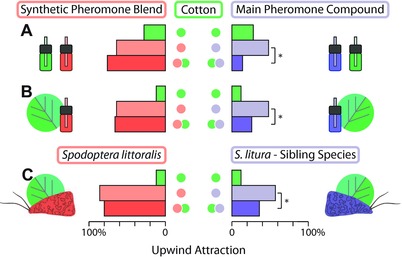
Specific mate recognition relies on the chemical senses in most animals, and especially in nocturnal insects. Two signal types mediate premating olfactory communication in terrestrial habitats: sex pheromones, which blend into an atmosphere of plant odorants. We show that host plant volatiles affect the perception of sex pheromone in males of the African cotton leafworm Spodoptera littoralis and that pheromone and plant volatiles are not perceived as independent messages. In clean air, S. littoralis males are attracted to single synthetic pheromone components or even the pheromone of a sibling species, oriental cotton leafworm S. litura. Presence of host plant volatiles, however, reduces the male response to deficient or heterospecific pheromone signals. That plant cues enhance discrimination of sex pheromone quality confirms the idea that specific mate recognition in noctuid moths has evolved in concert with adaptation to host plants. Shifts in either female host preference or sex pheromone biosynthesis give rise to new communication channels that have the potential to initiate or contribute to reproductive isolation.
特定的配偶识别依赖于大多数动物的化学感觉,尤其是夜间昆虫。有两种信号类型介导陆地生境中的交配前嗅觉通讯:性信息素,与植物气味混合在一起。我们表明,寄主植物挥发物会影响非洲棉叶虫 Spodoptera littoralis 雄虫对性信息素的感知,并且信息素和植物挥发物不会被视为独立的信息。在清洁空气中,S. littoralis 雄虫会被单一的合成信息素成分甚至是同种物种的信息素,东方棉叶虫 S. litura 吸引。然而,寄主植物挥发物的存在会降低雄虫对缺陷或异源信息素信号的反应。植物线索增强了对性信息素质量的辨别,证实了在夜间飞蛾中特定的配偶识别已经与适应寄主植物一起进化的观点。女性寄主偏好或性信息素生物合成的转变会产生新的通讯渠道,有可能引发或有助于生殖隔离。