1 Department of Internal Medicine, Naka Kinen Clinic , Ibaraki, Japan .
2 Ikuyaku, Integrated Value Development Division, Mitsubishi Tanabe Pharma Corporation , Tokyo, Japan .
Diabetes Technol Ther. 2018 Oct;20(10):681-688. doi: 10.1089/dia.2018.0169. Epub 2018 Aug 10.
Albuminuria characterizes the progression of kidney injury. The effect of canagliflozin on the excretion of microalbumin was assessed for investigating its renoprotective potential in Japanese patients with type 2 diabetes mellitus (T2DM).
Twenty Japanese patients with T2DM and microalbuminuria were enrolled and administered with 100 mg of canagliflozin once a day for 12 weeks. These subjects were admitted to the clinic at the start and end of the treatment period for 24-h urine collection. The primary endpoint was the percentage change in geometric mean 24-h urinary albumin excretion from baseline to week 12.
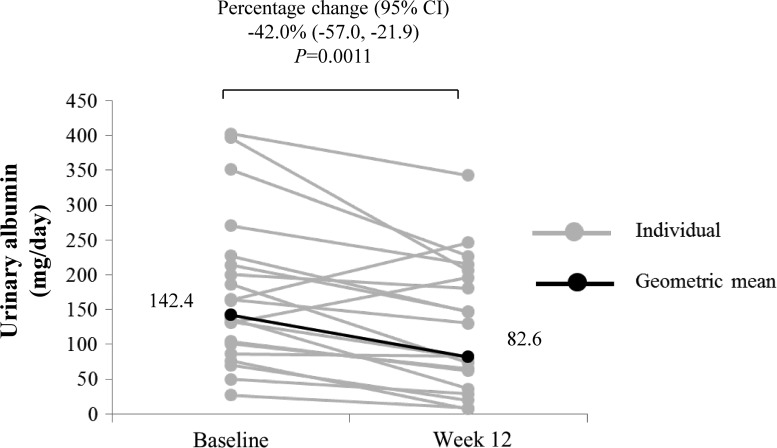
The urinary albumin level decreased by 42.0% (95% confidence interval: 21.9-57.0; P = 0.0011) after 12 weeks of canagliflozin treatment. A number of blood and urinary parameters also significantly decreased, including hemoglobin A1c, fasting plasma glucose, estimated glomerular filtration rate, and creatinine clearance, while hematocrit was elevated. Among the biomarkers associated with kidney injury and inflammation, the urinary level of the oxidative stress marker 8-hydroxy-2'-deoxyguanosine was also decreased. There were no meaningful correlations noted between changes in urinary albumin excretion and other parameters/biomarkers. No severe adverse events were reported over the 12-week treatment period.
The results of this study indicate that canagliflozin decreases microalbuminuria in Japanese patients with T2DM. Albuminuria could be reduced as a result of changes in various physiological pathways; therefore, it is imperative that future, large-scale, studies attempt to determine the detailed mechanisms involved. Canagliflozin may offer a novel therapeutic option for Japanese patients with T2DM and incipient nephropathy.
白蛋白尿是肾脏损伤进展的特征。评估卡格列净对微白蛋白排泄的影响,以研究其在日本 2 型糖尿病(T2DM)患者中的肾脏保护潜力。
20 名日本 T2DM 合并微量白蛋白尿患者接受卡格列净 100mg 治疗,每天一次,疗程 12 周。这些患者在治疗开始和结束时入住诊所进行 24 小时尿液收集。主要终点是从基线到第 12 周几何均数 24 小时尿白蛋白排泄的百分比变化。
卡格列净治疗 12 周后,尿白蛋白水平下降 42.0%(95%置信区间:21.9-57.0;P=0.0011)。多项血液和尿液参数也显著下降,包括糖化血红蛋白、空腹血糖、估算肾小球滤过率和肌酐清除率,而红细胞压积升高。在与肾脏损伤和炎症相关的生物标志物中,氧化应激标志物 8-羟基-2'-脱氧鸟苷的尿水平也降低。尿白蛋白排泄的变化与其他参数/生物标志物之间没有明显相关性。在 12 周治疗期间未报告严重不良事件。
本研究结果表明,卡格列净可降低日本 T2DM 患者的微量白蛋白尿。白蛋白尿的减少可能是由于各种生理途径的变化所致;因此,未来需要进行大规模研究以确定涉及的详细机制。卡格列净可能为日本 T2DM 和早期肾病患者提供一种新的治疗选择。