Biological Station Rybachy, Zoological Institute of Russian Academy of Sciences, 238535, Rybachy, Kaliningrad Region, Russia.
Sechenov Institute of Evolutionary Physiology and Biochemistry, Russian Academy of Sciences, 194223, St. Petersburg, Russia.
Sci Rep. 2018 Aug 10;8(1):11975. doi: 10.1038/s41598-018-30477-8.
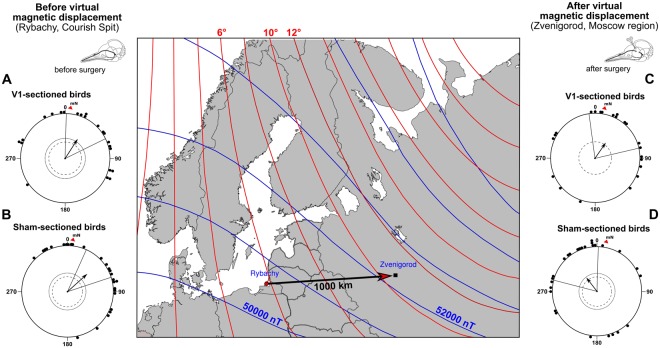
Recently, virtual magnetic displacement experiments have shown that magnetic cues are indeed important for determining position in migratory birds; but which sensory system(s) do they use to detect the magnetic map cues? Here, we show that Eurasian reed warblers need trigeminal input to detect that they have been virtually magnetically displaced. Birds with bilaterally ablated ophthalmic branches of the trigeminal nerves were not able to re-orient towards their conspecific breeding grounds after a virtual magnetic displacement, exactly like they were not able to compensate for a real physical displacement. In contrast, sham-operated reed warblers re-oriented after the virtual displacement, like intact controls did in the past. Our results show that trigeminally mediated sensory information is necessary for the correct function of the reed warblers' magnetic positioning system.
最近的虚拟磁场位移实验表明,磁场线索确实对候鸟确定位置很重要;但是它们使用哪个(或哪些)感觉系统来检测磁场地图线索呢?在这里,我们表明,欧亚苇莺需要三叉神经输入来检测它们是否已经被虚拟地磁化。双侧眶支三叉神经被切断的鸟类在虚拟磁场位移后无法重新定向到它们同种的繁殖地,就像它们无法补偿真实的物理位移一样。相比之下,假手术的苇莺在虚拟位移后重新定向,就像过去的完整对照组一样。我们的结果表明,三叉神经介导的感觉信息对于苇莺的磁定位系统的正确功能是必要的。