Schulte Marianne, Petrović Dušan, Neudecker Philipp, Hartmann Rudolf, Pietruszka Jörg, Willbold Sabine, Willbold Dieter, Panwalkar Vineet
Institut für Physikalische Biologie, Heinrich-Heine-Universität Düsseldorf, 40225 Düsseldorf, Germany.
Institute of Complex Systems 6 (ICS-6): Structural Biochemistry, Forschungszentrum Jülich, 52425 Jülich, Germany.
ACS Catal. 2018 May 4;8(5):3971-3984. doi: 10.1021/acscatal.7b04408. Epub 2018 Mar 27.
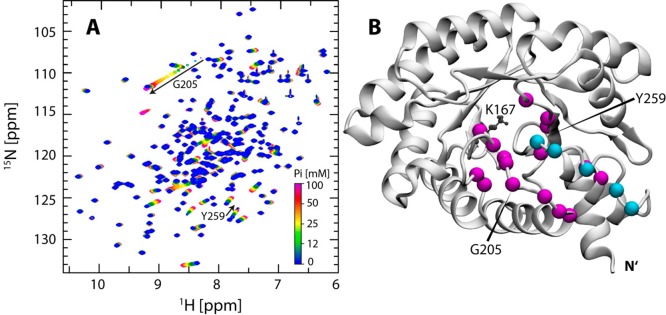
2-Deoxyribose-5-phosphate aldolase (DERA) catalyzes the reversible conversion of acetaldehyde and glyceraldehyde-3-phosphate into deoxyribose-5-phosphate. DERA is used as a biocatalyst for the synthesis of drugs such as statins and is a promising pharmaceutical target due to its involvement in nucleotide catabolism. Despite previous biochemical studies suggesting the catalytic importance of the C-terminal tyrosine residue found in several bacterial DERAs, the structural and functional basis of its participation in catalysis remains elusive because the electron density for the last eight to nine residues (i.e., the C-terminal tail) is absent in all available crystal structures. Using a combination of NMR spectroscopy and molecular dynamics simulations, we conclusively show that the rarely studied C-terminal tail of DERA (DERA) is intrinsically disordered and exists in equilibrium between open and catalytically relevant closed states, where the C-terminal tyrosine (Y259) enters the active site. Nuclear Overhauser effect distance restraints, obtained due to the presence of a substantial closed state population, were used to derive the solution-state structure of the DERA closed state. Real-time NMR hydrogen/deuterium exchange experiments reveal that Y259 is required for efficiency of the proton abstraction step of the catalytic reaction. Phosphate titration experiments show that, in addition to the phosphate-binding residues located near the active site, as observed in the available crystal structures, DERA contains previously unknown auxiliary phosphate-binding residues on the C-terminal tail which could facilitate in orienting Y259 in an optimal position for catalysis. Thus, we present significant insights into the structural and mechanistic importance of the DERA C-terminal tail and illustrate the role of conformational sampling in enzyme catalysis.
2-脱氧核糖-5-磷酸醛缩酶(DERA)催化乙醛和3-磷酸甘油醛可逆转化为5-磷酸脱氧核糖。DERA被用作合成他汀类药物等药物的生物催化剂,由于其参与核苷酸分解代谢,它是一个有前景的药物靶点。尽管先前的生化研究表明在几种细菌DERA中发现的C末端酪氨酸残基具有催化重要性,但由于所有可用晶体结构中都没有最后八到九个残基(即C末端尾巴)的电子密度,其参与催化的结构和功能基础仍然难以捉摸。我们结合核磁共振光谱和分子动力学模拟,确凿地表明DERA很少被研究的C末端尾巴是内在无序的,并且在开放状态和与催化相关的闭合状态之间存在平衡,其中C末端酪氨酸(Y259)进入活性位点。由于存在大量的闭合状态群体而获得的核Overhauser效应距离限制被用于推导DERA闭合状态的溶液状态结构。实时核磁共振氢/氘交换实验表明,Y259是催化反应质子抽取步骤效率所必需的。磷酸盐滴定实验表明,除了在可用晶体结构中观察到的位于活性位点附近的磷酸盐结合残基外,DERA在C末端尾巴上还含有先前未知的辅助磷酸盐结合残基,这些残基有助于将Y259定位在催化的最佳位置。因此,我们对DERA C末端尾巴的结构和机制重要性提供了重要见解,并阐明了构象采样在酶催化中的作用。