Department of Biostatistics.
Department of Epidemiology, Harvard T.H. Chan School of Public Health, Boston, Massachusetts.
AIDS. 2018 Oct 23;32(16):2337-2346. doi: 10.1097/QAD.0000000000001988.
To evaluate potential adverse associations of individual antiretroviral medications used in combination antiretroviral therapy regimens on cardiac structure and function in youth with perinatally-acquired HIV infection (PHIV).
PHIV youth (N = 325) enrolled in a prospective multisite cohort study had a single echocardiogram at age 7-16 years to evaluate cardiac function and structure.
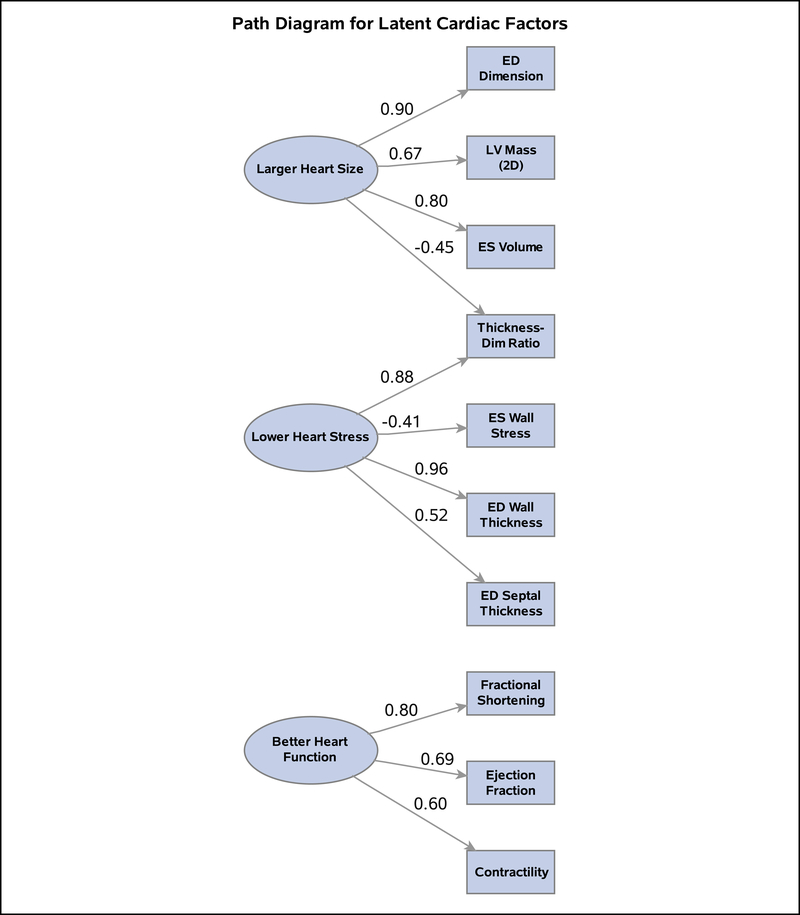
We applied several statistical approaches to evaluate associations between use of 18 individual antiretroviral medications with Z-scores for 11 measures of left ventricular function and structure. These included simultaneously evaluating all antiretroviral medications in adjusted linear regression models controlling for the false discovery rate (FDR), applying hierarchical models to estimate individual antiretroviral medication effects as deviations from drug class means, and evaluating latent measures of cardiac function and structure underlying multiple echocardiographic parameters.
Youth taking combination regimens with a protease inhibitor (69%) had significantly better cardiac function than those on other regimens. After FDR control and adjustment for other antiretroviral medications, no individual antiretroviral medication was significantly associated with any measure of left ventricular function, but zidovudine was associated with higher adjusted mean Z-scores for one measure of left ventricular structure (end-systolic wall stress). Factor analysis identified three latent factors: heart function, heart size, and heart wall stress. Lopinavir was associated with better heart function scores, whereas zidovudine was associated with higher wall stress scores. Zidovudine and nevirapine were associated with higher heart size factor scores.
Despite cardioprotective effects of combination regimens in PHIV youth, individual antiretroviral medications were associated with altered cardiac structure, which could progress to symptomatic cardiomyopathy in adulthood.
评估联合抗逆转录病毒疗法方案中使用的个别抗逆转录病毒药物对经母婴传播感染 HIV(PHIV)的青年人群心脏结构和功能的潜在不良关联。
PHIV 青年(N=325)入组前瞻性多中心队列研究,在 7-16 岁时进行单次超声心动图检查,以评估心脏功能和结构。
我们应用几种统计方法来评估 18 种个别抗逆转录病毒药物与 11 项左心室功能和结构指标的 Z 分数之间的关联。这些方法包括:同时在调整后的线性回归模型中评估所有抗逆转录病毒药物,控制假发现率(FDR);应用层次模型来估计个别抗逆转录病毒药物对药物类别平均值的偏离效应;评估潜在的心脏功能和结构测量指标,这些指标基于多个超声心动图参数。
服用包含蛋白酶抑制剂的联合治疗方案(69%)的青年心脏功能明显优于其他方案。在 FDR 控制和调整其他抗逆转录病毒药物后,没有一种个别抗逆转录病毒药物与任何左心室功能测量指标显著相关,但齐多夫定与一项左心室结构测量指标(收缩末期壁应力)的调整平均 Z 分数较高有关。因子分析确定了三个潜在因素:心脏功能、心脏大小和心脏壁应力。洛匹那韦与更好的心脏功能评分相关,而齐多夫定则与更高的壁应力评分相关。齐多夫定和奈韦拉平与更高的心脏大小因子评分相关。
尽管 PHIV 青年人群的联合治疗方案具有心脏保护作用,但个别抗逆转录病毒药物与心脏结构改变有关,这种改变可能在成年后进展为症状性心肌病。