School of Public Health, Southeast University, Nanjing 210003, China.
Department of Environmental Health, Nanjing Municipal Center for Disease Control and Prevention, Nanjing 210003, China.
Int J Environ Res Public Health. 2018 Aug 12;15(8):1728. doi: 10.3390/ijerph15081728.
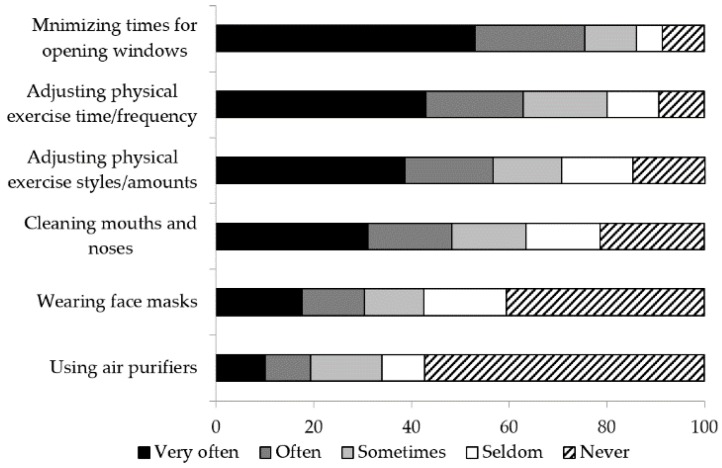
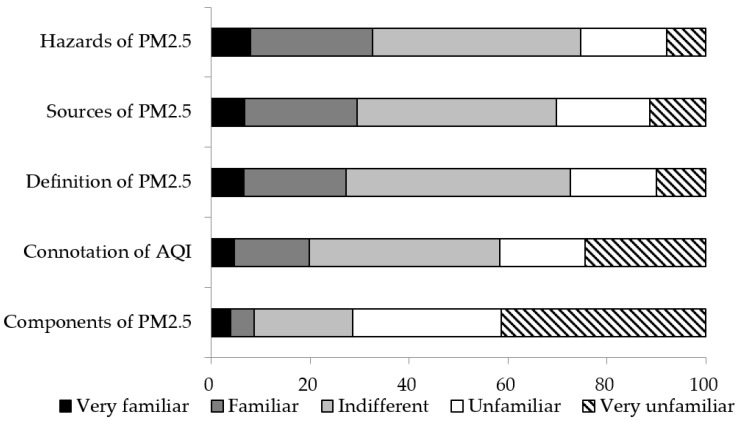
: This study aimed to describe risk reduction behaviors regarding ambient particulate matter with a diameter of 2.5 μm or less (PM) among outdoor exercisers and to explore potential factors influencing those behaviors in the urban area of Nanjing, China. : A cross-sectional convenience sample survey was conducted among 302 outdoor exercisers in May 2015. Descriptive analysis was used to describe demographics, outdoor physical activity patterns, knowledge of PM and risk reduction behaviors. Multivariate logistic regression analysis was then used to explore factors that influence the adoption of risk reduction behaviors. : The most common behavior to reduce PM exposure was minimizing the times for opening windows on hazy days (75.5%), and the least common one was using air purifiers (19.3%). Two thirds of respondents indicated that they wore face masks when going outside in the haze (59.5%), but only 13.6% of them would wear professional antismog face masks. Participants adopting risk reduction behaviors regarding PM exposure tended to be females, 50⁻60 year-olds, those with higher levels of knowledge about PM and those who had children. : These findings indicate the importance of improving knowledge about PM among outdoor exercisers. Educational interventions should also be necessary to guide the public to take appropriate precautionary measures when undertaking outdoor exercise in high PM pollution areas.
本研究旨在描述中国南京市城区户外锻炼者对直径 2.5μm 以下的大气细颗粒物(PM)的降低风险行为,并探讨影响这些行为的潜在因素。
2015 年 5 月,采用便利抽样法对 302 名户外锻炼者进行了横断面调查。采用描述性分析对人口统计学特征、户外体育活动模式、PM 知识和降低风险行为进行了描述。然后采用多变量逻辑回归分析探讨了影响采用降低风险行为的因素。
降低 PM 暴露风险的最常见行为是在雾霾天尽量减少开窗通风的次数(75.5%),而最不常见的行为是使用空气净化器(19.3%)。三分之二的受访者表示,在雾霾天外出时会戴口罩(59.5%),但只有 13.6%的人会戴专业的防雾霾口罩。采取降低 PM 暴露风险行为的参与者往往是女性、50-60 岁、PM 知识水平较高以及有孩子的人。
这些发现表明,提高户外锻炼者对 PM 的认识非常重要。还需要开展教育干预,指导公众在高 PM 污染地区进行户外锻炼时采取适当的预防措施。