Centre for Environmental Sciences, Hasselt University, Agoralaan Building D, 3590, Diepenbeek, Belgium.
Department of Analytical and Environmental Chemistry, Vrije Universiteit Brussel, Brussels, Belgium.
J Transl Med. 2018 Aug 13;16(1):224. doi: 10.1186/s12967-018-1599-z.
The developmental origins of health and disease theory states that a disturbance in the early life environment can contribute to disease risk in later life. Leptin and insulin are anorectic hormones involved in energy homeostasis and are crucial for foetal growth. Disturbances in the levels of these hormones contribute to obesity and diabetes. In adults, altered mitochondrial function is an important hallmark of metabolic disorders, including obesity and diabetes. However, the mitochondrial effects of early life metabolic variation are unexplored. We investigated whether there is an association between metabolic hormones and mitochondrial DNA (mtDNA) content in early life.
The study included 236 newborns from the FLEHS III birth cohort, Flanders (Belgium). Relative mtDNA content of cord blood leukocytes was determined using quantitative PCR. Cord blood levels of leptin and insulin were determined using immunoassays. We studied the association between these metabolic hormones and mtDNA content using multiple linear regression models, while accounting for covariates and potential confounders.
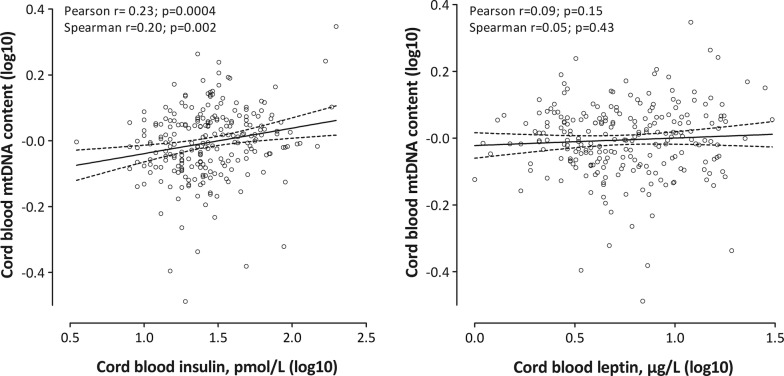
Leptin and insulin levels were positively associated with cord blood mtDNA content. mtDNA content was respectively 4.49% (95% CI 1.15-7.93; p = 0.008) and 1.60% (95% CI 0.31-2.91; p = 0.02) higher for a interquartile range increase of respectively cord blood leptin and insulin levels. In a sensitivity analysis, we observed that insulin and leptin were independently associated to mtDNA content and that insulin was stronger associated to mtDNA content in boys than in girls.
Neonatal metabolic hormones were associated with cord blood mtDNA content, which suggests that in early life the variation of mtDNA content might accommodate or reflect changes in the metabolic status.
健康与疾病的起源理论指出,早期生活环境的干扰可能导致晚年疾病风险增加。瘦素和胰岛素是参与能量平衡的厌食激素,对胎儿生长至关重要。这些激素水平的紊乱会导致肥胖和糖尿病。在成年人中,线粒体功能的改变是肥胖和糖尿病等代谢紊乱的重要标志。然而,早期生活代谢变化对线粒体的影响尚未得到探索。我们研究了代谢激素与早期生命中线粒体 DNA(mtDNA)含量之间是否存在关联。
本研究纳入了来自佛兰德(比利时)FLEHS III 出生队列的 236 名新生儿。使用定量 PCR 测定脐带血白细胞中的相对 mtDNA 含量。使用免疫测定法测定脐带血中的瘦素和胰岛素水平。我们使用多元线性回归模型研究了这些代谢激素与 mtDNA 含量之间的关系,同时考虑了协变量和潜在的混杂因素。
瘦素和胰岛素水平与脐带血 mtDNA 含量呈正相关。脐带血瘦素和胰岛素水平每增加一个四分位距,mtDNA 含量分别增加 4.49%(95%CI 1.15-7.93;p=0.008)和 1.60%(95%CI 0.31-2.91;p=0.02)。在敏感性分析中,我们观察到胰岛素和瘦素与 mtDNA 含量独立相关,且胰岛素与男孩的 mtDNA 含量相关性强于女孩。
新生儿代谢激素与脐带血 mtDNA 含量相关,这表明在生命早期,mtDNA 含量的变化可能适应或反映代谢状态的变化。