Mitanchez Delphine, Jacqueminet Sophie, Nizard Jacky, Tanguy Marie-Laure, Ciangura Cécile, Lacorte Jean-Marc, De Carne Céline, Foix L'Hélias Laurence, Chavatte-Palmer Pascale, Charles Marie-Aline, Dommergues Marc
Department of Perinatality, APHP, GHUEP, Armand Trousseau Hospital, Paris, France.
Sorbonne Universities, UPMC University Paris 06, Paris, France.
PLoS One. 2017 Jul 27;12(7):e0181307. doi: 10.1371/journal.pone.0181307. eCollection 2017.
To discriminate the effect of maternal obesity and gestational diabetes on birth weight and adipose tissue of the newborn.
Normal BMI women (group N, n = 243; 18.5≤ BMI<25 kg/m2) and obese women (group Ob, n = 253; BMI≥30 kg/m2) were recruited in a prospective study between 15 and 18 weeks of gestation. All women were submitted to a 75g oral glucose tolerance test in the second and third trimester. First trimester fasting blood glucose was also obtained from Ob women. All women with one measurement above normal values were considered positive for gestational diabetes and first treated by dietary intervention. When dietary measures were not efficient, they were treated by insulin. Neonatal anthropometrics, sum of skinfolds and cord serum hormones were measured.
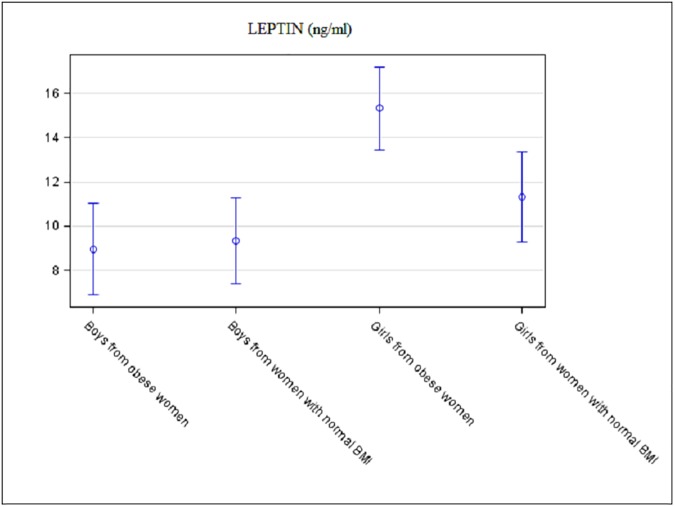
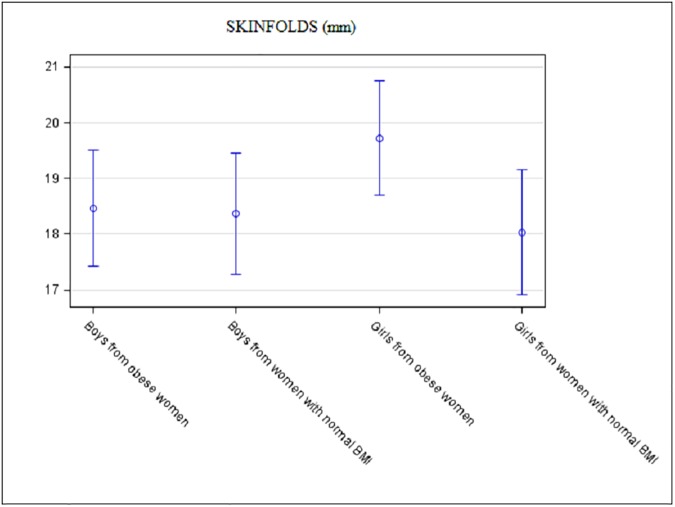
222 N and 226 Ob mothers and their newborns were included in the analysis. Diabetes was diagnosed in 20% and 45.2% of N and Ob women, respectively. Birth weight was not statistically different between groups (boys: 3456g±433 and 3392g±463; girls: 3316g±402 and 3391g±408 for N and Ob, respectively). Multivariate analysis demonstrated that skinfold thickness and serum leptin concentrations were significantly increased in girls born to women with obesity (18.0mm±0.6 versus 19.7mm±0.5, p = 0.004 and 11.3ng/mL±1.0 versus 15.3ng/mL±1.0, p = 0.02), but not in boys (18.4mm±0.6 versus 18.5mm±0.5, p = 0.9 and 9.3ng/mL±1.0 versus 9.0ng/mL±1.0, p = 0.9). Based on data from 136 N and 124 Ob women, maternal insulin resistance at 37 weeks was also positively related to skinfold in girls, only, with a 1-point increase in HOMA-IR corresponding to a 0.33mm±0.08 increase in skinfold (p<0.0001).
Regardless of gestational diabetes, maternal obesity and insulin resistance were associated with increased adiposity in girls only. Persistence of this sexual dimorphism remains to be explored during infancy.
鉴别母亲肥胖和妊娠期糖尿病对新生儿出生体重及脂肪组织的影响。
在一项前瞻性研究中,招募了妊娠15至18周的正常体重指数(BMI)女性(N组,n = 243;18.5≤BMI<25 kg/m²)和肥胖女性(Ob组,n = 253;BMI≥30 kg/m²)。所有女性在孕中期和孕晚期均接受了75克口服葡萄糖耐量试验。还获取了Ob组女性孕早期的空腹血糖。所有有一次测量值高于正常值的女性被视为妊娠期糖尿病阳性,并首先接受饮食干预治疗。当饮食措施无效时,她们接受胰岛素治疗。测量了新生儿的人体测量学指标、皮褶厚度总和及脐血血清激素。
222名N组母亲及其新生儿和226名Ob组母亲及其新生儿纳入分析。N组和Ob组女性中分别有20%和45.2%被诊断为糖尿病。两组间出生体重无统计学差异(男孩:N组为3456克±433,Ob组为3392克±463;女孩:N组为3316克±402,Ob组为3391克±408)。多因素分析表明,肥胖女性所生女孩的皮褶厚度和血清瘦素浓度显著增加(分别为18.0毫米±0.6与19.7毫米±0.5,p = 0.004;11.3纳克/毫升±1.0与15.3纳克/毫升±1.0,p = 0.02),但男孩中无此现象(分别为18.4毫米±0.6与18.5毫米±0.5,p = 0.9;9.3纳克/毫升±1.0与9.0纳克/毫升±1.0,p = 0.9)。基于136名N组女性和124名Ob组女性的数据,仅在女孩中,孕37周时母亲的胰岛素抵抗也与皮褶厚度呈正相关,稳态模型评估的胰岛素抵抗(HOMA-IR)每增加1个单位,皮褶厚度增加0.33毫米±0.08(p<0.0001)。
无论是否患有妊娠期糖尿病,母亲肥胖和胰岛素抵抗仅与女孩肥胖增加有关。这种性别差异在婴儿期是否持续仍有待探索。