Institute of Neuroinformatics, University of Zurich and ETH Zurich, Winterthurerstrasse 190, 8057, Zurich, Switzerland.
Neuroscience Center Zurich, University of Zurich and ETH Zurich, Winterthurerstrasse 190, 8057, Zurich, Switzerland.
Nat Commun. 2018 Aug 13;9(1):3218. doi: 10.1038/s41467-018-05422-y.
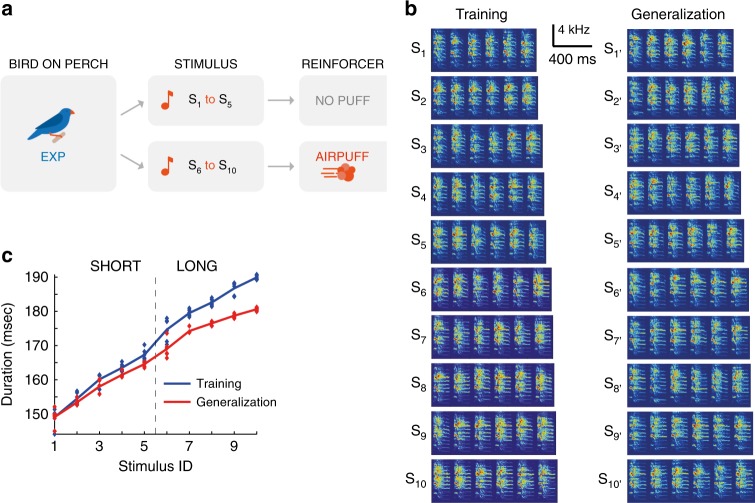
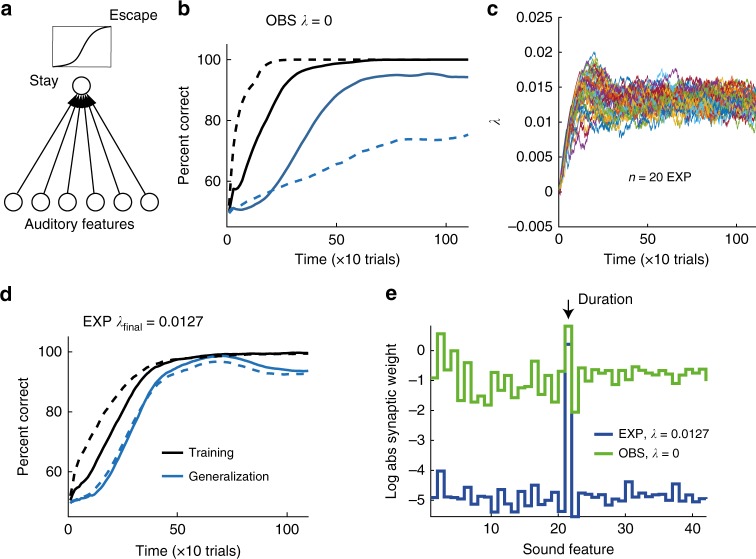
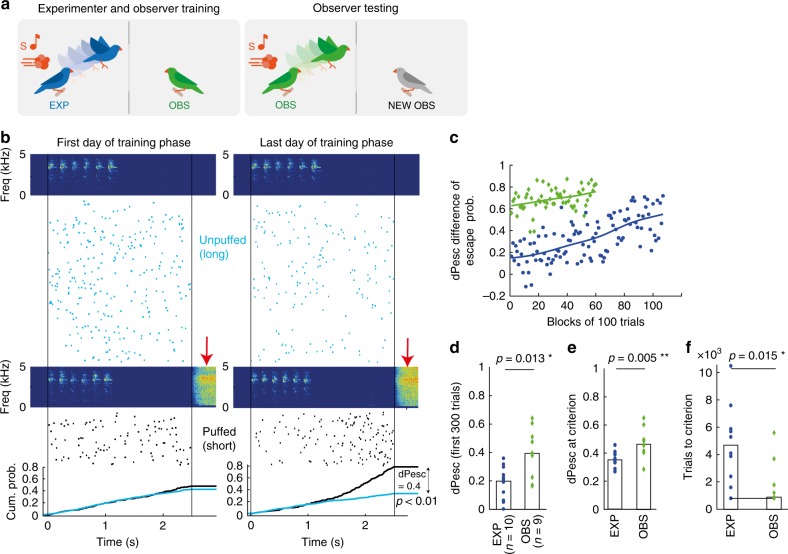
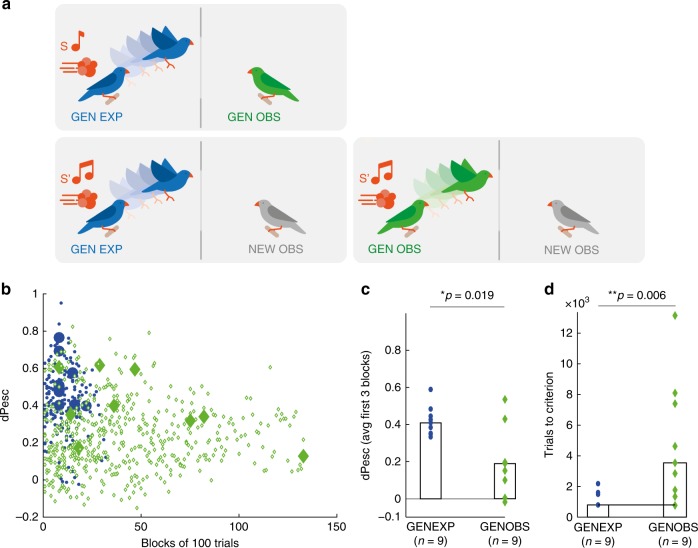
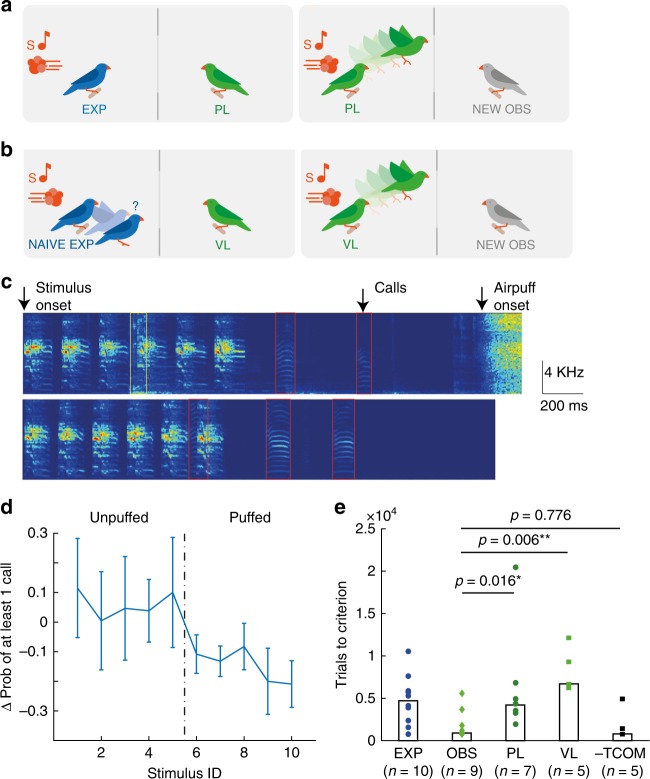
Social learning enables complex societies. However, it is largely unknown how insights obtained from observation compare with insights gained from trial-and-error, in particular in terms of their robustness. Here, we use aversive reinforcement to train "experimenter" zebra finches to discriminate between auditory stimuli in the presence of an "observer" finch. We show that experimenters are slow to successfully discriminate the stimuli, but immediately generalize their ability to a new set of similar stimuli. By contrast, observers subjected to the same task are able to discriminate the initial stimulus set, but require more time for successful generalization. Drawing on concepts from machine learning, we suggest that observer learning has evolved to rapidly absorb sensory statistics without pressure to minimize neural resources, whereas learning from experience is endowed with a form of regularization that enables robust inference.
社会学习使复杂的社会成为可能。然而,从观察中获得的见解与通过试错获得的见解相比,特别是在稳健性方面,其优势在很大程度上仍是未知的。在这里,我们使用厌恶性强化来训练“实验者”斑胸草雀在“观察者”斑胸草雀存在的情况下区分听觉刺激。我们表明,实验者需要很长时间才能成功区分刺激,但会立即将其区分能力推广到一组新的类似刺激上。相比之下,接受相同任务的观察者能够区分初始刺激集,但需要更多时间才能成功推广。借鉴机器学习的概念,我们认为,观察者的学习已经进化到能够快速吸收感官统计信息,而不会对最小化神经资源施加压力,而从经验中学习则具有一种能够实现稳健推断的正则化形式。