Department of Tourism, Collegium of World Economy, Warsaw School of Economics, Warsaw, Poland,
Department of Organization and History of Sport, Faculty of Physical Education, Józef Pilsudski University of Physical Education in Warsaw, Warsaw, Poland.
Clin Interv Aging. 2018 Jul 31;13:1341-1352. doi: 10.2147/CIA.S167131. eCollection 2018.
This paper concerns participation of Poles aged 15+ years in leisure time and transport-related physical activity (PA) with a special focus on the life stages. The purpose of the paper was to analyze types of exercises, current and future behavior concerning PA, availability of sport and recreation facilities, and factors having the strongest relation with undertaking PA at a sufficient level according to pro-health recommendations of World Health Organization (WHO).
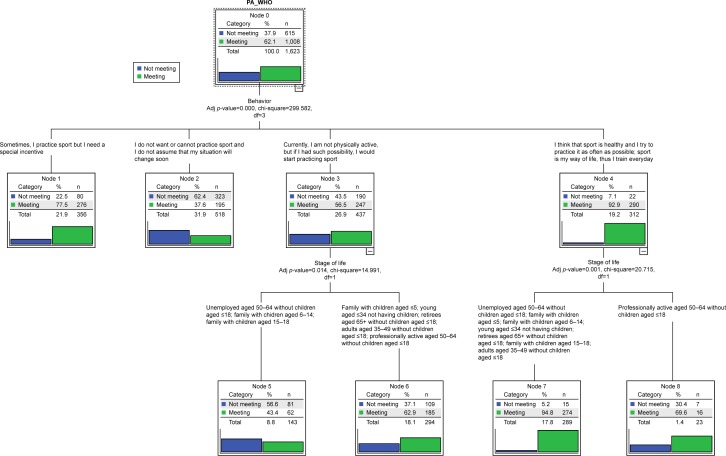
A survey was carried out on the representative sample (n=2,000). Respondents were classified in accordance to their life stages with a two-step cluster analysis. Relationships between meeting the dose of PA required for health recommendations and a membership in groups of life stages were evaluated using log-linear analysis. The strength of this relationship was expressed by the odds ratio. In order to capture relationships between meeting WHO recommendations and a set of explanatory variables, a predictive model was built.
Life stages and various related events have a significant relation with a decrease of PA. Among groups of a particular risk, there are professionally active and unemployed people aged 50-64 years without children as well as retirees aged 65+ years who do not meet WHO recommendations (45.3; 50.4% and 47.6%). The unemployed and retirees more frequently (<0.0001) do not or cannot practice sport and do not think that a change of their situation is expected soon. However, 35% of professionally active people aged 50-64 years without children and 18.2% of unemployed people declare that they are currently not active but if they had the possibility, they would start practicing sport.
Campaigns promoting PA should be targeted at groups of a particular risk. Any attempts of increasing PA or changing tendencies of its decrease should consider life conditions of these persons, as well as their needs, motivations, and barriers.
本文关注 15 岁以上波兰人参与休闲时间和与交通相关的体育活动(PA)的情况,特别关注生命阶段的作用。本文的目的是分析锻炼类型、当前和未来的 PA 行为、体育和娱乐设施的可用性,以及与根据世界卫生组织(WHO)促进健康建议进行足够 PA 相关的最强因素。
对代表性样本(n=2000)进行了调查。根据两步聚类分析对受访者进行分类。使用对数线性分析评估满足 PA 推荐剂量与生命阶段组归属之间的关系。采用比值比表示这种关系的强度。为了捕捉满足 WHO 建议与一组解释变量之间的关系,构建了一个预测模型。
生命阶段和各种相关事件与 PA 的减少有显著关系。在特定风险群体中,有职业活跃和失业的 50-64 岁无子女人群以及 65 岁以上的退休人员不符合 WHO 建议(45.3%;50.4%和 47.6%)。失业者和退休者更频繁地(<0.0001)不或不能进行体育活动,也不认为他们的情况很快会发生变化。然而,35%的 50-64 岁无子女的职业活跃人群和 18.2%的失业人群表示他们目前不活跃,但如果有机会,他们将开始进行体育活动。
应针对特定风险群体开展 PA 宣传活动。任何增加 PA 或改变其减少趋势的尝试都应考虑这些人的生活条件,以及他们的需求、动机和障碍。