Xu Xiaolong, Liu Qingquan, He Shasha, Zhao Jingxia, Wang Ning, Han Xuyang, Guo Yuhong
Beijing Hospital of Traditional Chinese Medicine, Affiliated with Capital Medical University, Beijing, China.
Beijing Institute of Traditional Chinese Medicine, Beijing, China.
Front Pharmacol. 2018 Jul 30;9:818. doi: 10.3389/fphar.2018.00818. eCollection 2018.
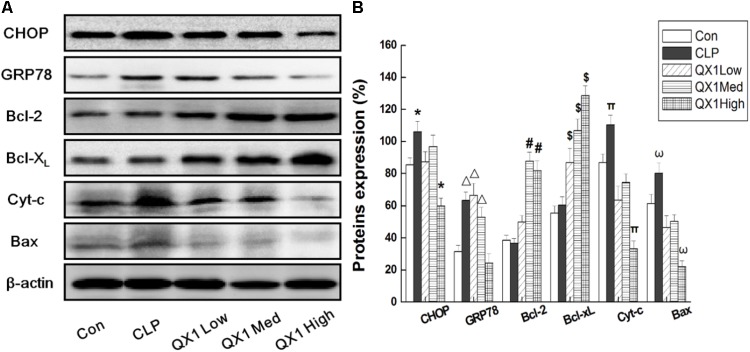
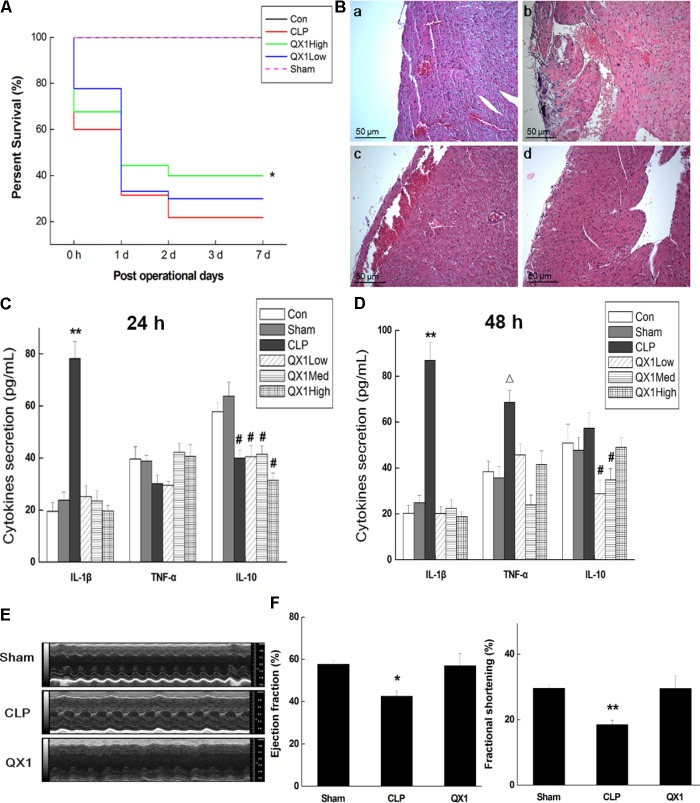
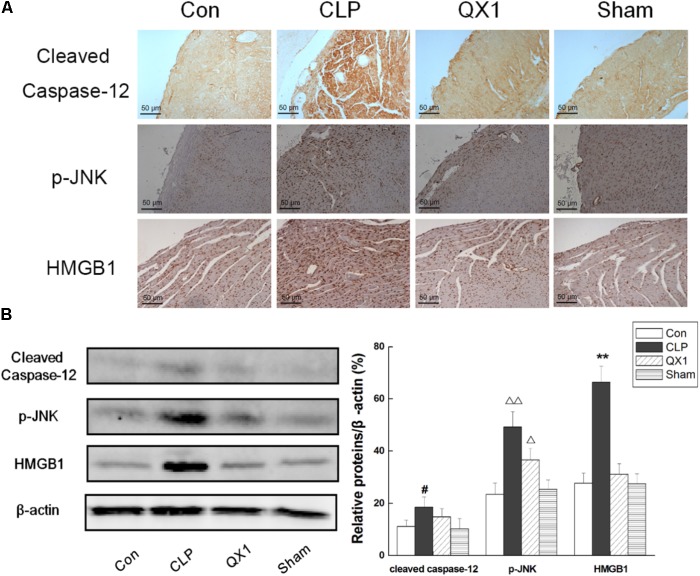
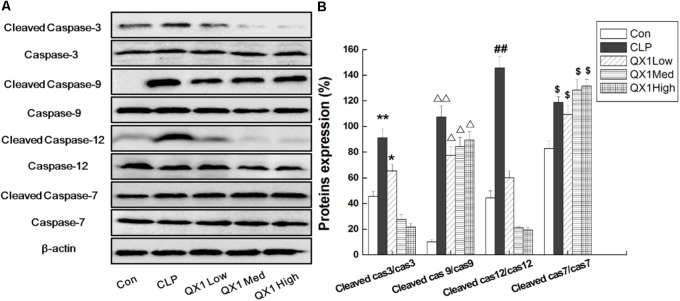
Sepsis is reported to be an unusual systemic reaction to infection, accompanied by multiple-organ failure. Sepsis-induced cardiomyopathy (SIC), defined as damages and dysfunction of the heart, is essential in the pathogenesis of sepsis. Traditional Chinese formula, which has long been used to improve the situation of patients through multitarget regulation, is now gradually being used as complementary therapy. The present study aimed to investigate the effect of Qiang-Xin 1 (QX1) formula, a traditional Chinese herbal medicine designed for cardiac dysfunction, on cecal ligation puncture (CLP)-induced heart damage and its underlying mechanisms in mice. Survival test first showed that an oral administration of QX1 formula significantly increased the 7-days survival of septic mice from 22 to 40%. By estimating the secretion of serum cytokines, QX1 treatment dramatically inhibited the excessive production of interleukin-1β and tumor necrosis factor-α. Immunohistochemical staining illustrated that the expression of c-Jun N-terminal kinase, caspase-12, and high-mobility group box 1 was downregulated in cardiomyocytes of the QX1-treated group compared with that of the CLP surgery group. Western blotting confirmed that the activation of essential caspase family members, such as caspase-3, caspase-9, and caspase-12, was prohibited by treatment with QX1. Moreover, the abnormal expression of key regulators of endoplasmic reticulum (ER) and mitochondria-associated apoptosis in cardiomyocytes of septic mice, including CHOP, GRP78, Cyt-c, Bcl-2, Bcl-X, and Bax, was effectively reversed by treatment with QX1 formula. This study provided a new insight into the role of QX1 formula in heart damage and potential complementary therapeutic effect of traditional Chinese medicine on sepsis.
据报道,脓毒症是一种对感染的异常全身反应,伴有多器官功能衰竭。脓毒症诱导的心肌病(SIC),定义为心脏损伤和功能障碍,在脓毒症的发病机制中至关重要。长期以来用于通过多靶点调节改善患者状况的中药配方,现在正逐渐用作辅助治疗。本研究旨在探讨强心1号(QX1)配方,一种针对心脏功能障碍设计的中药,对盲肠结扎穿刺(CLP)诱导的小鼠心脏损伤及其潜在机制的影响。生存试验首先表明,口服QX1配方显著提高了脓毒症小鼠的7天生存率,从22%提高到40%。通过估计血清细胞因子的分泌,QX1治疗显著抑制了白细胞介素-1β和肿瘤坏死因子-α的过度产生。免疫组织化学染色表明,与CLP手术组相比,QX1治疗组心肌细胞中c-Jun氨基末端激酶、半胱天冬酶-12和高迁移率族蛋白B1的表达下调。蛋白质印迹法证实,用QX1治疗可抑制关键半胱天冬酶家族成员如半胱天冬酶-3、半胱天冬酶-9和半胱天冬酶-12的激活。此外,用QX1配方治疗可有效逆转脓毒症小鼠心肌细胞中内质网(ER)和线粒体相关凋亡关键调节因子的异常表达,包括CHOP、GRP78、细胞色素c、Bcl-2、Bcl-X和Bax。本研究为QX1配方在心脏损伤中的作用以及中药对脓毒症的潜在辅助治疗作用提供了新的见解。