Department of Infectious Diseases, Shanghai Public Health Clinical Center, China.
Chronic Viral Illness Service, McGill University Health Centre, Montreal, Quebec, Canada.
Clin Infect Dis. 2019 Apr 8;68(8):1274-1281. doi: 10.1093/cid/ciy676.
Indoleamine 2,3-dioxygenase (IDO) is an immunoregulatory enzyme that metabolizes tryptophan to immunosuppressive kynurenines. We investigated whether IDO activity is associated with the size of HIV reservoir.
Total human immunodeficiency virus (HIV) DNA in peripheral blood mononuclear cells (PBMCs) from 127 HIV-infected patients receiving antiretroviral therapy (ART) was quantified. Tryptophan and kynurenine concentrations, as well as microbial translocation markers, were measured in plasma samples. T-cell activation and exhaustion in PBMCs were assessed by flow cytometry.
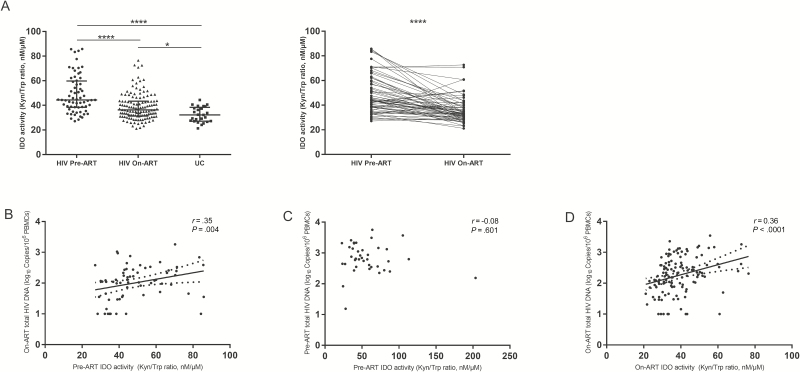
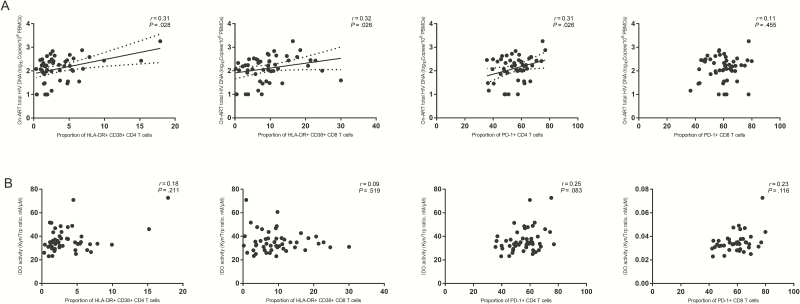
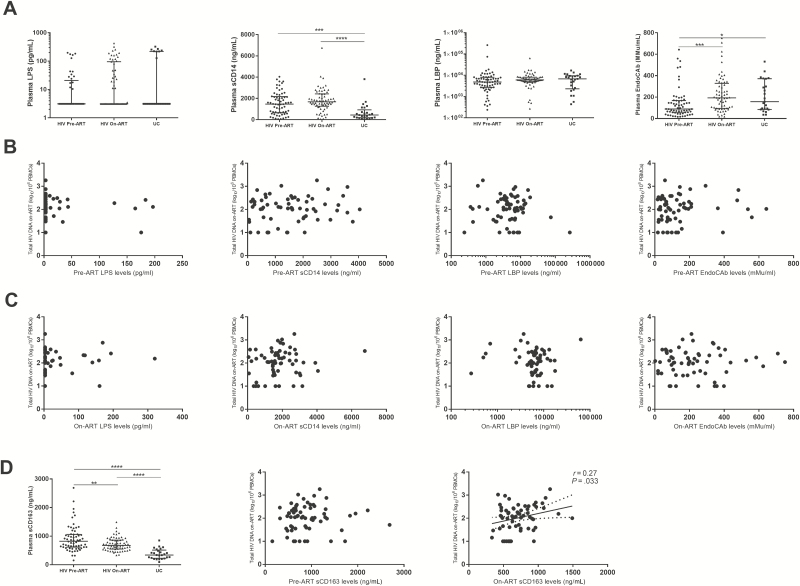
Elevated IDO activity prior to ART correlated with on-ART HIV DNA (r = 0.35, P = .004), but was not associated with pre-ART HIV DNA. A median duration of 15 months of ART significantly decreased IDO activity; however, these levels were still higher than those observed in HIV-uninfected controls. Among treated participants, IDO activity positively correlated with their concurrent HIV DNA (r = 0.36, P < .0001). Multivariate model showed an independent association of pre-ART CD4/CD8 ratio (adjusted odds ratio [aOR], 0.75 per 0.1 increase [95% confidence interval {CI}, .62-.91]) and on-ART IDO activity (aOR, 1.09 per nM/μM increase [95% CI, 1.04-1.14]) with higher levels of HIV DNA on-ART. A lack of association of the microbial translocation markers was observed with the size of HIV reservoir. HIV DNA positively correlated with the proportions of activated CD4 T and CD8 T cells and exhausted CD4 T cells.
We observed a positive correlation between IDO activity and total HIV DNA in blood, highlighting the important role of immunometabolic aberrations in HIV persistence.
吲哚胺 2,3-双加氧酶(IDO)是一种免疫调节酶,可将色氨酸代谢为免疫抑制性犬尿氨酸。我们研究了 IDO 活性是否与 HIV 储存库的大小有关。
对 127 名接受抗逆转录病毒治疗(ART)的 HIV 感染者外周血单个核细胞(PBMC)中的总人类免疫缺陷病毒(HIV)DNA 进行定量。在血浆样本中测量色氨酸和犬尿氨酸浓度以及微生物易位标志物。通过流式细胞术评估 PBMC 中的 T 细胞激活和耗竭。
ART 前升高的 IDO 活性与 ART 时的 HIV DNA 相关(r = 0.35,P =.004),但与 ART 前的 HIV DNA 无关。中位时长为 15 个月的 ART 显著降低了 IDO 活性;然而,这些水平仍高于未感染 HIV 的对照组。在接受治疗的参与者中,IDO 活性与同时期的 HIV DNA 呈正相关(r = 0.36,P <.0001)。多变量模型显示,ART 前 CD4/CD8 比值(调整优势比 [aOR],每增加 0.1 个单位为 0.75 [95%置信区间 {CI},.62-.91])和 ART 时的 IDO 活性(aOR,每增加 1nM/μM 为 1.09 [95% CI,1.04-1.14])与 ART 时 HIV DNA 水平升高独立相关。未观察到微生物易位标志物与 HIV 储存库大小之间存在关联。HIV DNA 与激活的 CD4 T 和 CD8 T 细胞以及耗竭的 CD4 T 细胞的比例呈正相关。
我们观察到 IDO 活性与血液中总 HIV DNA 之间存在正相关,这突显了免疫代谢异常在 HIV 持续存在中的重要作用。