Biophysics Department, Federal Research and Clinical Center of Physical-Chemical Medicine, Moscow 119435, Russia.
Nucleic Acids Res. 2018 Sep 28;46(17):8978-8992. doi: 10.1093/nar/gky729.
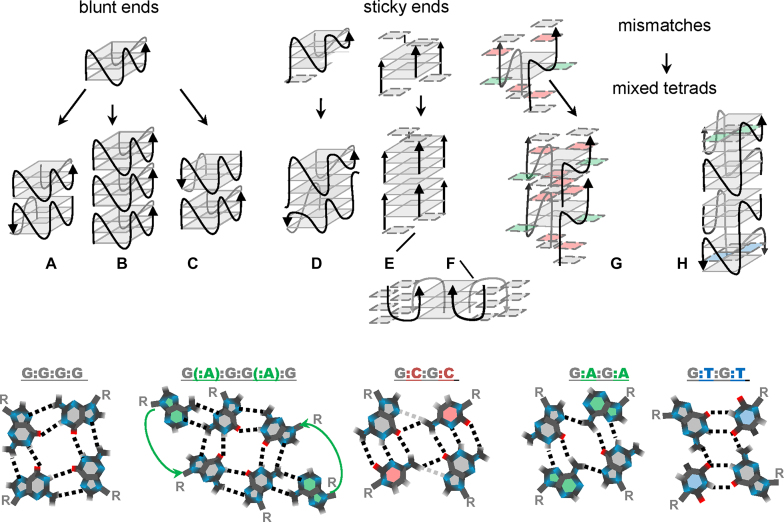
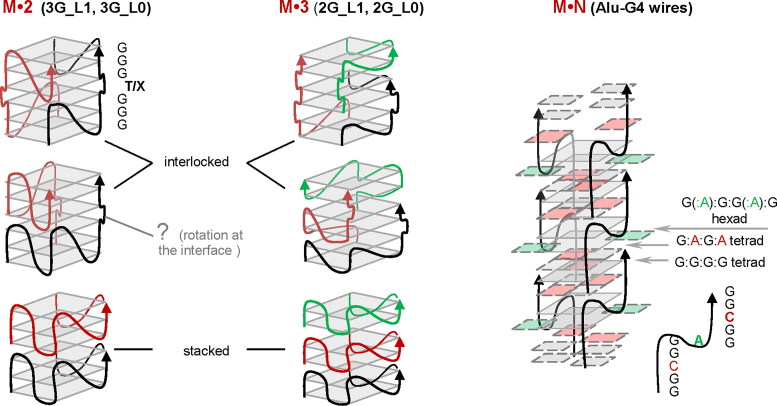
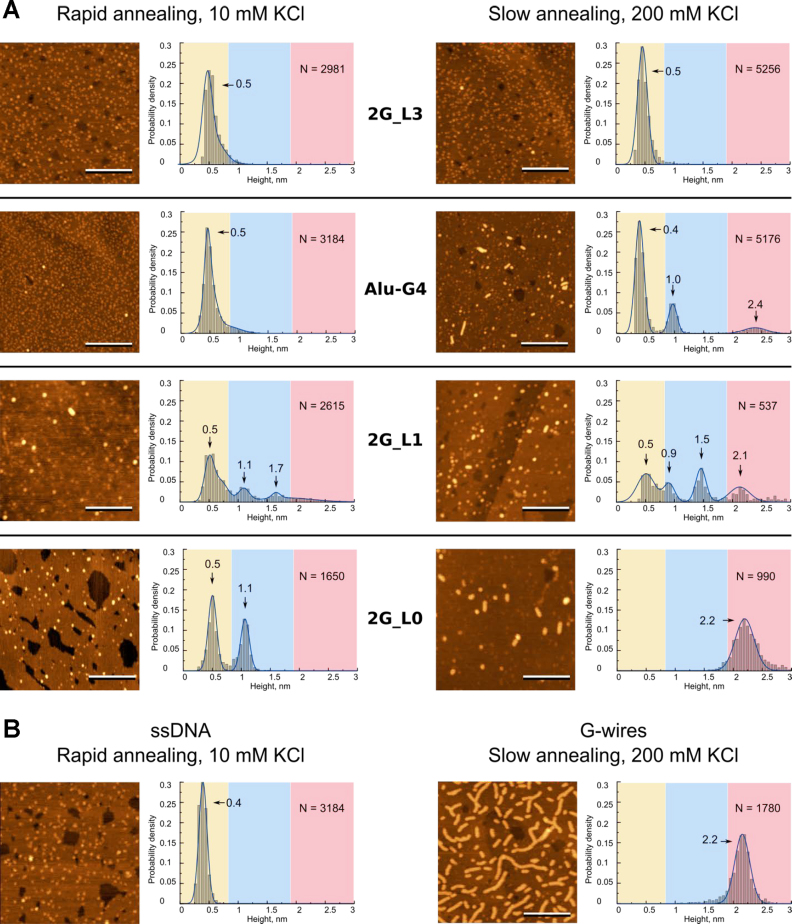
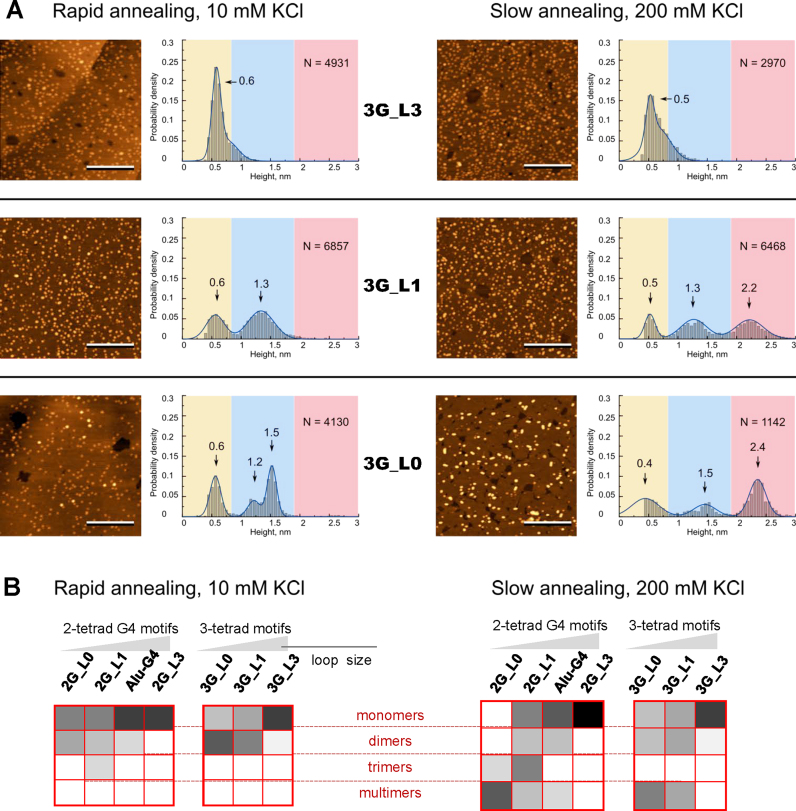
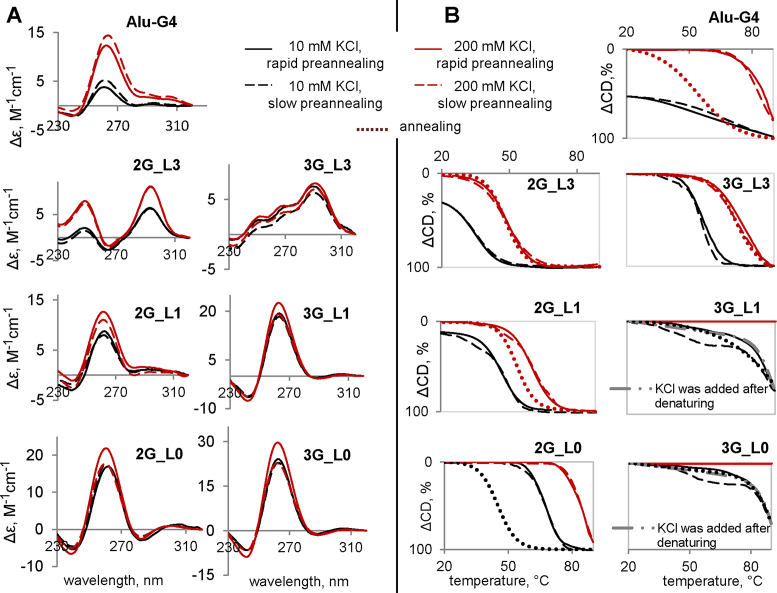
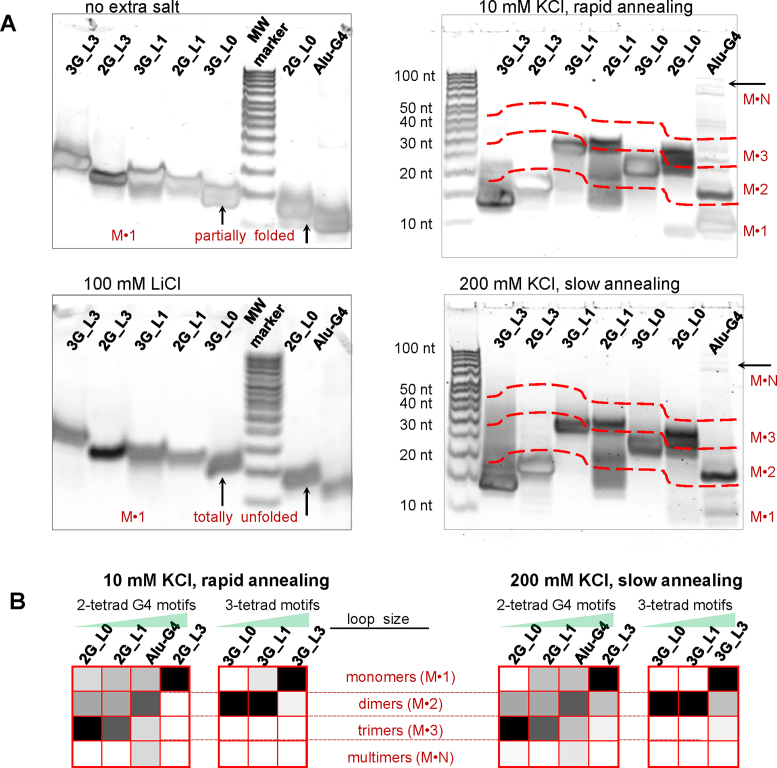
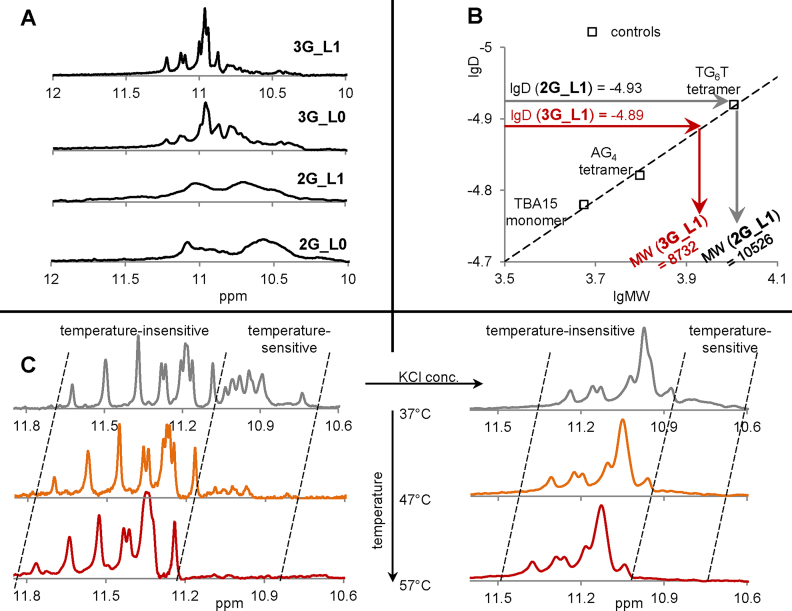
We examined the assembly of DNA G-quadruplexes (G4s) into higher-order structures using atomic force microscopy, optical and electrophoretic methods, NMR spectroscopy and molecular modeling. Our results suggest that parallel blunt-ended G4s with single-nucleotide or modified loops may form different types of multimers, ranging from stacks of intramolecular structures and/or interlocked dimers and trimers to wires. Decreasing the annealing rate and increasing salt or oligonucleotide concentrations shifted the equilibrium from intramolecular G4s to higher-order structures. Control antiparallel and hybrid G4s demonstrated no polymorphism or aggregation in our experiments. The modification that mimics abasic sites (1',2'-dideoxyribose residues) in loops enhanced the oligomerization/multimerization of both the 2-tetrad and 3-tetrad G4 motifs. Our results shed light on the rules that govern G4 rearrangements. Gaining control over G4 folding enables the harnessing of the full potential of such structures for guided assembly of supramolecular DNA structures for nanotechnology.
我们使用原子力显微镜、光学和电泳方法、NMR 光谱学和分子建模研究了 DNA G-四链体(G4)组装成高级结构的过程。我们的结果表明,具有单核苷酸或修饰环的平行平头 G4 可能形成不同类型的多聚体,范围从分子内结构的堆叠和/或互锁的二聚体和三聚体到线。降低退火速率并增加盐或寡核苷酸浓度会使平衡从分子内 G4 转移到高级结构。在我们的实验中,对照反平行和杂合 G4 没有表现出多态性或聚集。修饰模仿碱基缺失(1',2'-二脱氧核糖残基)环中的结构增强了 2-四联体和 3-四联体 G4 基序的寡聚/多聚化。我们的结果揭示了控制 G4 重排的规则。控制 G4 折叠可以充分利用这些结构的潜力,用于引导组装用于纳米技术的超分子 DNA 结构。