Cardiometabolic and Renal Risk Research Group, INCLIVA Biomedical Research Institute, Avd. Menendez Pelayo, accesorio 4, 46010, Valencia, Spain.
Genomic and Genetic Diagnosis Unit, INCLIVA Biomedical Research Institute, Valencia, Spain.
J Transl Med. 2018 Aug 14;16(1):228. doi: 10.1186/s12967-018-1604-6.
There is increasing interest in using extracellular vesicle-derived microRNAs (miRNAs) as biomarkers in renal dysfunction and injury. Preliminary evidence indicates that miRNAs regulate the progression of glomerular disease. Indeed, exosomes from the renal system have provided novel evidence in the clinical setting of albuminuria. Thus, the aim of this study was to quantify the urinary miRNAs present in exosome and microvesicles (MVs), and to assess their association with the presence of increased urinary albumin excretion in essential hypertension.
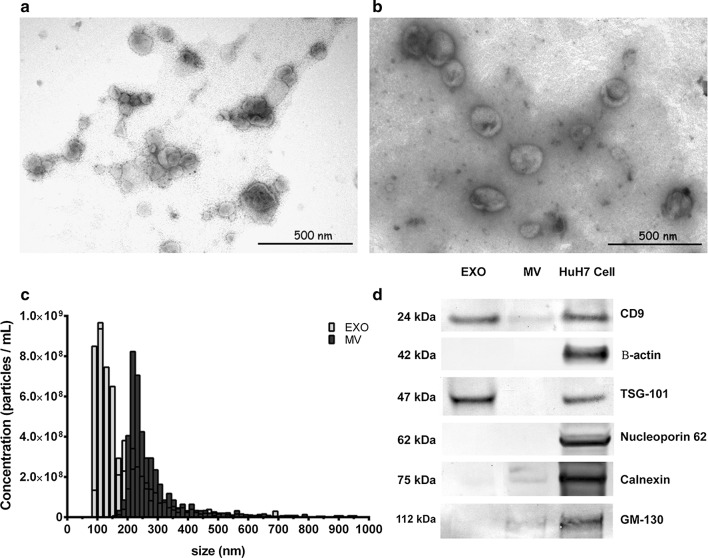
Exosomes were collected from urine specimens from a cohort of hypertensive patients with (n = 24) or without albuminuria (n = 28), and from 20 healthy volunteers as a control group. Urinary exosomes were phenotyped by Western blot, tunable resistive pulse sensing, and electronic microscopy. Expression of miR-146a and miR-335* was analysed by qRT-PCR and any associations between albuminuria and exosomal miRNAs were analysed.
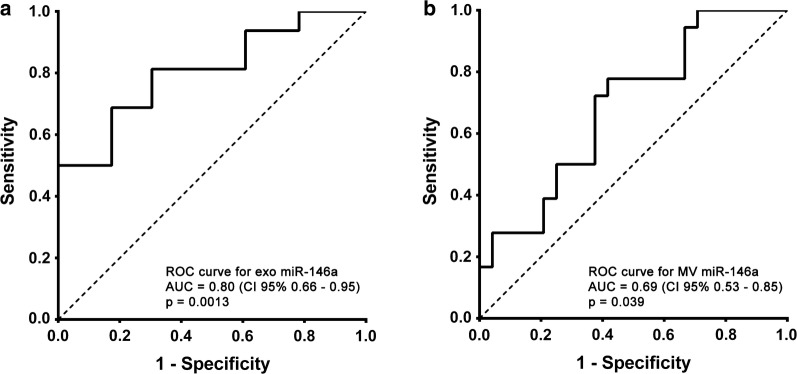
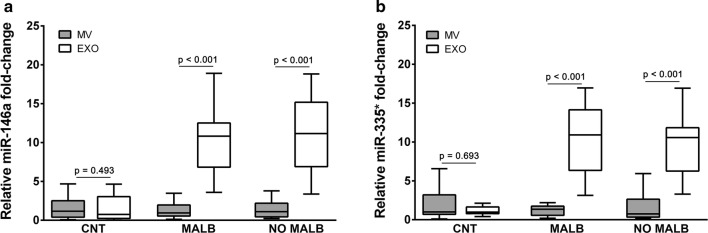
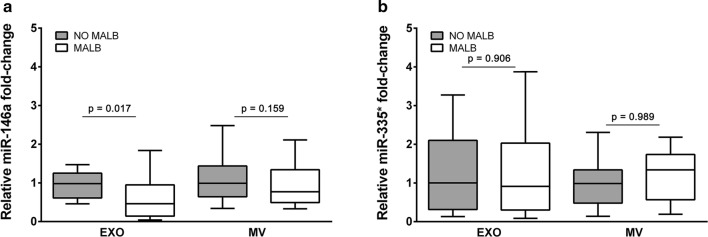
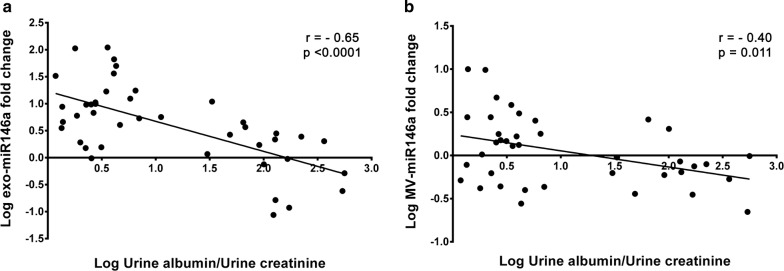
Urinary miRNAs are highly enriched in exosome subpopulations compared to MVs, both in patients with or without increased albuminuria (p < 0.001), but not in the control group. High albuminuria was associated with 2.5-fold less miR-146a in exosomes (p = 0.017), whereas miR-146a levels in MV did not change. In addition, exosome miR-146a levels were inversely associated with albuminuria (r = 0.65, p < 0.0001), and discriminated the presence of urinary albumin excretion presence [area under the curve = 0.80, 95% confidence interval: 0.66-0.95; p = 0.0013].
Our results indicate that miRNAs were enriched in the urinary exosome subpopulation in hypertensive patients and that low miR-146a expression in exosomes was associated with the presence of albuminuria. Thus, urinary exosome miR-146a may be a potentially useful tool for studying early renal injury in hypertension.
人们对利用细胞外囊泡衍生的 microRNAs(miRNAs)作为肾功能障碍和损伤的生物标志物越来越感兴趣。初步证据表明,miRNAs 调节肾小球疾病的进展。事实上,来自肾脏系统的外泌体在白蛋白尿的临床环境中提供了新的证据。因此,本研究的目的是定量分析存在于外泌体和微泡(MV)中的尿 miRNA,并评估它们与原发性高血压中尿白蛋白排泄增加的存在的关系。
从一组伴有白蛋白尿的高血压患者(n=24)和不伴有白蛋白尿的高血压患者(n=28)的尿液标本中收集外泌体,并从 20 名健康志愿者中收集作为对照组。通过 Western blot、可调电阻脉冲感应和电子显微镜对尿外泌体进行表型分析。通过 qRT-PCR 分析 miR-146a 和 miR-335*的表达,并分析白蛋白尿与外泌体 miRNA 之间的任何关联。
与 MV 相比,无论是否存在高白蛋白尿,患者尿液中的 miRNA 在外泌体亚群中高度富集(p<0.001),但在对照组中没有。高白蛋白尿与外泌体中 miR-146a 减少 2.5 倍相关(p=0.017),而 MV 中的 miR-146a 水平没有变化。此外,外泌体 miR-146a 水平与白蛋白尿呈负相关(r=0.65,p<0.0001),并能区分尿白蛋白排泄的存在[曲线下面积=0.80,95%置信区间:0.66-0.95;p=0.0013]。
我们的研究结果表明,miRNAs 在高血压患者的尿液外泌体亚群中富集,外泌体中 miR-146a 的低表达与白蛋白尿的存在有关。因此,尿外泌体 miR-146a 可能是研究高血压早期肾损伤的一个潜在有用的工具。